Understanding number patterns Worksheets for Ages 7-8
4 filtered results
-
From - To
Enhance your child's math skills with our "Understanding Number Patterns Worksheets for Ages 7-8", specifically designed to engage young minds in recognizing and predicting sequences. These printable worksheets from Kids Academy offer a variety of exercises that help children identify numerical patterns, develop critical thinking, and build a solid mathematical foundation. Perfect for both classroom use and home study, our worksheets ensure that learning is interactive and fun. Encourage your child to master mathematics through engaging activities, paving the way for future academic success. Download now and watch your child's confidence soar with each pattern they solve!
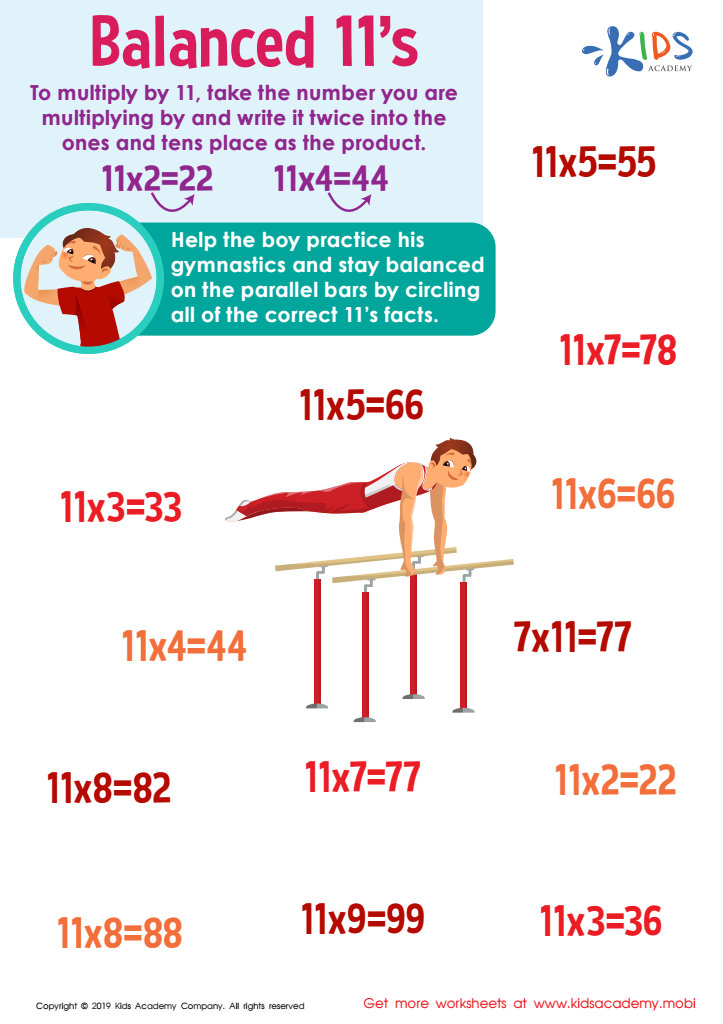
Balanced 11s Worksheet
 Assign to My Students
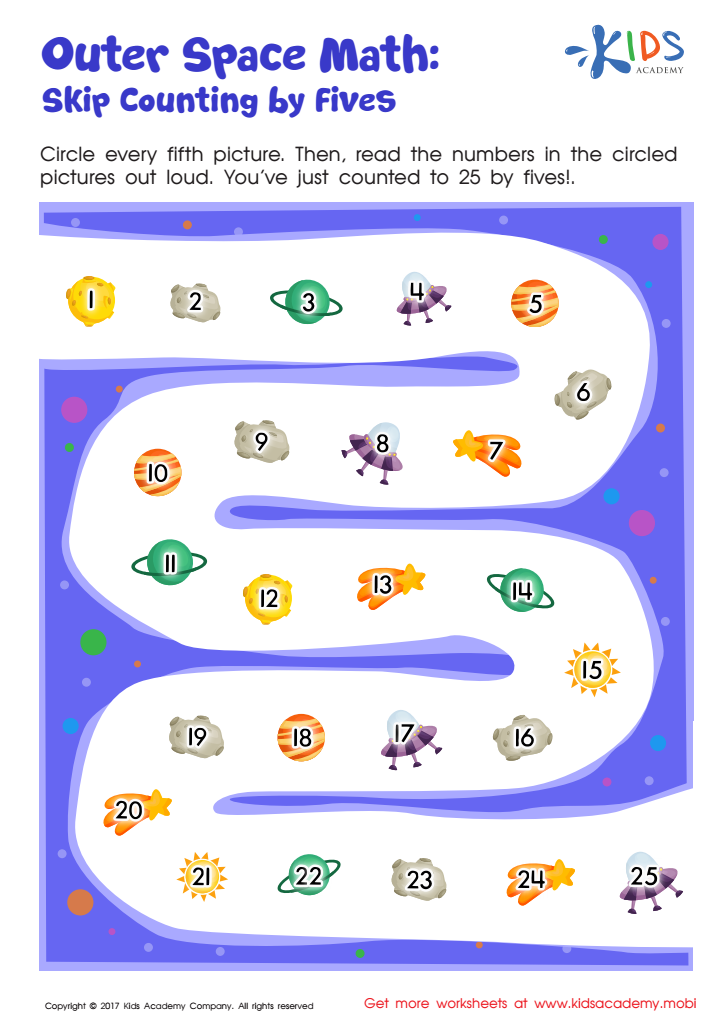
Skip Counting by 5s: Outer Space Math Printable








Understanding number patterns is vital in early childhood education, especially for children aged 7-8, because it provides a foundational building block for later mathematical success. Number patterns help children grasp essential concepts such as addition, subtraction, multiplication, and division. As children recognize and predict patterns, they develop critical thinking and problem-solving skills, which are not just limited to mathematics but are also transferable to other subjects and everyday situations.
Moreover, understanding number patterns fosters a child’s number sense—their intuitive grasp of numbers and their relationships. This intuitive understanding is crucial as it makes arithmetic calculations easier and quicker. It builds confidence and encourages a positive attitude towards learning mathematics, which can combat math anxiety that often develops at later stages.
Patterns are also the entry point to more advanced mathematical ideas like algebra. Recognizing and working with patterns teach children about sequencing, which prepares them for understanding functions and variables. Additionally, the skill of recognizing patterns is not confined to math but extends to reading (understanding plots and sequences) and even science (observing natural patterns and cycles).
Thus, parents and teachers should prioritize number patterns because they enhance cognitive development, enable cross-curricular learning, and lay the groundwork for future academic and life skills.








