
Vowel differentiation Worksheets for Ages 7-8
3 filtered results
Difficulty Level
Grade
Age
-
From - To
Subject
Activity
Standards
Enhance your child's reading and spelling skills with our specially designed Vowel Differentiation Worksheets for Ages 7-8. These engaging activities help young learners distinguish between long and short vowel sounds, a crucial step in early literacy development. Each worksheet is crafted to provide practice that builds phonetic awareness through fun, interactive exercises. Parents and teachers alike will appreciate the easy-to-follow formats, which include an array of puzzles, matching games, and fill-in-the-blank tasks. Boost your child's confidence and capability in reading by integrating these educational worksheets into your daily learning routine today!
Favorites
With answer key
Interactive
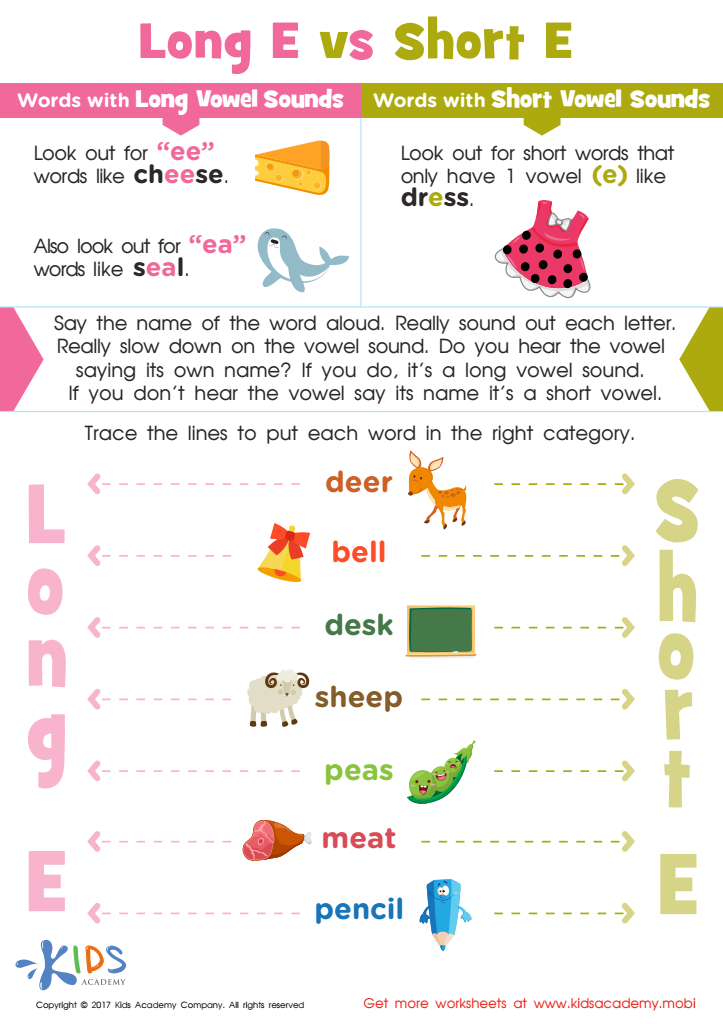
Long and Short Vowel E Spelling Worksheet
This worksheet helps kids master spelling with the letter "E". They read about long and short vowel sounds, view examples and sound out words to complete it. Two vowels distinguish long "E" sounds from its short vowel counterparts with just one.
Long and Short Vowel E Spelling Worksheet
Worksheet
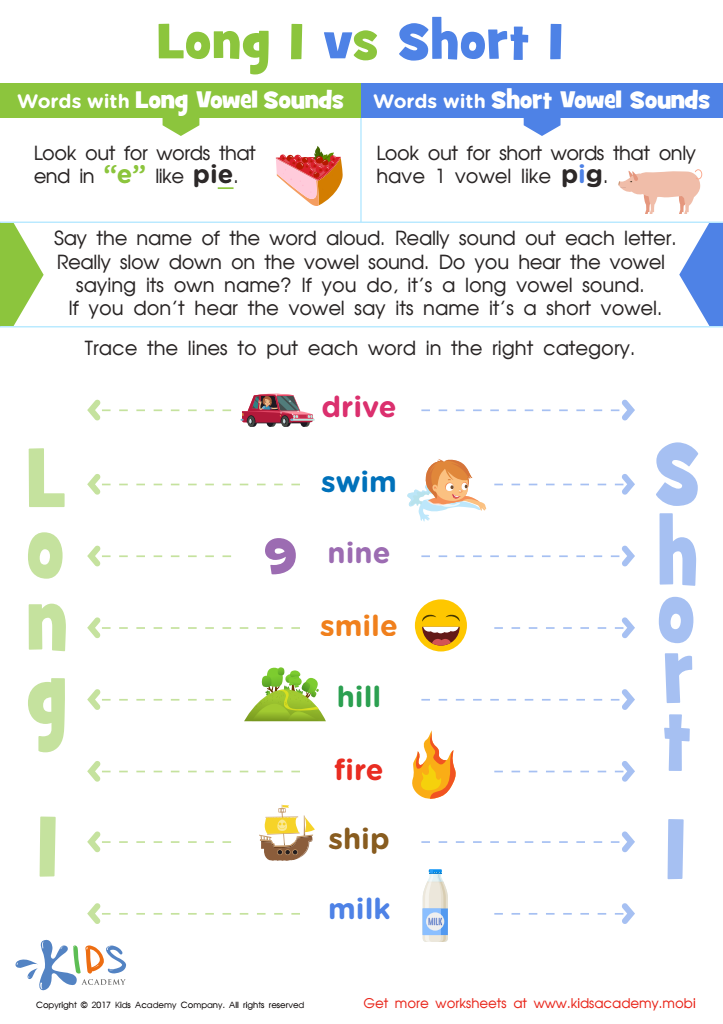
Long and Short Vowel I Spelling Worksheet
When it comes to long "I" sounds, kids should look out for the letter "E" at the end. With examples and sounding out words, kids will improve spelling skills with this long/short "I" worksheet!
Long and Short Vowel I Spelling Worksheet
Worksheet

Long and Short E Worksheet
This fun printout makes learning phonics enjoyable for Grade 3 students. Get them to read the words “tree” and “bed” to recognize the different sounds of the letter “E”. After hearing the words they can color the words and the pictures to understand differences between long and short vowels.
Download (PDF)
 Assign to My Students
Assign to My Students
Long and Short E Worksheet
Worksheet
Join Kids Academy for Free
Who is primarily going to use this learning content?


.jpg)




At ages 7-8, children are in a critical phase of their linguistic development, and vowel differentiation plays a crucial role in their reading proficiency and overall literacy. Parents and teachers should care about this aspect for several reasons:
Firstly, vowels form the building blocks of words. Proper differentiation helps kids decode words accurately, fostering better pronunciation and reading fluency. Misunderstanding vowel sounds can lead to confusion and hinder their ability to decode and spell words correctly, impacting their reading comprehension and writing skills.
Secondly, confident readers are generally more engaged learners. When children struggle to differentiate between vowels, they may become frustrated or disinterested in reading activities. By focusing on vowel differentiation, parents and teachers can ensure that reading remains a positive experience, promoting a lifelong love for books and learning.
Thirdly, a strong foundation in phonemic awareness, including vowel sounds, supports the learning of more complex language patterns. This foundational knowledge enables children to advance smoothly to more challenging texts, enhancing their academic performance across all subjects.
Finally, early proficiency in vowel differentiation equips children with essential communication skills, enabling them to articulate words clearly and effectively.
In short, giving attention to vowel differentiation equips 7-8-year-olds with critical skills that boost their reading fluency, promote a positive learning attitude, and lay a robust foundation for future academic achievements.








