
Basic arithmetic understanding Math Worksheets for Ages 7-8
4 filtered results
Difficulty Level
Grade
Age
-
From - To
Subject
Activity
Standards
Boost your child's confidence in math with our engaging Basic Arithmetic Understanding Math Worksheets for Ages 7-8. Designed to align with educational standards, these worksheets offer a variety of fun and comprehensive activities that cover addition, subtraction, multiplication, and division. Each worksheet supports the development of essential arithmetic skills through step-by-step instructions and clear examples. Perfect for both classroom use and home practice, our worksheets make learning math enjoyable and accessible. Help your 7-8 year old child master basic arithmetic concepts and build a strong foundation for future math success with our expertly crafted resources.
Favorites
With answer key
Interactive
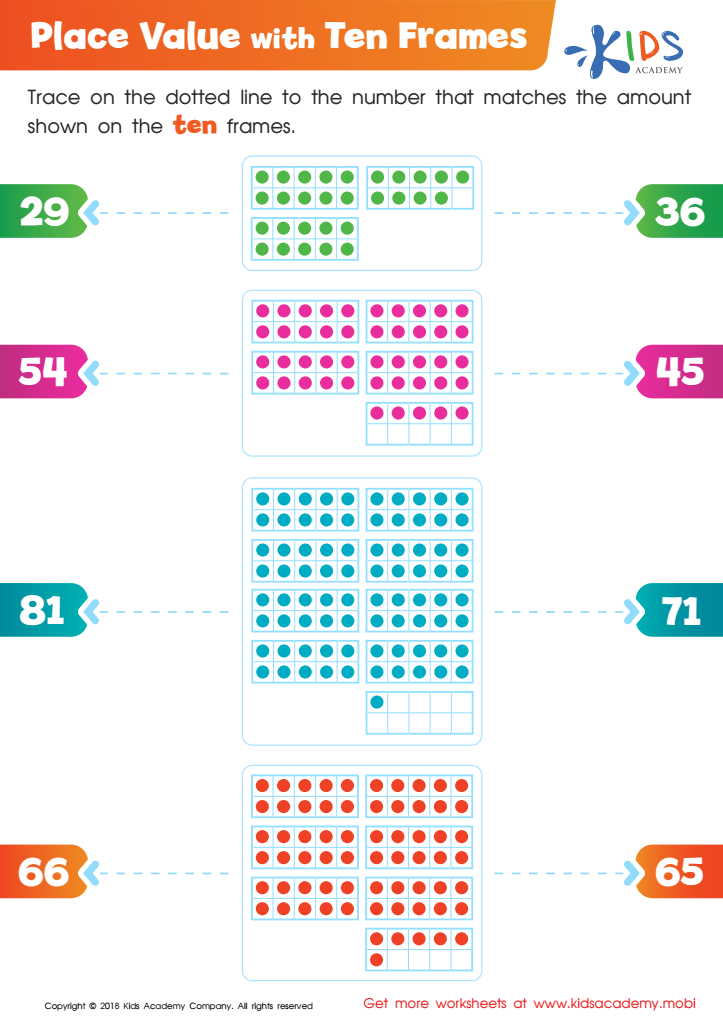
Place Values with Ten Frames Worksheet
Assist your child in counting the dots in each of the framed numbers. Then, guide them as they trace the dotted lines to the number that matches the amount shown. This worksheet will help them learn more about mathematics, as well as how to count numbers.
 Assign to My Students
Place Values with Ten Frames Worksheet
Worksheet
Join Kids Academy for Free
Who is primarily going to use this learning content?








Parents and teachers should care deeply about basic arithmetic understanding for ages 7-8 because this is a foundational period in children's cognitive and academic development. At this age, children are developing critical thinking and problem-solving skills. Proficiency in basic arithmetic, such as addition, subtraction, multiplication, and division, lays the groundwork for more advanced math concepts and everyday practicality.
Firstly, grasping these basic skills builds confidence. When children successfully solve arithmetic problems, they gain a sense of accomplishment and motivation to tackle more complex tasks. Frustration with these early concepts can lead to math anxiety, which may persist and hinder future learning.
Secondly, arithmetic skills are crucial for understanding money, time, measurement, and various activities in daily life. They form the basis for logical reasoning and decision-making. Whether they are calculating change, following a recipe, or planning time, a solid foundation in arithmetic enables children to function more effectively and independently.
Lastly, early proficiency influences future academic and career opportunities. STEM fields (Science, Technology, Engineering, and Mathematics) require strong mathematical abilities. By ensuring that children have a robust understanding of basic arithmetic, we set them up for success in a myriad of future endeavors.
Thus, parents and educators should prioritize fostering strong arithmetic skills, leveraging engaging and supportive practices, to ensure children's overall development and lifelong success.








