Shape identification Math Worksheets for Ages 7-8 - Page 2
26 filtered results
-
From - To
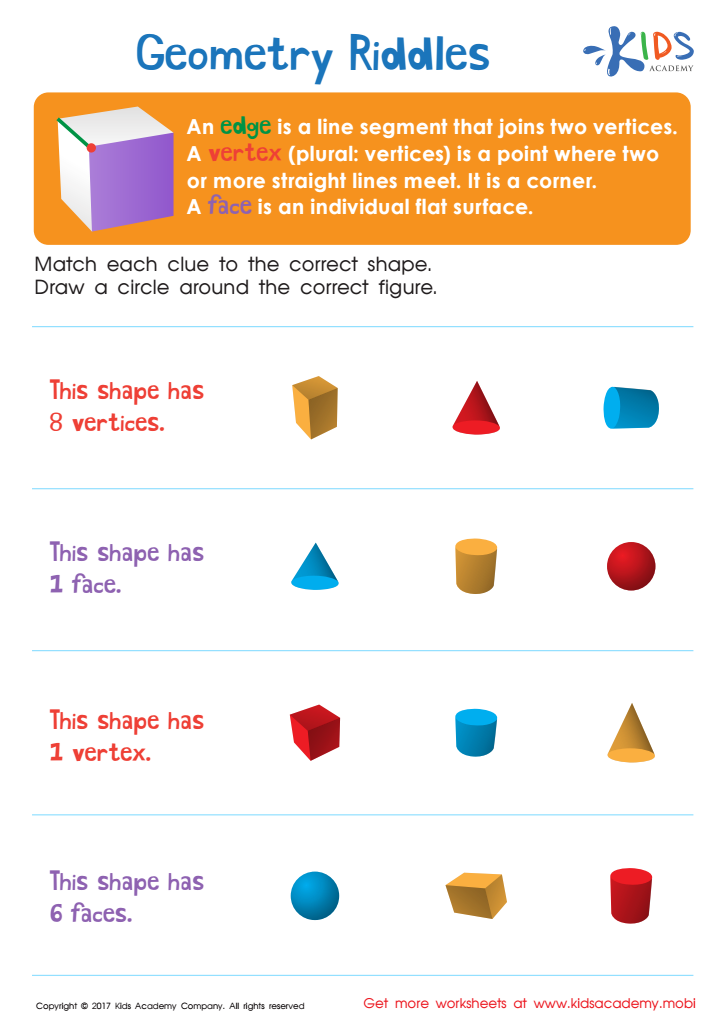
Geometry Riddles Printable
 Assign to My Students
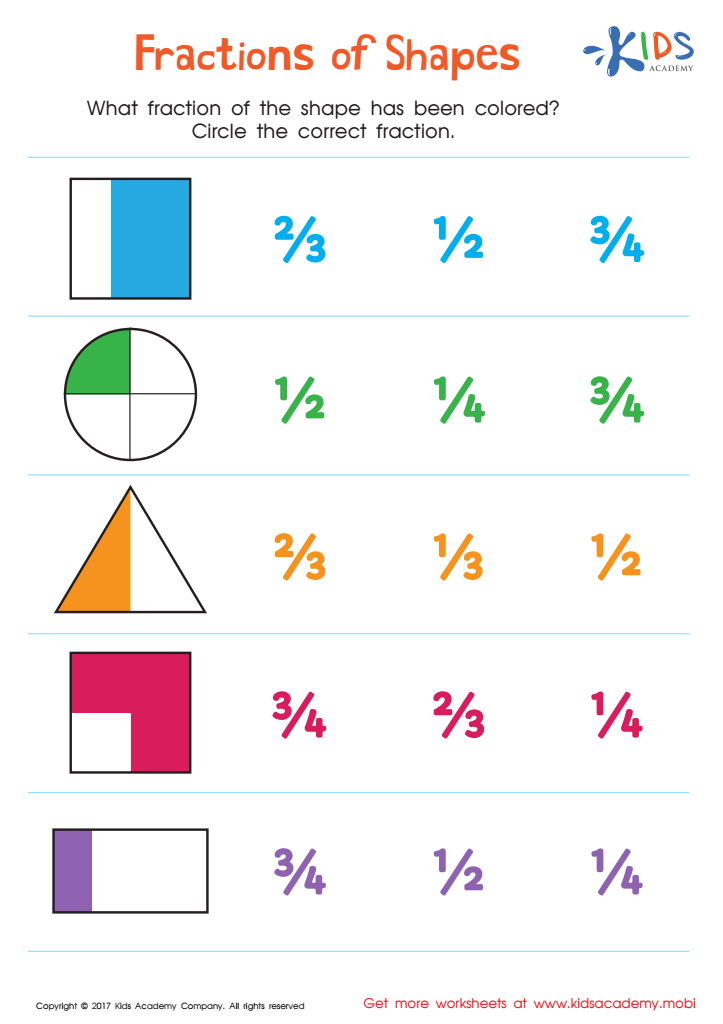
Fractions of Shapes: Math Concept Worksheet







Mathematical shape identification is a foundational skill for children aged 7 to 8 that extends beyond mere recognition of shapes. It is essential for developing critical thinking, spatial awareness, and problem-solving abilities. At this age, children are increasingly engaging with geometry in their math curricula, making it crucial for parents and teachers to prioritize this skill.
Understanding shapes allows young learners to categorize and differentiate between various objects in their environment. This skill enhances their ability to make connections between the physical world and mathematical concepts, promoting overall cognitive development. Furthermore, shape identification lays the groundwork for future mathematics topics, such as measurement, area, and volume, which are pivotal in higher-level thinking in later grades.
Beyond academics, learning about shapes fosters creativity and innovation. By encouraging children to explore compositions of shapes, they strengthen their imaginative skills essential for art and design. Moreover, shape identification can contribute to improved fine motor skills through activities, such as drawing or cutting shapes in art projects.
Overall, supporting shape identification in early childhood helps in creating well-rounded individuals equipped with essential skills for present and future learning. Parents and teachers play a vital role in facilitating this process, ensuring children have a strong mathematical foundation.








