
Spatial reasoning Math Worksheets for Ages 7-8
4 filtered results
Difficulty Level
Grade
Age
-
From - To
Subject
Activity
Standards
Enhance your child's mathematical skills with our Spatial Reasoning Math Worksheets designed for ages 7-8. These engaging activities help young learners develop critical thinking and problem-solving abilities by visualizing and manipulating shapes and patterns. Our expertly crafted worksheets provide a fun and interactive way to improve spatial awareness, an essential skill for geometry and beyond. Perfect for both classroom and at-home learning, these worksheets ensure a solid foundation in spatial reasoning, enabling children to tackle more complex mathematical concepts with confidence. Give your child the tools to succeed in math by incorporating these valuable resources into their learning routine.
Favorites
With answer key
Interactive
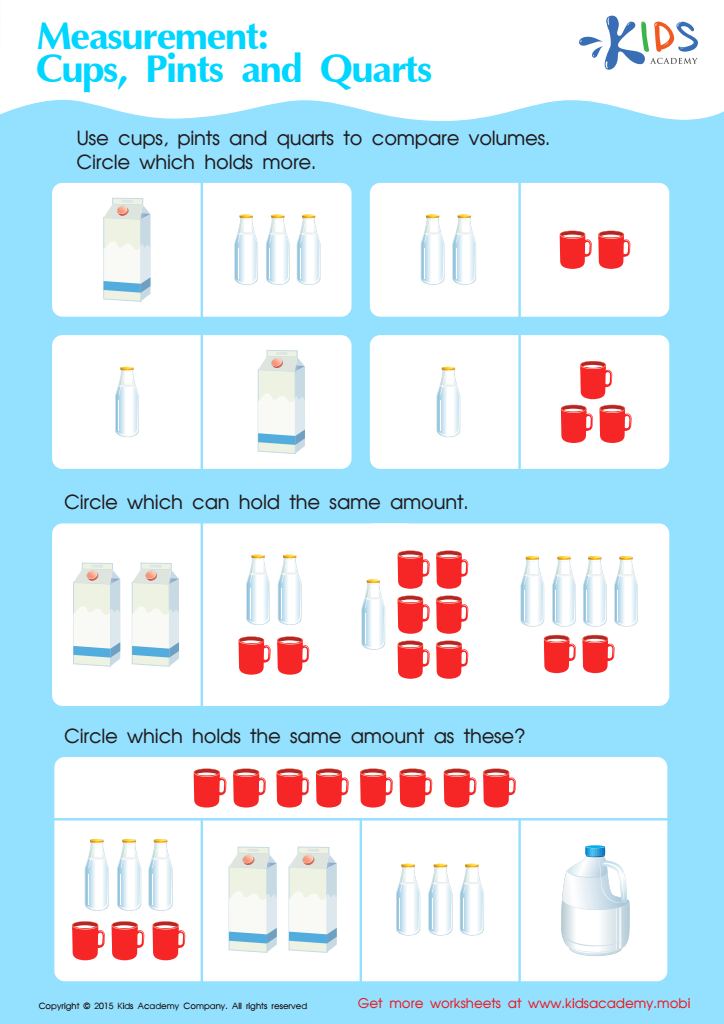
Measurement: Compare Volumes Worksheet
Compare volumes with Kids Academy and have fun! (80 words)
Practice measuring with Kids Academy and have fun! Compare volumes in pictures and circle which holds more. Keep learning with free math worksheets available on our website. Enjoy the process and have fun!
 Assign to My Students
Measurement: Compare Volumes Worksheet
Worksheet
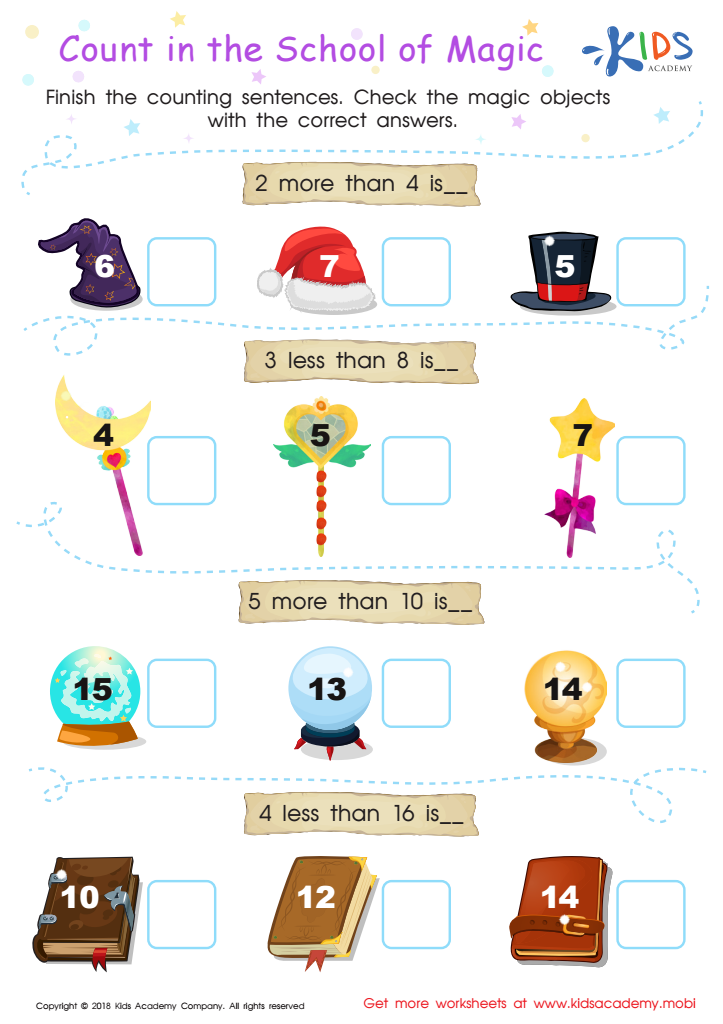
Count in the School of Magic Worksheet
Your math learners can explore the School of Magic with this worksheet. They'll read equations with addition and subtraction numbers under 20, count back and forth to find the answer, then complete the counting sentences. Fun pictures and easy accuracy make it an enjoyable and successful learning experience.
Count in the School of Magic Worksheet
Worksheet
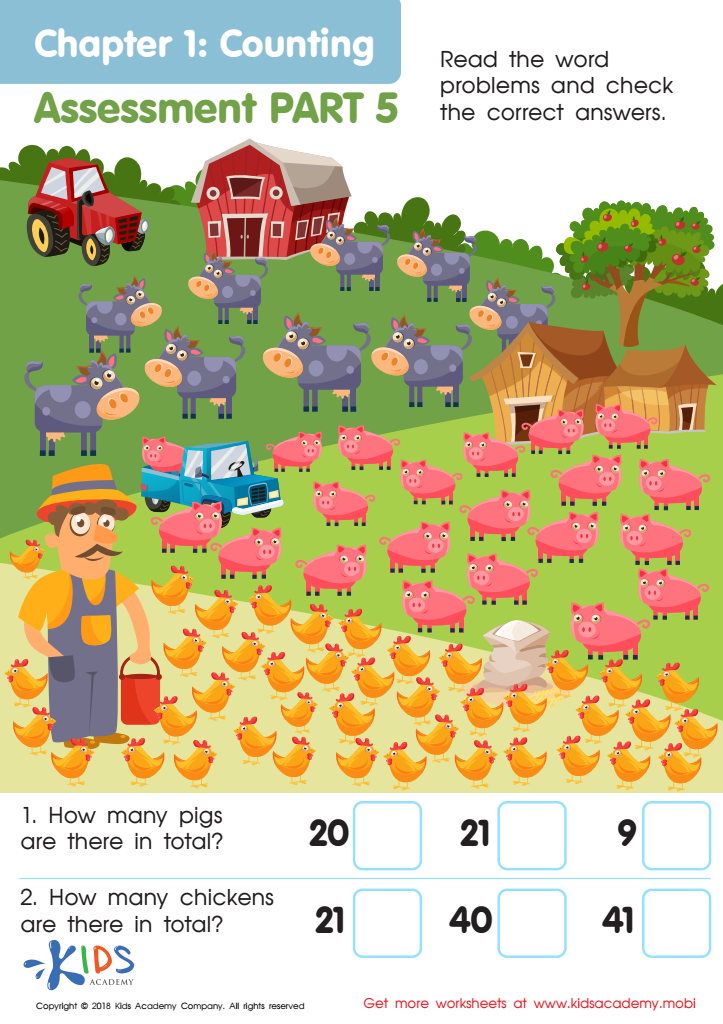
Counting: Assessment 5 Worksheet
Let your kids have fun counting farm animals on this worksheet! Help the farmer count the animals and have your child check the answers to assess their counting skills. Read the word problem at the bottom of the page and count the animals together. It's an entertaining way to practice counting and have a great time!
Counting: Assessment 5 Worksheet
Worksheet
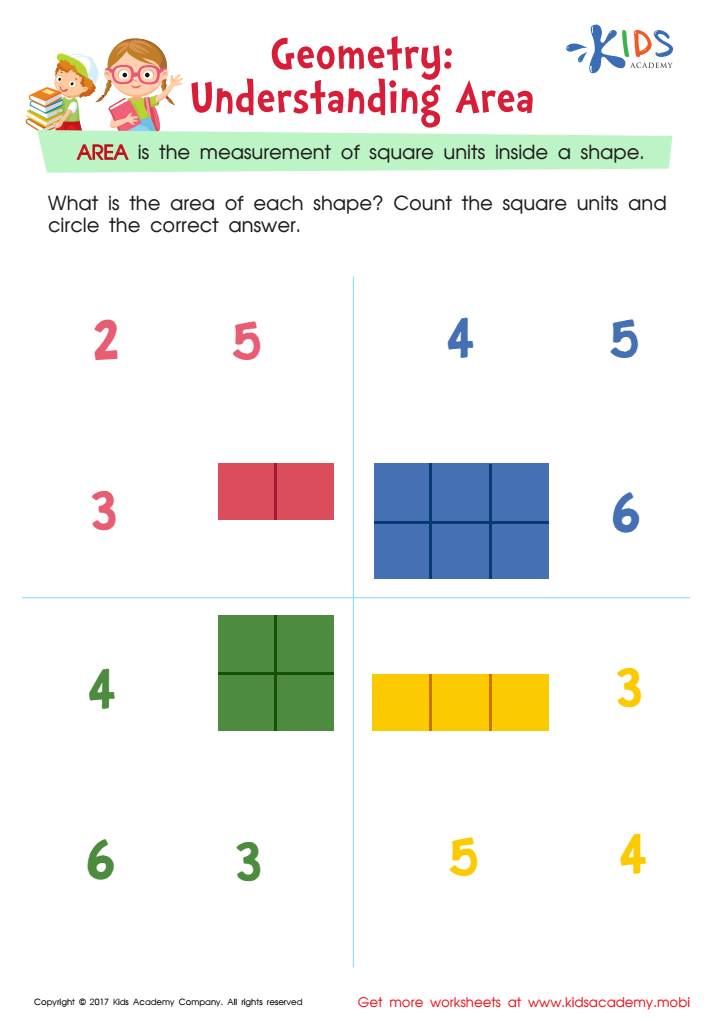
Understanding Area Worksheet
This helps them develop a better understanding and an easier way to learn instead of memorizing a formula.
Understanding Area Worksheet
Worksheet
Join Kids Academy for Free
Who is primarily going to use this learning content?








Spatial reasoning is crucial for children ages 7-8 because it forms a foundational skill set that supports their overall cognitive development and future academic success. At this age, children are beginning to understand and interact with the world in more complex ways, and spatial reasoning helps them make sense of their experiences. It involves the ability to visualize and manipulate objects and shapes in the mind, which is essential for problem-solving and understanding abstract concepts.
Parents and teachers should care about developing spatial reasoning because it enhances children's abilities in mathematics, science, and technology. Research has shown that strong spatial skills are closely linked to success in STEM fields. For instance, tasks like geometry, measurement, and understanding maps all rely on good spatial reasoning. Moreover, improving these skills early can make future learning easier and more intuitive.
In addition, spatial reasoning fosters creativity and critical thinking. Activities like building blocks, puzzles, and drawing are not just play; they are opportunities for children to enhance their spatial understanding. When children manipulate objects and visualize scenarios, they are practicing thinking in new and flexible ways.
By focusing on spatial reasoning at a young age, parents and teachers help children develop tools that will benefit them throughout their lives, both academically and personally. Prioritizing these activities can set children up for success and create a strong foundation for future learning.








