
Understanding Quantities Math Worksheets for Ages 7-8
6 filtered results
Difficulty Level
Grade
Age
-
From - To
Subject
Activity
Standards
Unlock your child's math potential with our "Understanding Quantities Math Worksheets" designed specifically for ages 7-8. These engaging and educational worksheets help young learners grasp essential concepts of numbers and quantities, enhancing their math skills through fun and interactive activities. Our expertly crafted exercises cover a range of topics including equation practice, array math, and measurement problems. Perfect for both classroom and home use, these worksheets support foundational understanding and boost confidence in mathematical abilities. Start your child's journey to math success today with our comprehensive Understanding Quantities Math Worksheets!
Favorites
With answer key
Interactive
 Assign to My Students
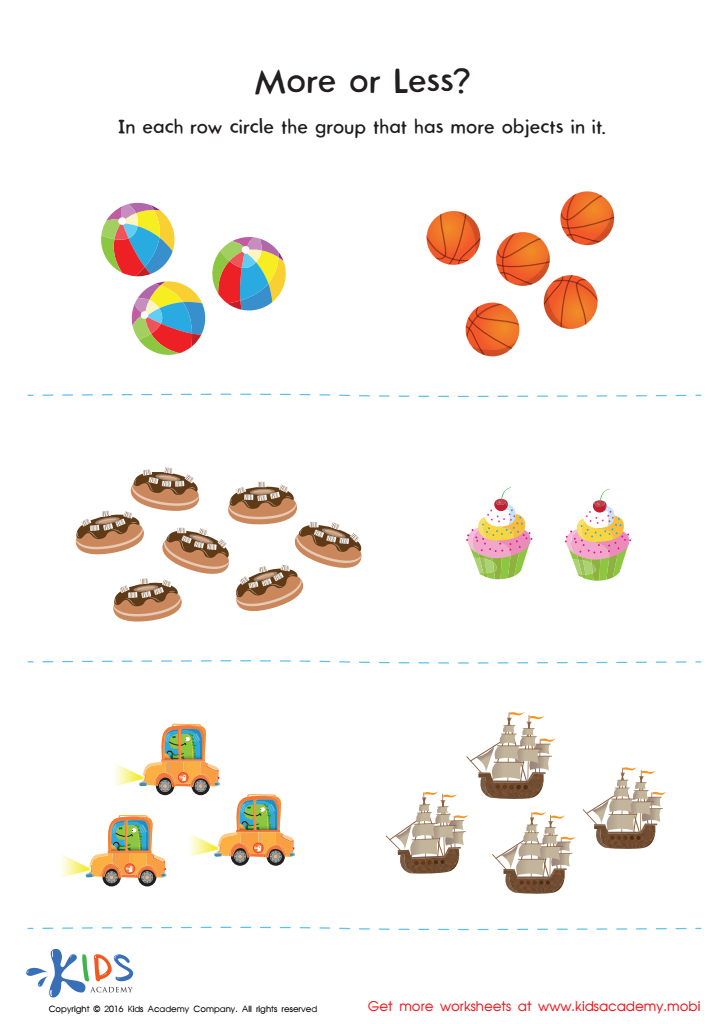
More or Less Size Worksheet
Worksheet
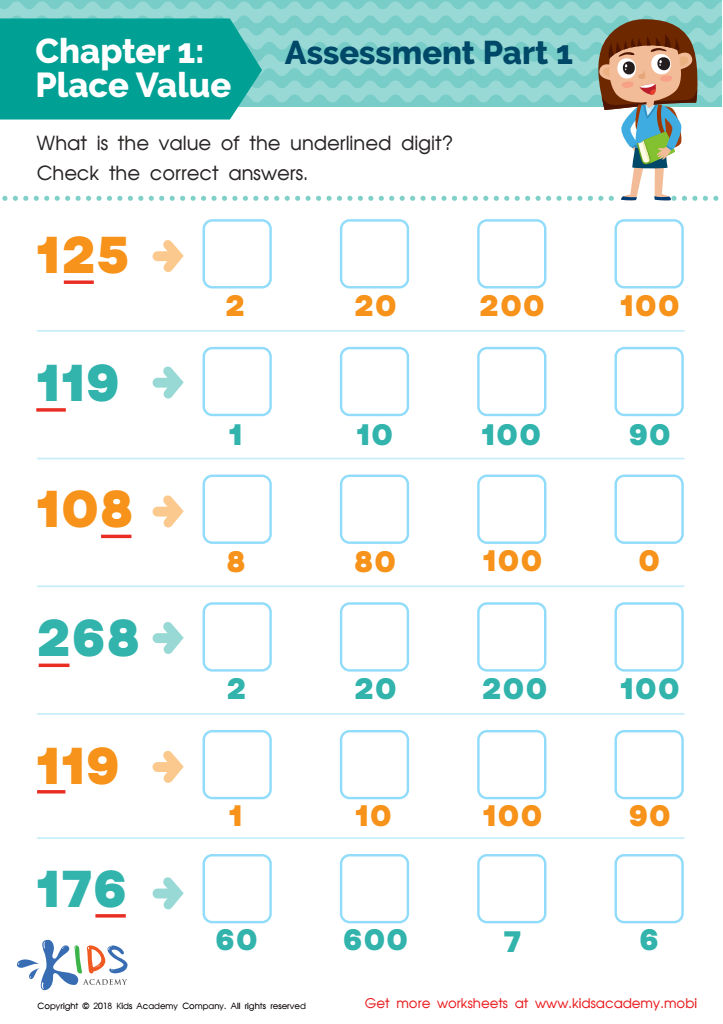
Place Value: Chapter 1 Worksheet
Check your kid's place value understanding with this assessment worksheet. It features 6 questions with one digit underlined for your child to determine the correct value of. Get the download and see if they can correctly choose the answer from the options given. It's a great way to test progress and keep their minds sharp!
Place Value: Chapter 1 Worksheet
Worksheet
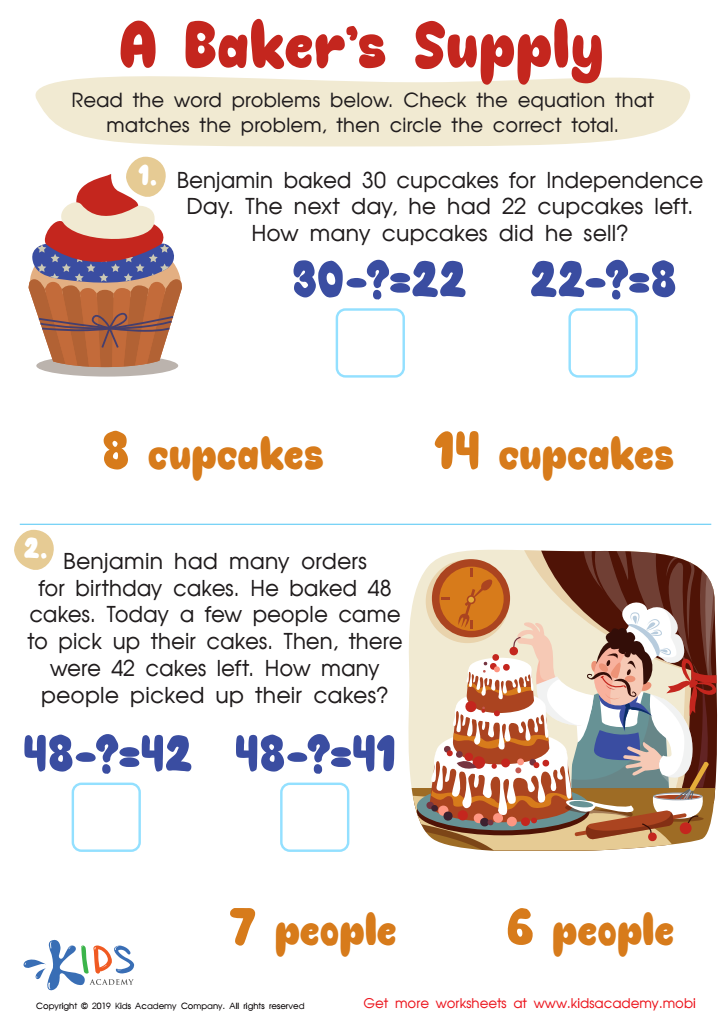
A Baker's Supply Worksheet
A visit to the baker's shop is thrilling! Your kids will love it! From scrumptious goodies to the mouthwatering aroma, it's a magical experience. Ask your kids what they're most eager to see and do. Now, read the word problems in this worksheet to them. Help them choose the correct answer for each problem and circle the correct total.
A Baker's Supply Worksheet
Worksheet
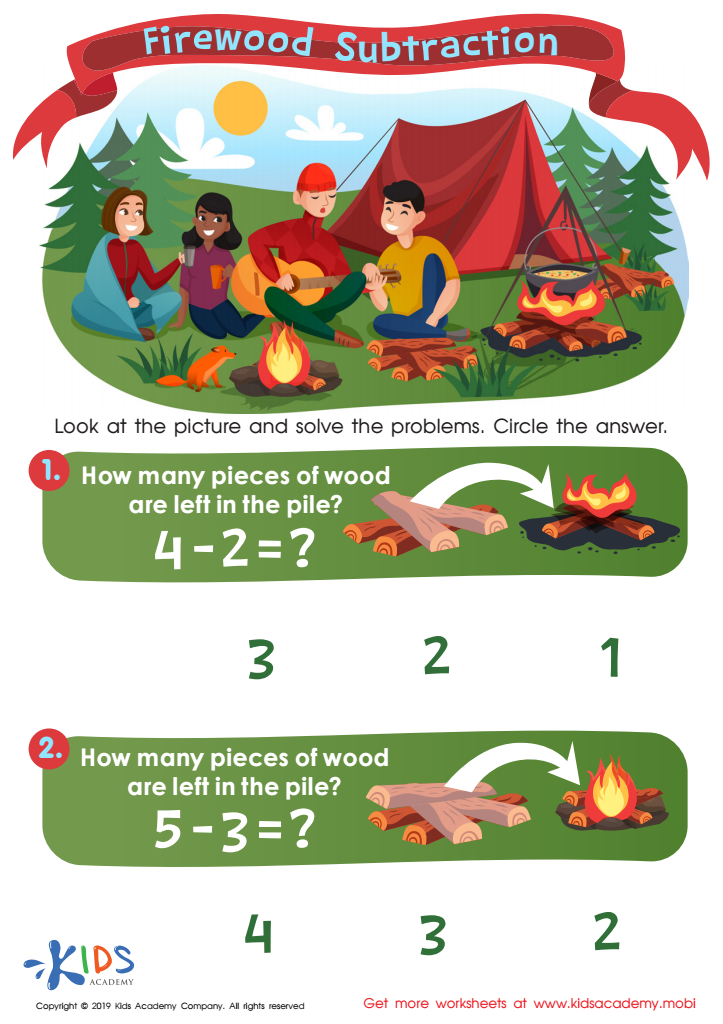
Firewood Subtraction Worksheet
Guide your students to show that math can be fun! If your kindergartners need help with addition and subtraction, the simple problems in this worksheet are ideal. Ask them to look at the two pictures and find the correct answers. Help them check their work to build their confidence in math.
Firewood Subtraction Worksheet
Worksheet
Join Kids Academy for Free
Who is primarily going to use this learning content?






Understanding quantities is a fundamental aspect of math for ages 7-8 and is crucial for a child's development in mathematical thinking and real-world problem-solving. At this age, children transition from concrete to more abstract thinking. Grasping quantitative concepts helps them make sense of numbers, shapes, and spaces in everyday life.
Firstly, mastering quantities strengthens number sense, the foundation of all math learning. It enables children to comprehend different values, recognize patterns, and perform basic arithmetic operations fluently. Skills like measuring quantities, understanding fractions, and handling money are directly connected to a solid grasp of quantity concepts.
Secondly, understanding quantities enhances cognitive skills. It encourages logical thinking, decision-making, and the ability to analyze and compare information. These skills contribute significantly to academic success beyond mathematics, including science and literacy.
Lastly, everyday interactions often require quantity understanding: sharing toys, cooking measurements, time management, and shopping. Proficiency in quantities fosters confidence, self-sufficiency, and a positive attitude toward learning.
In a globally competitive world, foundational numeracy is essential. By valuing and supporting the learning of quantities in early education, parents and teachers set children up for long-term academic achievement and daily life competence. This early exposure builds a vital substrate for future complex math challenges.








