Visual perception Numbers up to 100 Worksheets for Ages 7-8
3 filtered results
Difficulty Level
Grade
Age
-
From - To
Subject
Activity
Standards
Enhance your child's mathematical skills with our "Visual Perception Numbers up to 100 Worksheets" designed for ages 7-8. These engaging and educational printables help young learners improve their number recognition and visual processing abilities. Through a variety of fun and challenging exercises, children will practice identifying, comparing, and sequencing numbers up to 100. Our worksheets provide a solid foundation for more advanced math concepts, while making learning enjoyable and interactive. Perfect for use at home or in the classroom, these resources support children in building confidence and competence in their numeracy skills. Download now and watch their math proficiency soar!
Favorites
With answer key
Interactive
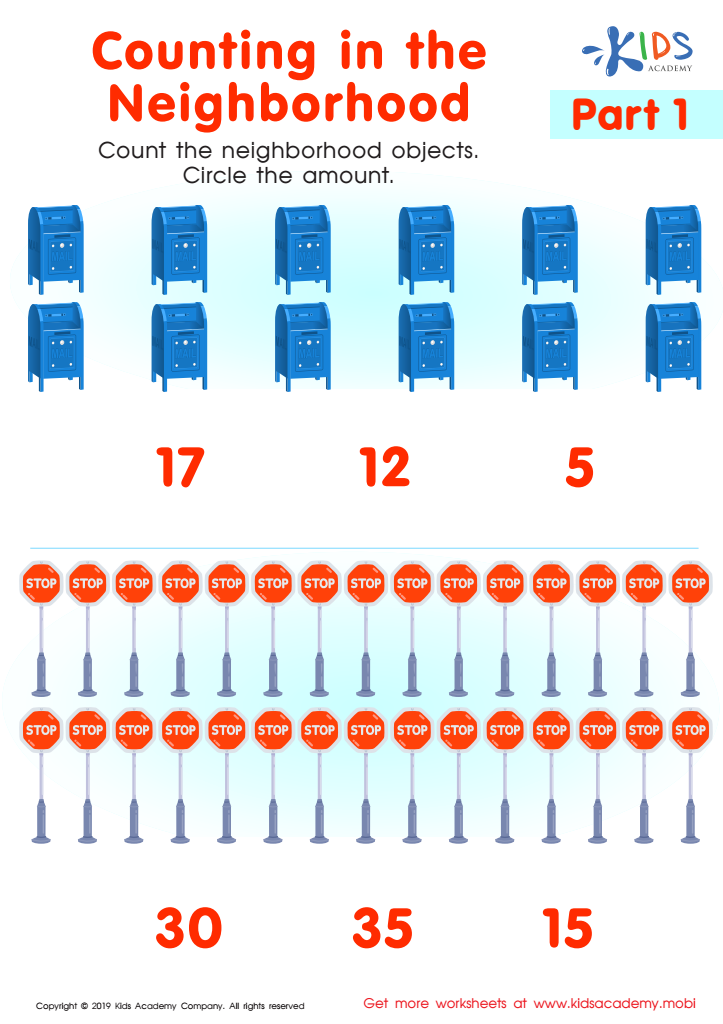
Counting in the Neighborhood Part1 Worksheet
Counting using one-to-one representation is a great way to develop a child's number sense. Use objects, pictures and images to help counting beyond the fingers. This worksheet uses everyday objects to practice counting. It encourages children to find the correct number and count forward. Give it a try!
 Assign to My Students
Counting in the Neighborhood Part1 Worksheet
Worksheet
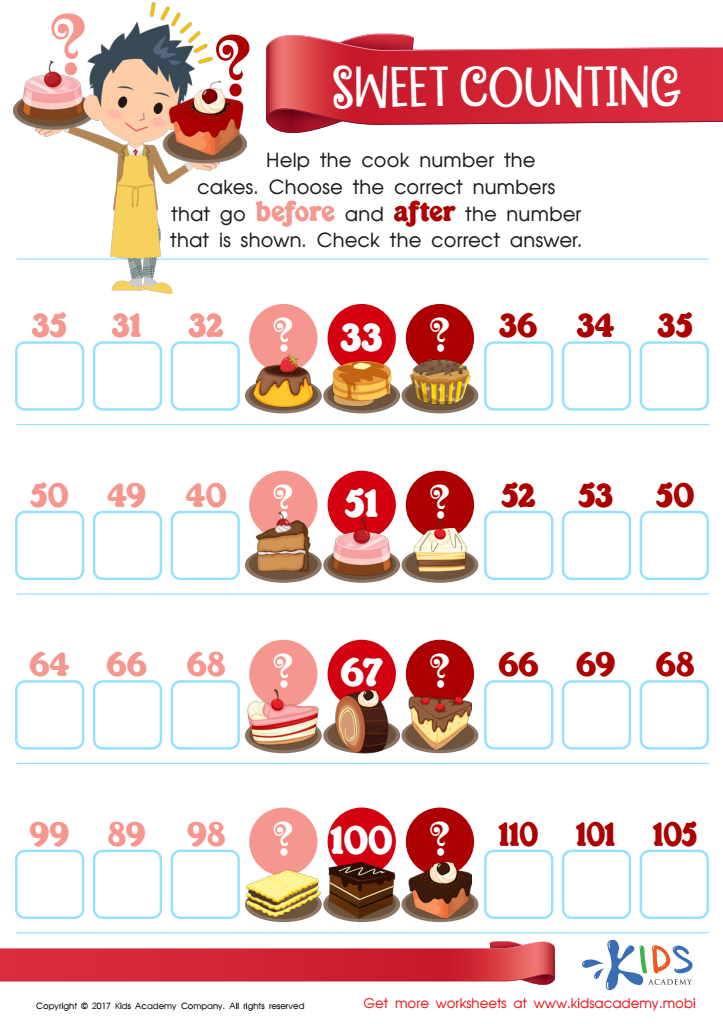
Sweet Counting - Part 1 Worksheet
Help your child learn numbers by counting cakes! Download this fun worksheet and have them fill in the numbers missing in the line of cakes. They'll have fun helping the cook and be learning at the same time!
Sweet Counting - Part 1 Worksheet
Worksheet
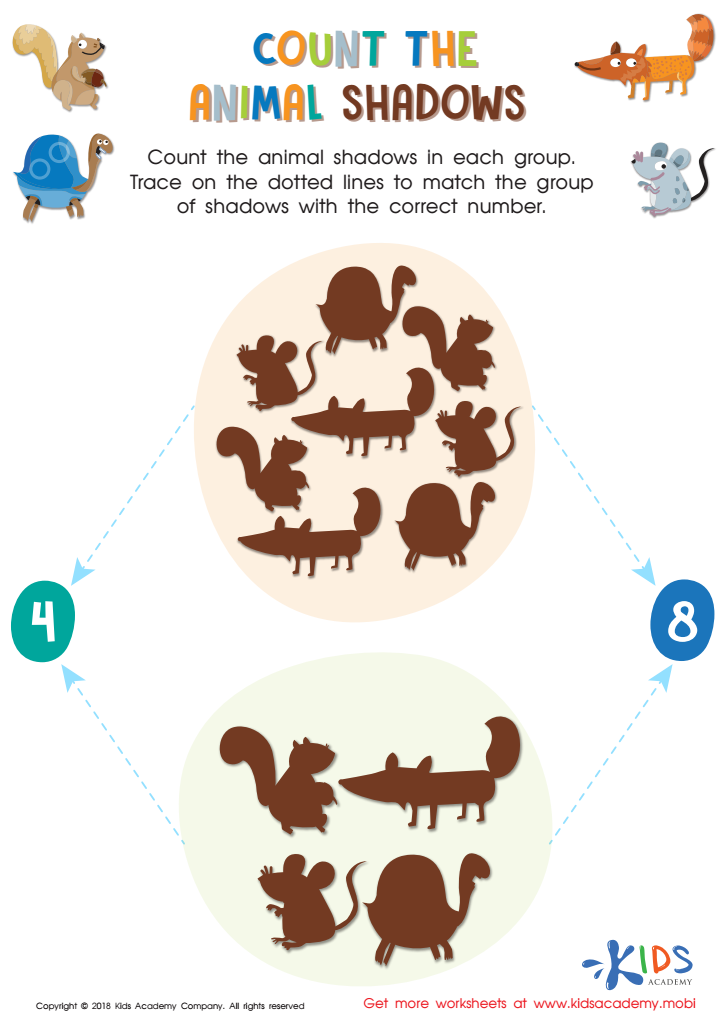
Count the Animal Shadows Worksheet
Our shadows accompany us wherever we go. Even your kids have seen theirs! Did they know that animals have shadows too? Count the animal shadows in each group with this worksheet. Ask your child to identify the animals pictured, then help them trace the dotted lines to match with the right number.
Count the Animal Shadows Worksheet
Worksheet
Join Kids Academy for Free
Who is primarily going to use this learning content?








Visual perception of numbers up to 100 is crucial for children aged 7-8 as it forms the foundation for their mathematical understanding and numeracy skills. At this age, children typically transition from simple counting to more complex arithmetic operations like addition, subtraction, and basic multiplication. Developing a robust visual perception of numbers allows them to recognize and differentiate numbers quickly, grasp number patterns, and understand place value—all of which are essential for performing these operations accurately.
This skill also plays a significant role in problem-solving. When children can easily visualize numbers, they are better equipped to conceptualize and tackle mathematical problems, thereby enhancing their critical thinking abilities. Additionally, strong visual number perception aids children in estimation and mental math, which are practical skills for real-life scenarios.
For teachers and parents, focusing on the development of a child's ability to perceive and understand numbers up to 100 can lead to improved mathematical confidence and academic performance. Activities such as number games, puzzles, and visual aids can make learning fun and engaging, while also reinforcing these critical skills. Investing time in nurturing this capability builds a strong mathematical foundation, setting the stage for future learning and success in more advanced mathematical concepts.