
Analyzing patterns Worksheets for Ages 7-9
3 filtered results
Difficulty Level
Grade
Age
-
From - To
Subject
Activity
Standards
Welcome to our "Analyzing Patterns Worksheets" page for ages 7-9! Our carefully designed worksheets aim to enhance critical thinking and analytical skills in young learners through engaging activities. Children will explore various patterns, identifying and extending sequences using shapes, colors, and numbers, fostering their problem-solving abilities. These worksheets are perfect for homeschooling, classroom use, or supplemental practice, allowing students to build a strong foundation in pattern recognition. With simple instructions and vibrant illustrations, they will keep kids motivated while learning essential math skills. Discover the joy of learning through patterns and watch your child's confidence bloom!
Favorites
With answer key
Interactive
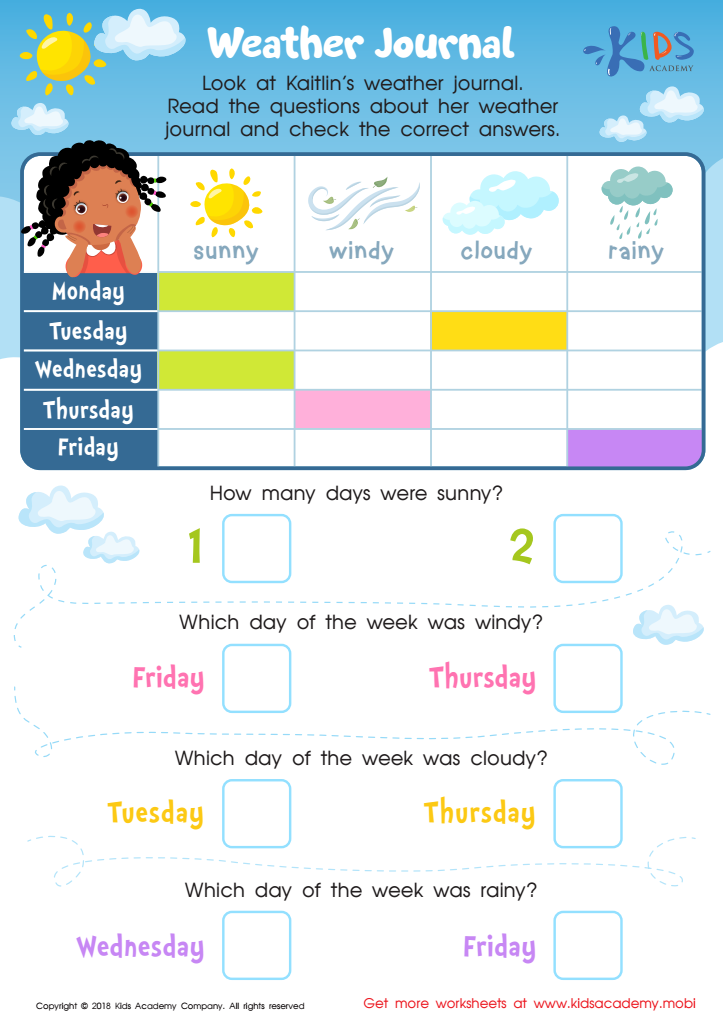
Weather Journal Worksheet
Kaitlin keeps a weather journal. Encourage your child to do the same! Look at Kaitlin's journal with them, and have them note the weather for each day. Read aloud the questions and check the correct answers.
 Assign to My Students
Weather Journal Worksheet
Worksheet
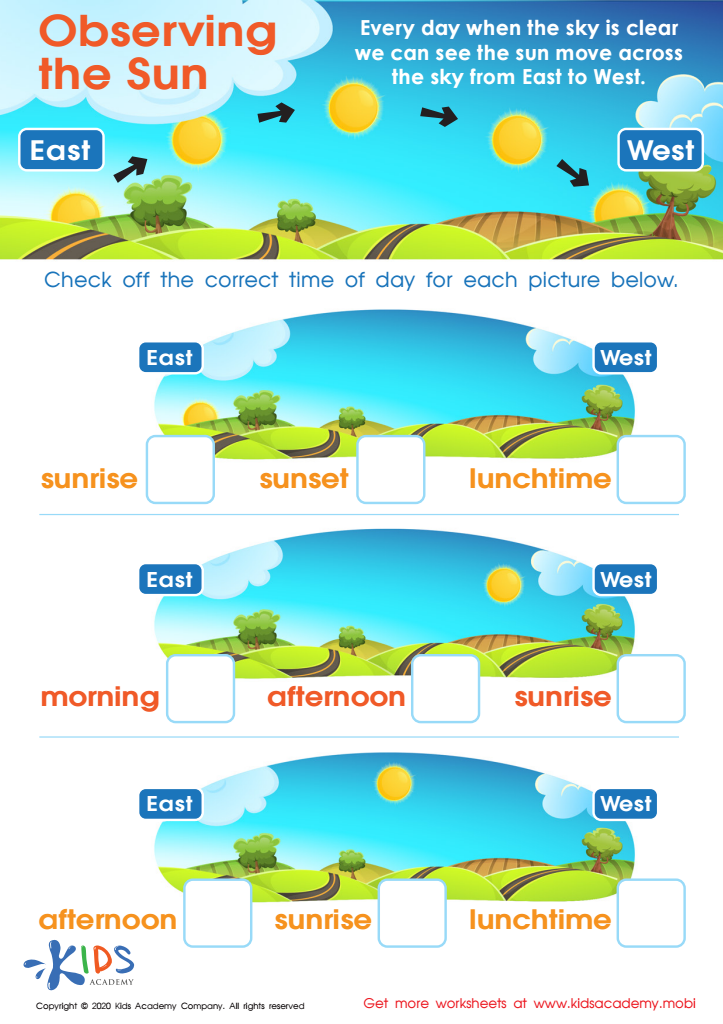
Observing the Sun Worksheet
Observe the image of the sun's progression with your child and use it to complete this free printable worksheet from Kids Academy. Have your kid look at the pictures on the left and check off the numbers in the correct order from sunrise to sunset! This will expand their science knowledge and help them understand when it's time to rise, reach its highest point during midday and set again in the West.
Observing the Sun Worksheet
Worksheet
Join Kids Academy for Free
Who is primarily going to use this learning content?





.jpg)

.jpg)
Analyzing patterns is crucial for children aged 7-9 as it lays the groundwork for essential cognitive development and mathematical understanding. During this stage, kids begin to identify and explore various patterns—numerical, geometric, and even social—which fosters critical thinking and problem-solving skills. By recognizing patterns, children learn to predict outcomes, make connections, and enhance their reasoning abilities.
Parents and teachers should care about this skill because it directly impacts children's ability to grasp more complex concepts later on, such as algebra and data analysis. Additionally, pattern recognition is not limited to mathematics; it applies to literacy and scientific inquiry, helping children understand sequences in stories or biological processes.
Furthermore, by engaging in activities that promote pattern analysis—like completing puzzles, playing games, or creating art—children develop perseverance and attention to detail. These are integral skills that contribute to academic success and lifelong learning. Encouraging children to analyze patterns also cultivates a sense of curiosity and discovery, fostering a positive attitude toward learning. Ultimately, prioritizing pattern analysis supports a holistic educational approach, preparing children for future challenges across various disciplines.








