
Basic science knowledge Worksheets for Ages 7-9
3 filtered results
Difficulty Level
Grade
Age
-
From - To
Subject
Activity
Standards
Unlock the wonders of science for your young learners with our Basic Science Knowledge Worksheets for ages 7-9. These engaging resources from Kids Academy are designed to nurture curiosity and critical thinking. Covering a range of fundamental topics, including Earth Science, Biology, and simple Physics, our worksheets feature fun, interactive activities that make learning enjoyable. Each carefully crafted worksheet aims to build foundational understanding and inspire a lifelong love of science. Perfect for both classroom use and at-home studying, our worksheets are your gateway to sparking scientific curiosity in your young explorers.
Favorites
With answer key
Interactive
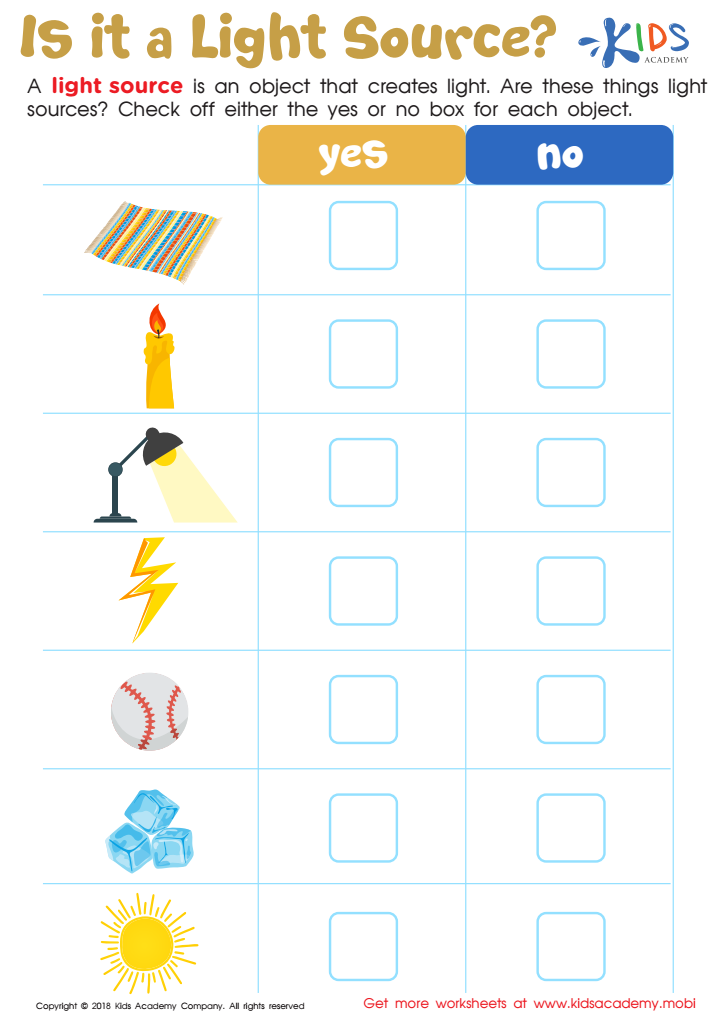
Is It a Light Source? Worksheet
This worksheet is a fun way to teach kids about light sources. Children must identify natural sources like the sun and lightning, and man-made sources such as candles and lamps. Ask them to look at each object and check the box to indicate if it's a light source or not.
 Assign to My Students
Is It a Light Source? Worksheet
Worksheet
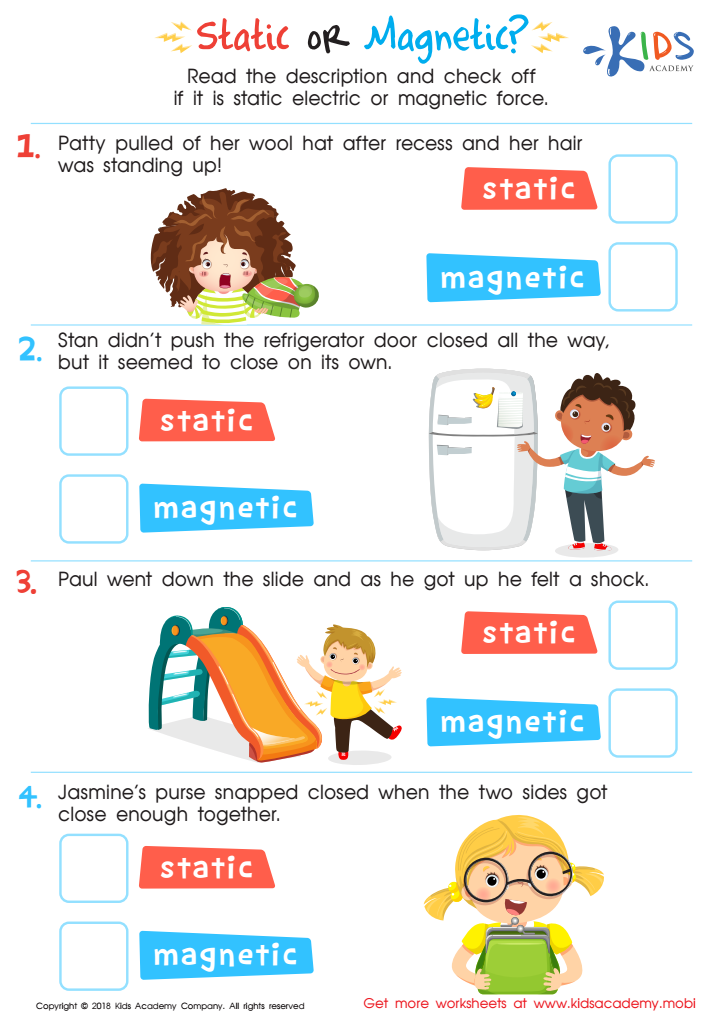
Static or Magnetic Printable Worksheet
Ever wondered if a situation involved static or magnetic force? This printable worksheet has the answer! Read the scenarios and check out the illustrations to decide which force is in play for each. Learn about these two amazing forces with this fun activity!
Static or Magnetic Printable Worksheet
Worksheet
Join Kids Academy for Free
Who is primarily going to use this learning content?








Basic science knowledge is crucial for children aged 7-9 because it lays the foundation for their overall intellectual development. At this age, children are naturally curious and eager to explore the world around them. Introducing them to basic scientific concepts helps to nurture this innate curiosity and encourages critical thinking skills. Understanding basic science enables kids to make sense of everyday phenomena, from why the sky is blue to how plants grow, fostering a sense of wonder and inquisitiveness.
Moreover, early science education promotes problem-solving abilities. When children engage in simple experiments, they learn to ask questions, make observations, and draw conclusions. These fundamental scientific processes enhance their ability to think logically and make evidence-based decisions, skills that are valuable both academically and in everyday life.
Another reason why basic science knowledge is essential is that it builds a solid foundation for future learning. When children grasp the rudimentary principles of science, they are better prepared for advanced studies in the subject. This early exposure can often spark a lifelong interest in scientific fields, potentially leading to careers in science, technology, engineering, or mathematics (STEM).
Finally, learning science at a young age fosters important life values such as perseverance and resilience. Many scientific experiments require multiple trials and do not always yield immediate results, teaching children the value of persistence and learning from failure. Therefore, both parents and teachers should prioritize basic science education to support holistic child development and prepare them for future success.








