
Chess piece identification Worksheets for Ages 7-9
3 filtered results
Difficulty Level
Grade
Age
-
From - To
Subject
Activity
Standards
Enhance your child's strategic thinking with our "Chess Piece Identification Worksheets for Ages 7-9." Perfectly tailored for budding chess enthusiasts, these engaging worksheets help young learners easily recognize and differentiate between each chess piece. Through fun and interactive activities, kids will not only identify kings, queens, knights, rooks, bishops, and pawns but also understand their unique movements and roles. Strengthen your child's cognitive and decision-making skills while nurturing a love for this timeless game. Ideal for classroom use or skill-building at home, our worksheets make learning chess simple and enjoyable for children aged 7-9.
Favorites
With answer key
Interactive
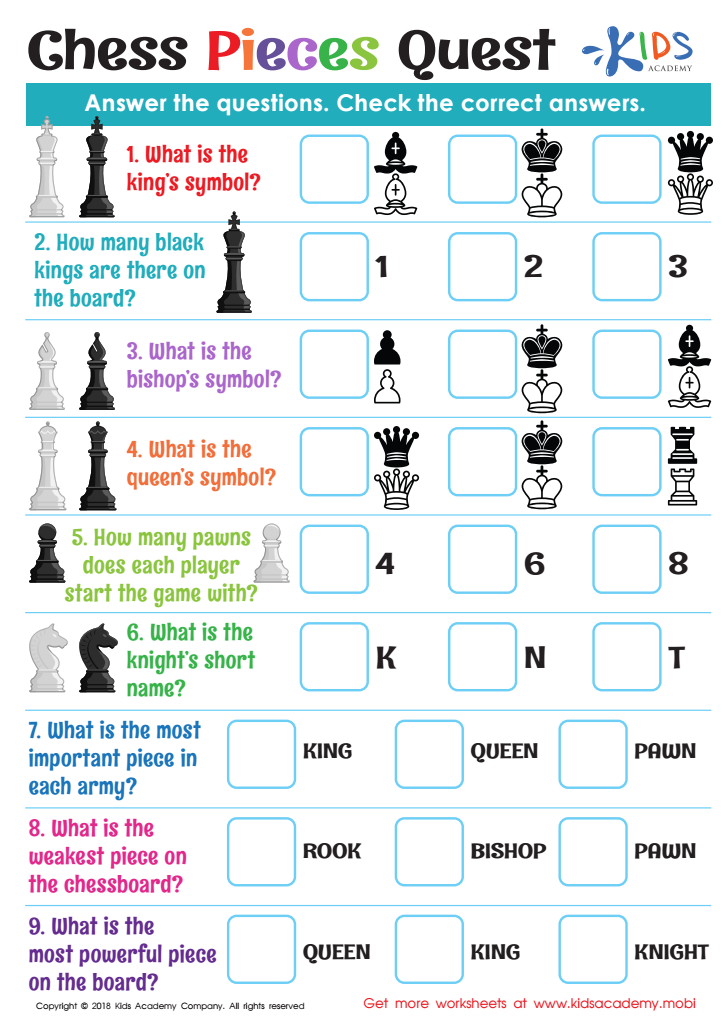
Chess Pieces Quest Worksheet
Help your child prepare for the chess quest by refreshing their knowledge of the symbols and characteristics of each chess piece. Then, have them try the 9 questions on this worksheet. These questions will assess their understanding of the symbols and how many pieces each player starts with.
 Assign to My Students
Chess Pieces Quest Worksheet
Worksheet
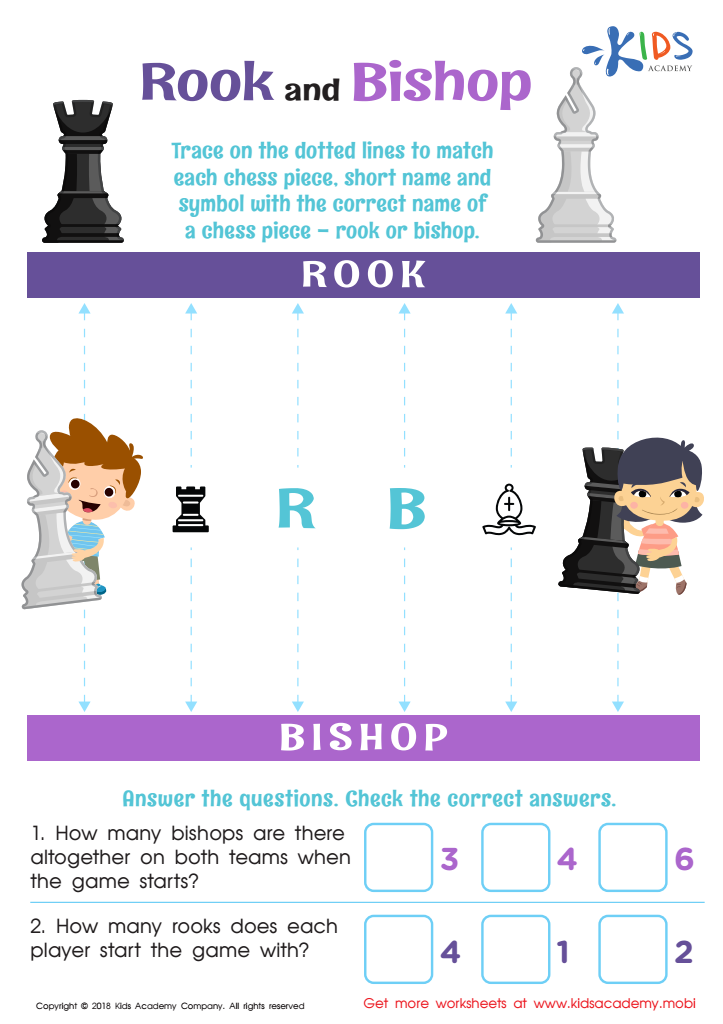
Rook and Bishop Worksheet
This tracing sheet helps your child learn chess pieces by matching each piece, short name and symbol to the correct name. After tracing, have them answer the questions and check their answers. It's a great way for them to become familiarized with chess.
Rook and Bishop Worksheet
Worksheet
Join Kids Academy for Free
Who is primarily going to use this learning content?








Chess piece identification for children aged 7-9 offers essential developmental benefits. Teaching kids to identify pieces and understand their unique movements enhances critical cognitive skills such as problem-solving, memory, and strategic thinking. At early ages, children's brains are highly adaptable, making this an optimal period to introduce challenging concepts wrapped in fun activities like chess.
From an educational perspective, learning the names, values, and movements of each piece strengthens pattern recognition and enhances spatial reasoning. These skills are foundational for subjects such as mathematics and science. Additionally, chess nurtures focus and patience. Young children often struggle with attention spans, but the engaging nature of chess can teach them to concentrate for extended periods.
Socially, playing chess provides a valuable opportunity for children to develop interpersonal skills. They learn to win graciously and, more importantly, how to handle losses—a crucial life lesson.
Lastly, fostering an interest in chess at a young age can promote a lifelong engagement with intellectually stimulating activities rather than passive entertainment. Therefore, by helping children aged 7-9 identify chess pieces and comprehend their roles, parents and teachers invest in cultivating well-rounded individuals equipped with critical thinking skills and resilience.








