Comparing weights Worksheets for Ages 7-9
3 filtered results
-
From - To
Discover our engaging "Comparing Weights Worksheets" designed for ages 7-9! These interactive worksheets encourage young learners to explore and understand the concept of weight through fun activities. Students will practice comparing objects, estimating weights, and using measurement tools, helping to build essential math skills. Ideal for classroom use or at-home learning, our worksheets are crafted to inspire curiosity and make weight comparison enjoyable. With various exercises catering to different learning styles, children will gain confidence in their abilities while mastering essential concepts. Start your child’s enriching journey in math today with our carefully designed comparing weights resources!
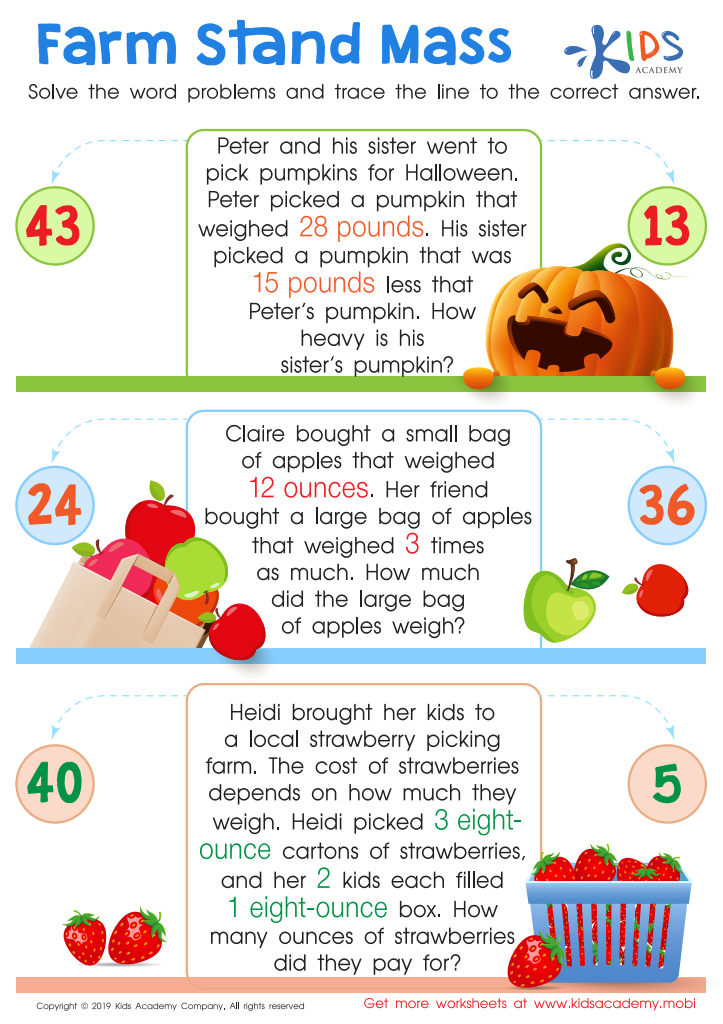
Farm Stand Mass Worksheet
 Assign to My Students
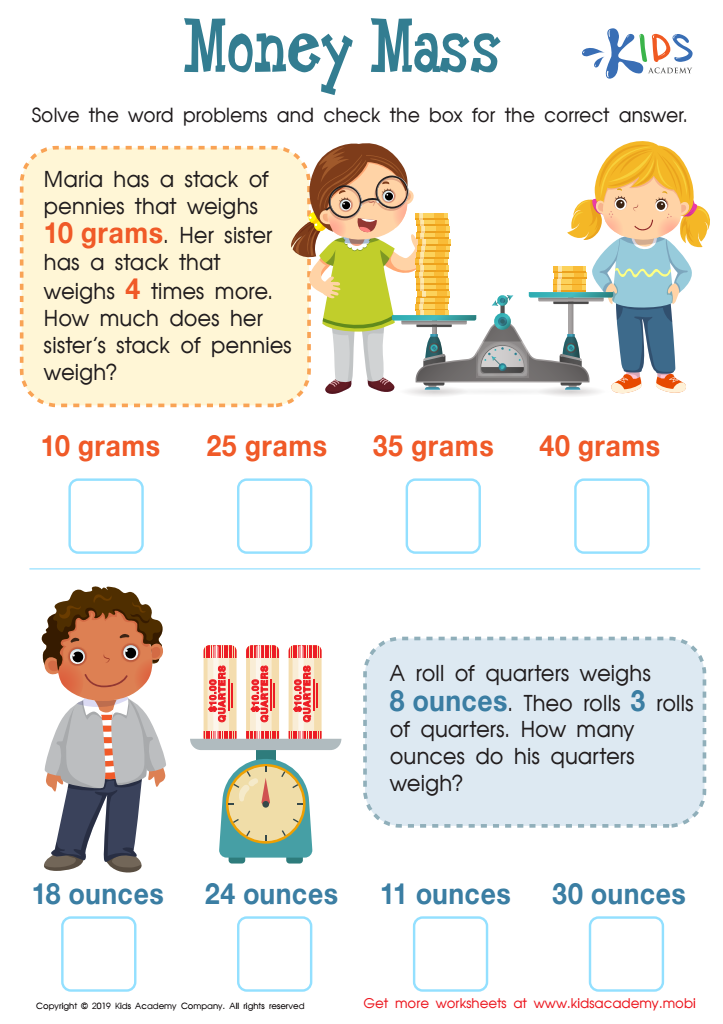
Money Mass Worksheet






Comparing weights is an essential skill for children aged 7-9, as it lays the foundation for critical thinking, mathematical understanding, and an appreciation for measurement in everyday life. At this developmental stage, children are eager to explore their environment, and hands-on activities that involve weighing objects can enhance their learning experience.
By engaging in weight comparison, children develop their ability to categorize and organize information, which is fundamental in mathematics. Understanding concepts such as heavier, lighter, or equal weights helps students grasp more complex ideas, such as addition, subtraction, and even basic physics principles later on.
Furthermore, this activity fosters collaboration and communication skills. When children work together to compare weights, they learn to articulate their thoughts and listen to different perspectives, promoting teamwork.
Parents and teachers should encourage weight comparison as it nurtures critical life skills such as problem-solving and analytical thinking. Additionally, this activity can help children make real-world connections, reinforcing the importance of measurement and estimation in daily tasks, such as cooking or shopping.
Ultimately, the ability to compare weights contributes to a child's overall mathematical literacy and reinforces the value of hands-on learning, making this a critical focus for their early education.








