
Fraction subtraction Worksheets for Ages 7-9
3 filtered results
Difficulty Level
Grade
Age
-
From - To
Subject
Activity
Standards
Explore our engaging Fraction Subtraction Worksheets designed for children aged 7-9! These interactive resources help young learners master the essential skills of subtracting fractions with ease and confidence. Our worksheets feature a variety of exercises, including visual aids and simple fraction problems, that cater to different learning styles. By practicing with these materials, your child will enhance their understanding of fractions and improve their mathematical skills. Perfect for classroom use or at-home learning, these worksheets are an excellent way to reinforce key concepts and make learning fractions fun. Start your child's math journey today and watch them excel in subtraction!
Favorites
With answer key
Interactive
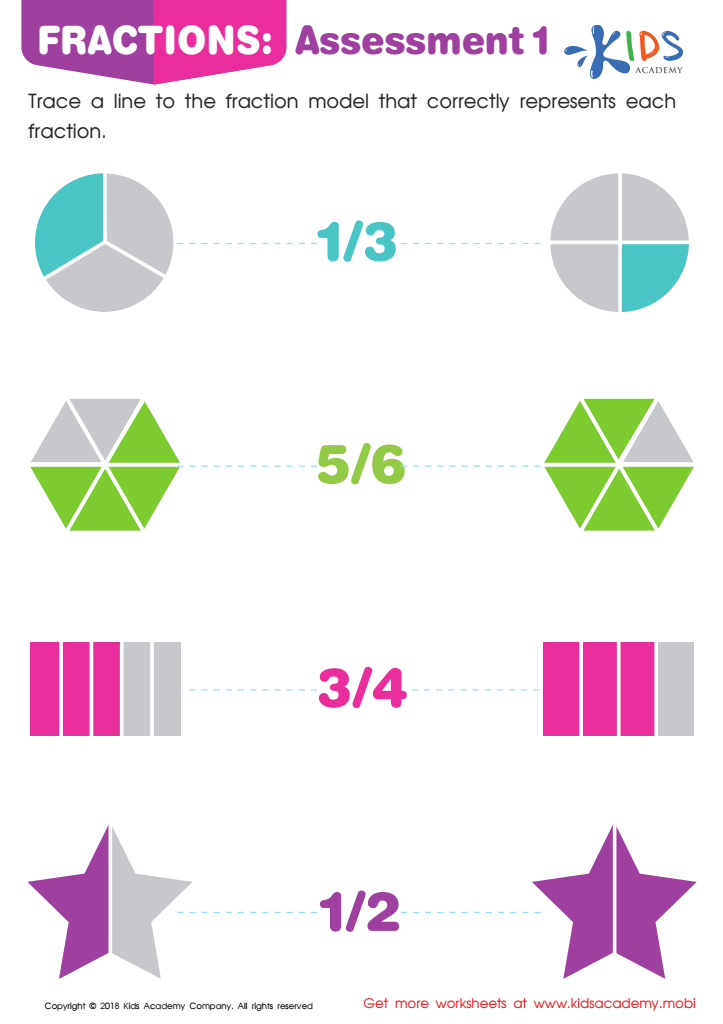
Fractions: Assessment 1 Worksheet
Master fractions easily with this worksheet! It has four sets of fraction models and fraction equations with two models each. Guide your kids to trace a line to the correct fraction model for each equation.
 Assign to My Students
Fractions: Assessment 1 Worksheet
Worksheet
Join Kids Academy for Free
Who is primarily going to use this learning content?








Understanding fraction subtraction is essential for children aged 7-9, as it lays the groundwork for more complex mathematical concepts in later years. At this developmental stage, children are beginning to grasp numbers and operations beyond whole numbers. Not only does mastering fraction subtraction bolster their arithmetic skills, but it also enhances critical thinking and problem-solving abilities.
When children learn to subtract fractions, they explore concepts of equivalence, the relationship between numbers, and the application of mathematical rules—skills that are crucial for real-world problem-solving. For example, cooking, measuring distances, and even financial transactions involve fractions.
Moreover, achieving proficiency in fraction subtraction promotes confidence in math. Struggling with basic concepts can lead to math anxiety, affecting a child's future engagement with the subject. Parents and teachers play a vital role in providing support and resources to make learning these concepts engaging, fostering a positive attitude towards math.
Furthermore, foundational skills in fractions contribute to their overall academic performance across subjects, as mathematics is increasingly interconnected with other areas of learning. By prioritizing fraction subtraction, parents and teachers empower students to become confident, capable learners ready to tackle more advanced concepts.








