
Practicing division Worksheets for Ages 7-9
3 filtered results
Difficulty Level
Grade
Age
-
From - To
Subject
Activity
Standards
Unlock your child's potential with our "Practicing Division Worksheets for Ages 7-9," designed to boost their math skills and confidence. These engaging and educational worksheets offer a variety of fun division problems, helping kids master essential concepts through practice and repetition. Suitable for both classroom and home use, our expertly crafted materials align with educational standards, ensuring your child stays on track. From simple division facts to more challenging puzzles, each worksheet provides an interactive way to learn and grow. Empower your young learner with the tools they need for division success!
Favorites
With answer key
Interactive
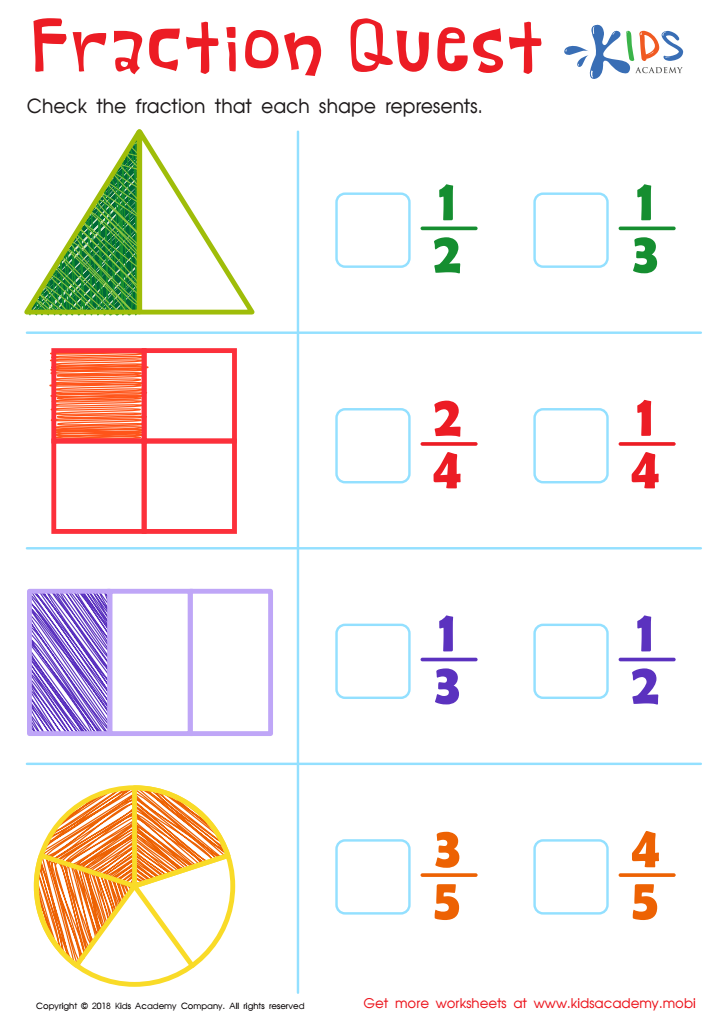
Fraction Quest Worksheet
This colorful and educative worksheet can help kids conquer their fractions struggles. Ask them to identify the four shapes, then the fractions they represent. They can then check the correct answers from the options given.
 Assign to My Students
Fraction Quest Worksheet
Worksheet
Join Kids Academy for Free
Who is primarily going to use this learning content?







Practicing division for children aged 7-9 is critically important as it lays the foundation for advanced mathematical concepts and everyday problem-solving skills. At this stage, young learners are transitioning from understanding basic arithmetic operations to more complex calculations. Division isn't just a standalone concept; it intertwines with multiplication, fractions, and even real-life applications like sharing, grouping, or distributing items evenly.
When children practice division, they develop logical thinking and pattern recognition. These skills are transferable across various subjects and tasks, from figuring out science experiments to distributing resources fairly in team activities. Additionally, mastering division early reduces math anxiety, fostering confidence in their ability to handle more challenging mathematics in the future.
For teachers and parents, encouraging regular practice in division ensures that children do not develop gaps in their mathematical understanding. This early intervention can help detect and address areas where a child might struggle, offering tailored support to solidify their skills. In today's fast-paced and competitive world, mathematical proficiency is crucial. Starting strong with foundational concepts like division ultimately equips children with the critical thinking and numeric literacy necessary for long-term academic and practical success.








