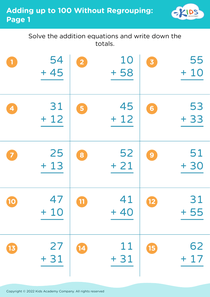
Recognize patterns Adding up to 100 with Regrouping Worksheets for Ages 7-9
3 filtered results
-
From - To
Enhance your child’s arithmetic skills with our "Recognize Patterns Adding up to 100 with Regrouping Worksheets" designed for ages 7-9. These engaging worksheets focus on helping young learners identify number patterns, and master addition with regrouping. Through a variety of exercises, kids will gain confidence and improve their mental math abilities. Bright, colorful designs and fun activities keep children motivated while aligning with common core standards. Perfect for classroom or at-home learning, these worksheets provide rigorous practice that will aid students in understanding essential math concepts, preparing them for more complex problems. Ideal for ages 7-9!
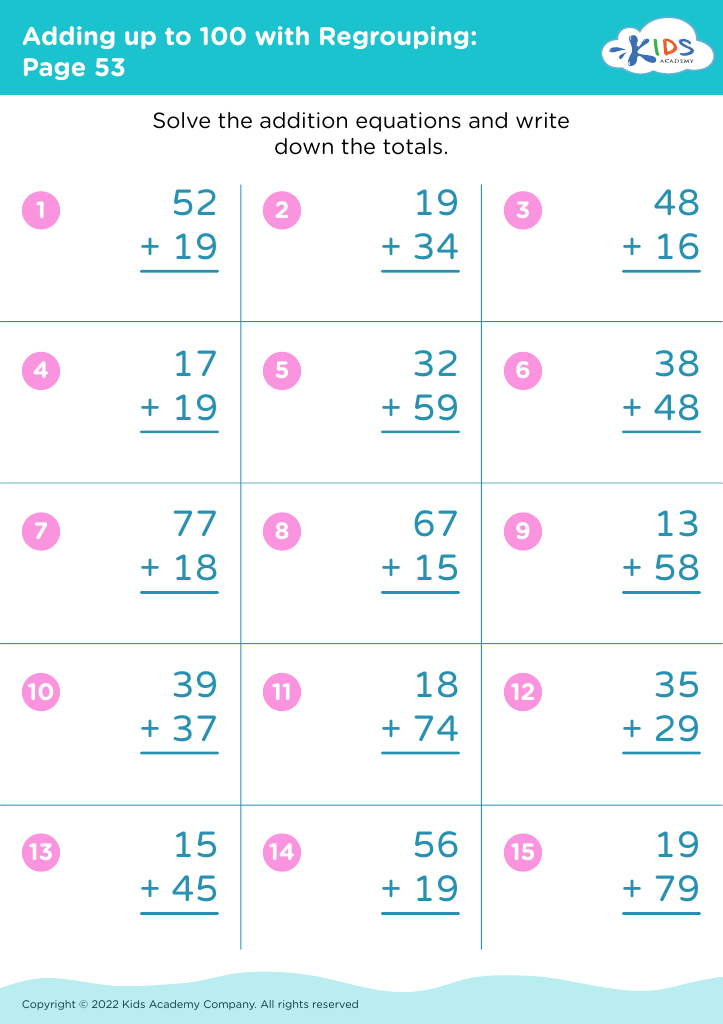
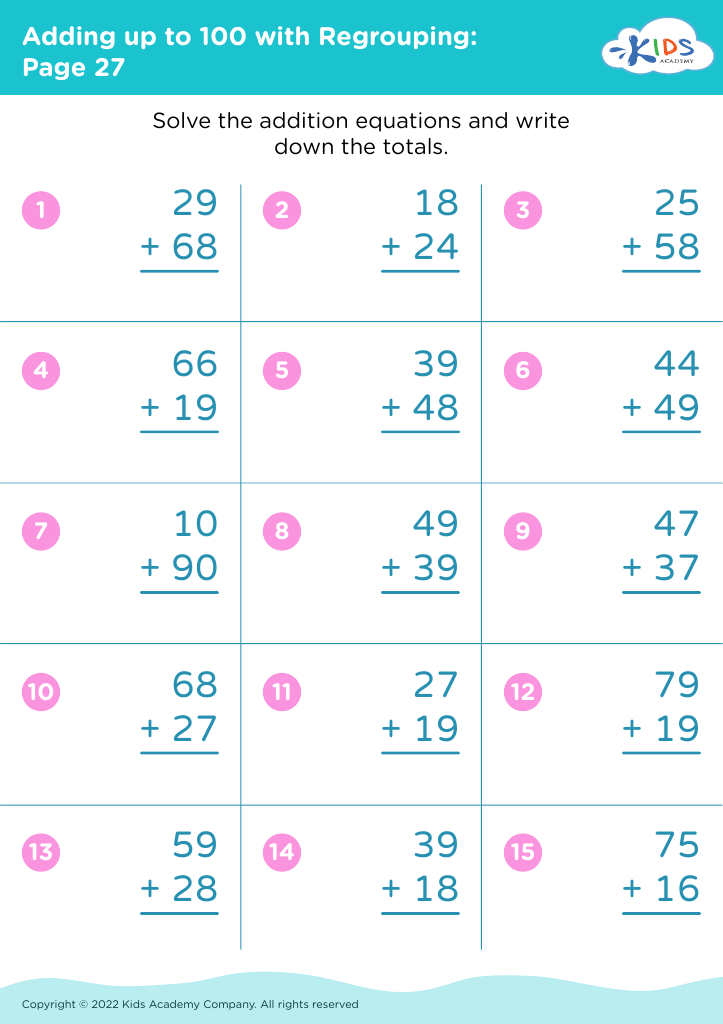
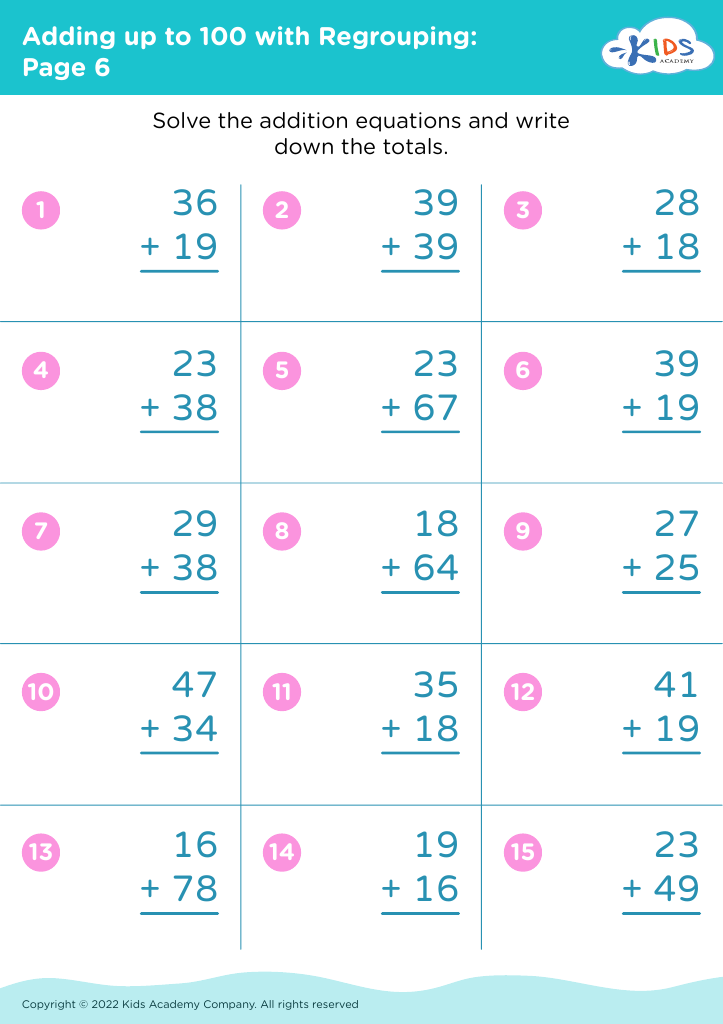




Recognizing patterns and mastering addition up to 100 with regrouping are vital concepts for children aged 7-9. These skills are fundamental building blocks of arithmetic, crucial for advanced math and everyday problem-solving. When children understand patterns, they develop critical thinking and analytical skills, which aid in predicting outcomes and making connections across various concepts.
Addition up to 100 reinforces number sense, helping kids visualize quantities and the relationships between numbers. This age-appropriate achievement enhances their ability to perform more complex calculations with confidence. Regrouping, also known as carrying over, teaches them sophisticated techniques for handling larger numbers, promoting accuracy and laying the groundwork for future topics, such as subtraction, multiplication, and division.
For parents and teachers, fostering these skills ensures that children are on the right track academically, boosting their confidence and motivation in math. It also equips students with essential tools to solve real-life problems, promoting their overall cognitive development. By caring about these mathematical concepts, parents and teachers support a child’s foundational education, providing a strong mathematical base that enhances their lifelong learning journey. Additionally, early mastery of these skills can open doors to STEM fields, encouraging a future generation of thinkers, innovators, and problem-solvers.