Arithmetic practice Addition & Subtraction Worksheets for Ages 7-9
3 filtered results
-
From - To
Boost your child’s math skills with our engaging Arithmetic Practice Addition & Subtraction Worksheets for ages 7-9. Designed to reinforce fundamental arithmetic concepts, these interactive worksheets help kids build confidence in solving addition and subtraction problems. Perfect for classroom use or at-home learning, each worksheet is crafted to align with school curriculums, ensuring consistency in your child's education. Colorful illustrations and diverse problem sets make learning fun and effective, encouraging continuous practice and mastery. Start your journey towards mathematical excellence with our user-friendly, printable worksheets today, and watch your child’s numerical abilities soar!
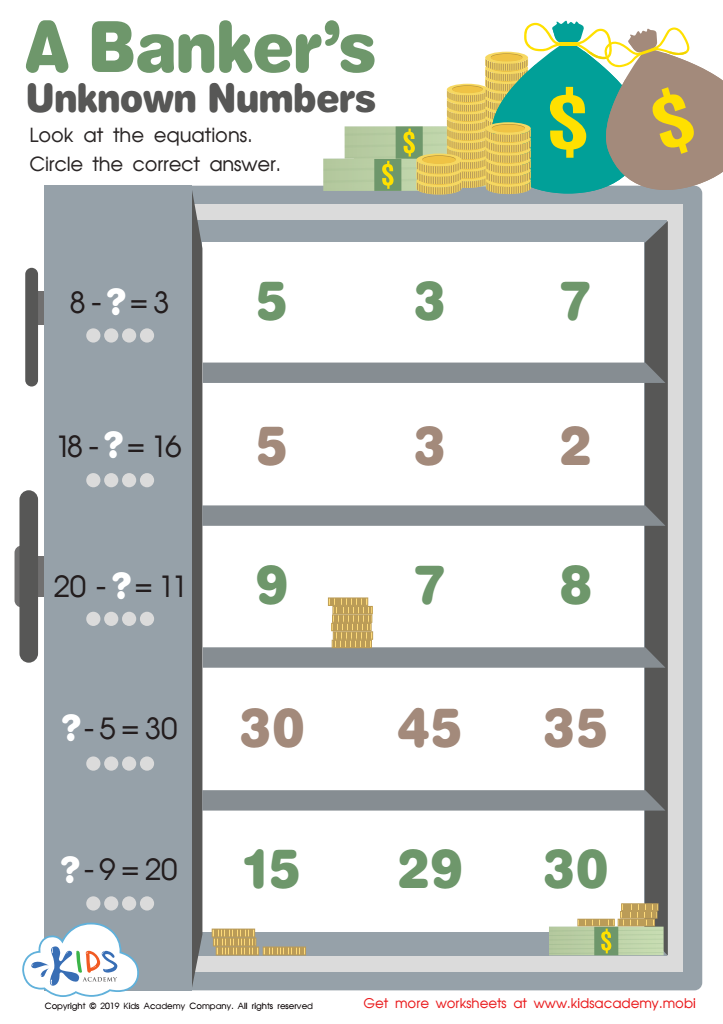
A Banker's Unknown Numbers Worksheet
 Assign to My Students
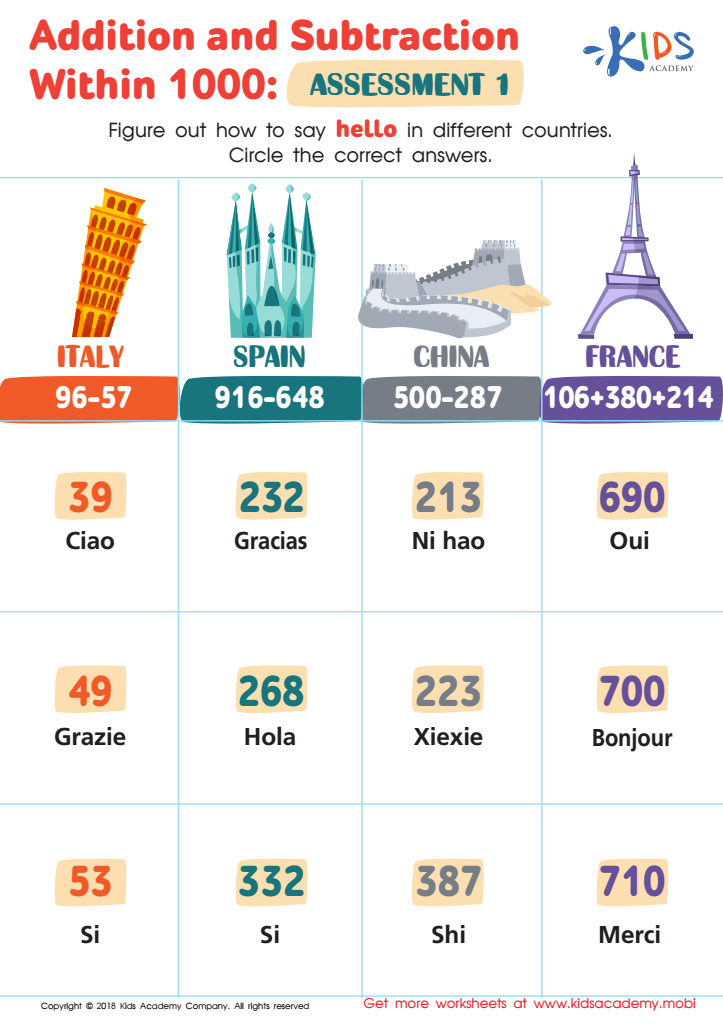
Addition and Subtraction Within 1000: Assessment 1 Worksheet








Parents and teachers should care about arithmetic practice, especially addition and subtraction, for children ages 7-9 because these fundamental concepts are foundational for their overall mathematical development. At this stage, children solidify their understanding of basic number sense, which is crucial for tackling more complex math topics in later grades, such as multiplication, division, fractions, and problem-solving.
Practicing addition and subtraction helps enhance cognitive skills like memory, concentration, and logical thinking. It enables children to tackle everyday tasks, such as counting money, measuring ingredients in a recipe, or telling time with confidence. Mastery of these operations also boosts a child’s self-esteem and interest in math, turning potential struggles into engaging challenges.
In early education, consistent practice ensures that children achieve a level of fluency where these basic calculations become second nature. This fluency allows them to approach higher-level problem-solving without being bogged down by simple arithmetic issues. Moreover, research suggests that early math skills strongly predict later academic success, more so than early reading abilities.
In summary, focusing on practicing addition and subtraction sets the groundwork for academic achievement and practical life skills, fostering a positive attitude towards learning mathematics in both immediate and future educational endeavors.








