Improving mental math Addition & Subtraction Worksheets for Ages 7-9
3 filtered results
-
From - To
Welcome to our "Improving Mental Math Addition & Subtraction Worksheets" page designed for children aged 7-9! Here, you'll find engaging and interactive worksheets that help young learners sharpen their mental math skills. Focusing on addition and subtraction, these activities encourage quick thinking and problem-solving, making math fun and accessible. Our carefully crafted exercises promote number sense and fluency, empowering students to solve problems without relying heavily on written calculations. Whether used as classroom resources or at-home practice, these worksheets support your child’s journey to becoming a confident and capable mathematician. Explore today and enhance your child's mental math skills!
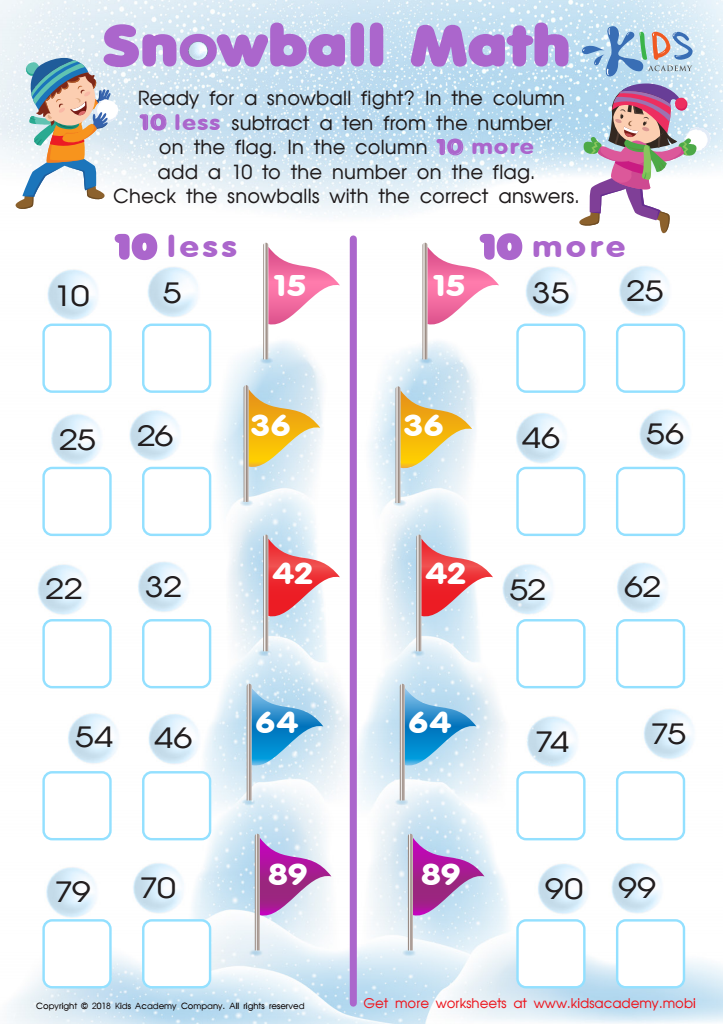
Snowball Math Worksheet
 Assign to My Students
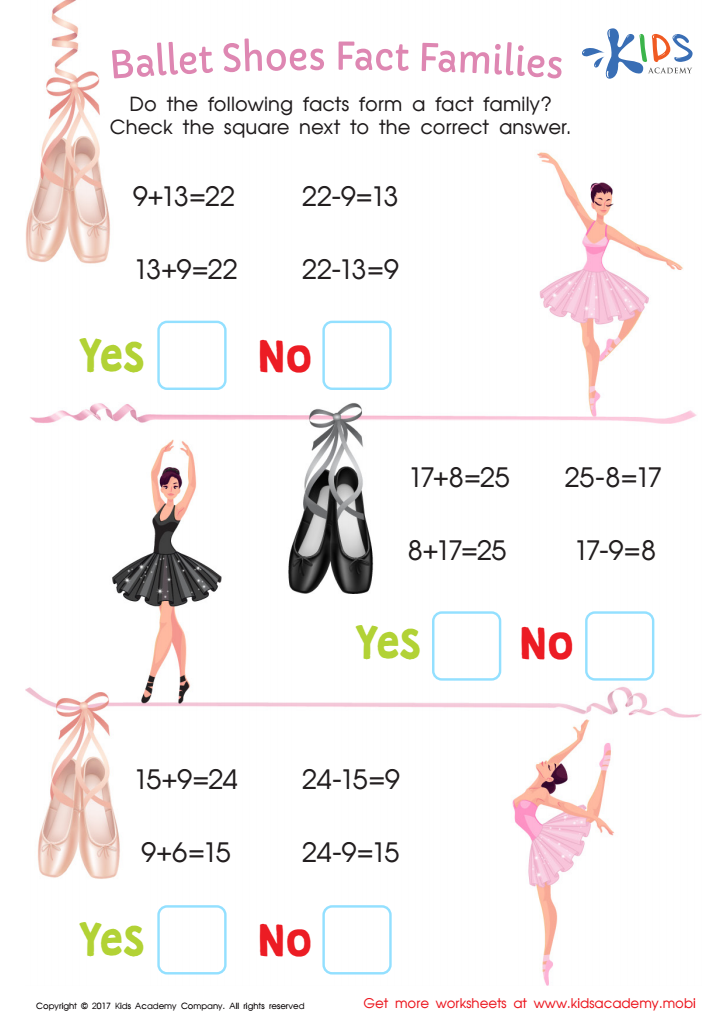
Ballet Shoes Fact Family Printable








Improving mental math skills in addition and subtraction for children aged 7 to 9 is crucial for their cognitive development and academic success. At this age, children are transitioning from concrete mathematical concepts to more abstract thinking. By honing mental math skills, they build confidence and fluency, which are essential for tackling more complex mathematical operations later on.
Mental math encourages children to develop number sense, enabling them to understand relationships between numbers and perform calculations more quickly and accurately. This skill not only facilitates mathematics but also strengthens problem-solving abilities, critical thinking, and perseverance. Furthermore, proficient mental math can be a source of enjoyment and achievement, fostering a positive attitude towards mathematics as they progress in their education.
From a teacher's perspective, enhanced mental math can lead to improved classroom performance and engagement. For parents, encouraging this skill supports homework and daily life applications, such as budgeting or cooking measurements. Ultimately, investing time in improving addition and subtraction mental skills lays the foundation for lifelong learning and academic resilience, preparing children to face future challenges with confidence in their mathematical abilities.








