Comparing objects Math Worksheets for Ages 7-9
3 filtered results
-
From - To
Enhance your child's math skills with our "Comparing Objects Math Worksheets for Ages 7-9." These engaging and educational worksheets are designed to help kids master important math concepts such as comparing sizes, weights, lengths, and quantities. Each worksheet offers fun activities and colorful illustrations to make learning enjoyable. Ideal for classroom use or at-home practice, our worksheets support critical thinking and problem-solving skills, giving young learners a solid foundation in math. Ideal for kids aged 7-9, these worksheets help make comparison exercises easy and effective, preparing them for more advanced math challenges.
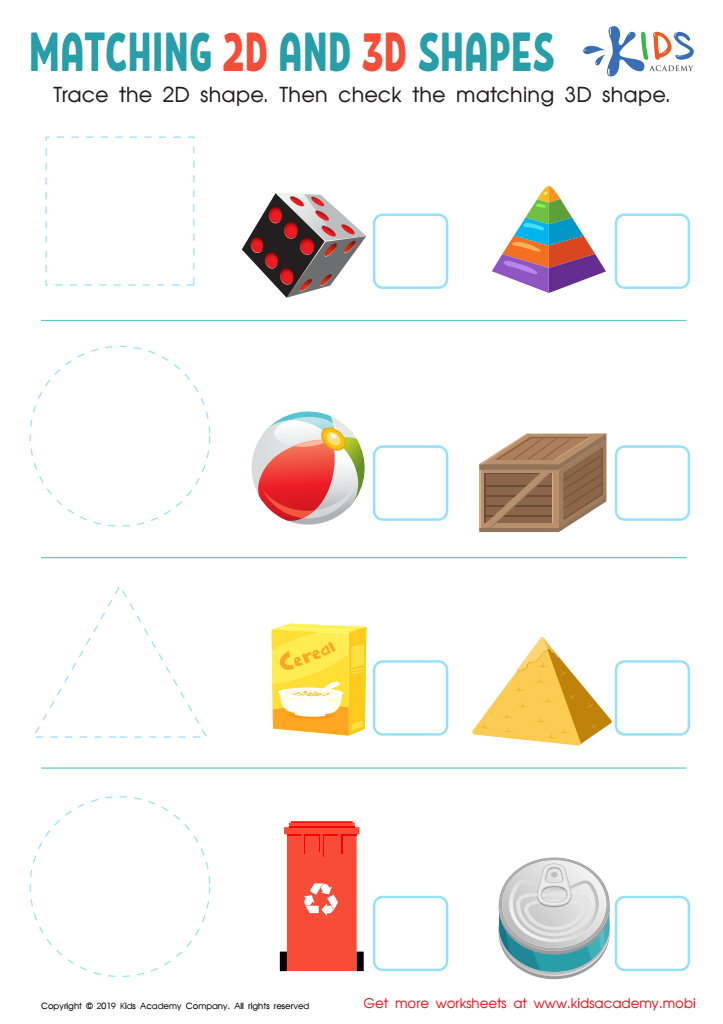
Matching 2D and 3D Shapes Worksheet
 Assign to My Students






Comparing objects in math for ages 7-9 is vital for foundational mathematical development. At this age, children are honing their cognitive skills and learning to apply logical thinking, which comparing objects fundamentally nurtures. By comparing attributes like length, weight, volume, and number, children develop strong number sense and an understanding of measurement concepts.
It underpins higher-order math skills; comprehending what is "more" or "less", for example, is essential before children can tackle addition or subtraction problems effectively. Additionally, comparing and contrasting objects builds critical thinking and problem-solving abilities, which are transferrable to other areas of learning and even daily decision-making.
Parents and teachers should care because these comparisons lay the groundwork for later concepts like fractions, ratios, and even algebra. Engaging with concrete objects makes math tangible and relatable, helping to demystify abstract ideas and fostering a positive attitude towards math. Additionally, discussing their comparisons enhances vocabulary and language skills as language often elaborates on and supports cognitive processes.
Moreover, these comparisons are essential for scientific understanding, where distinguishing between observations and properties is crucial. Ultimately, supporting children in developing these skills not only improves their math proficiency but reinforces a range of analytical and language abilities fundamental to holistic education.








