
Developing spatial awareness Math Worksheets for Ages 7-9
3 filtered results
Difficulty Level
Grade
Age
-
From - To
Subject
Activity
Standards
Unlock your child's mathematical potential with our "Developing Spatial Awareness Math Worksheets for Ages 7-9". Our expertly crafted worksheets focus on enhancing spatial reasoning, an essential skill for understanding geometry and solving complex mathematical problems. These engaging activities help young learners visualize shapes, comprehend spatial relationships, and develop critical thinking. Perfect for both classroom and home learning, our worksheets make learning exciting and effective. Give your child the tools to excel in math and beyond with Kids Academy’s resource-rich worksheets designed to foster confidence and academic success. Start now to pave the way for your child's future achievements!
Favorites
With answer key
Interactive
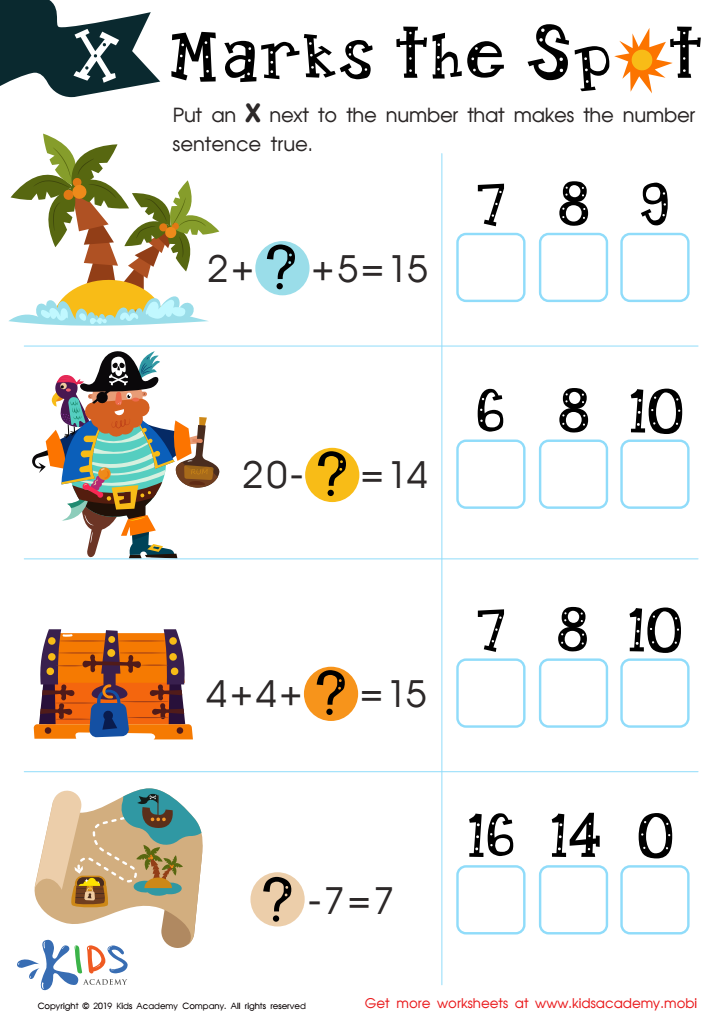
X Marks the Spot Worksheet
Let your kids explore the world of pirates! Ask them what they know about them, what they do and the phrases they like. Download the printout and point at the images, asking them to tell you what they see. Help them tick the box for the number that makes the sentence true. Let them have fun learning about pirates! (80 words)
 Assign to My Students
X Marks the Spot Worksheet
Worksheet
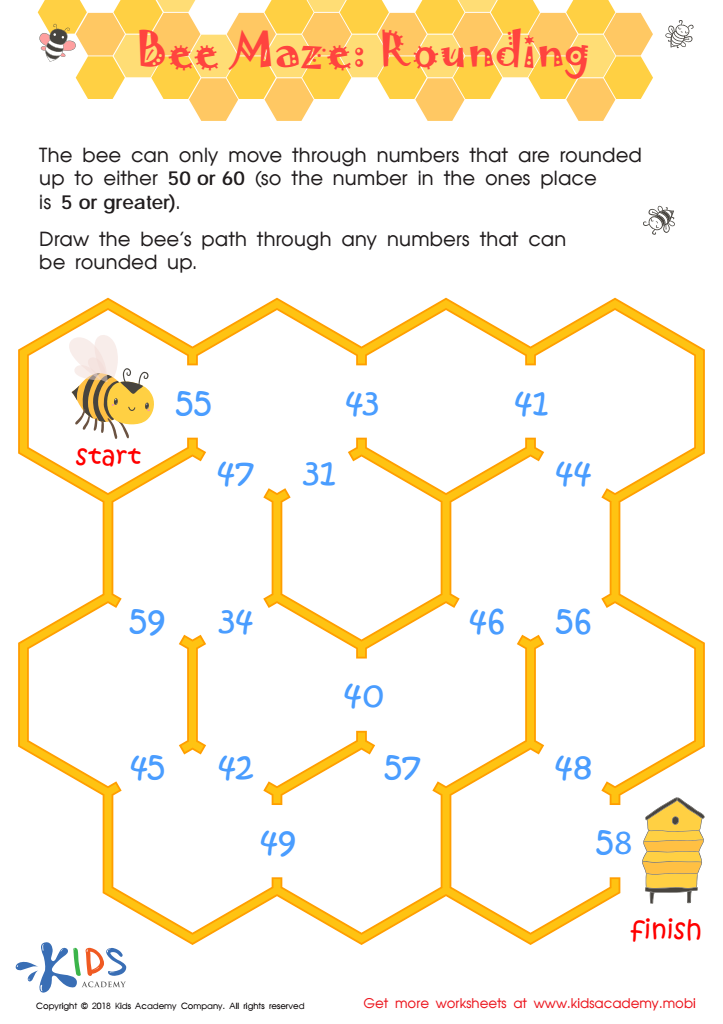
Bee Maze Rounding Worksheet
Round up the bee! Your child will practice rounding with this fun maze worksheet. Kids round up to 50 or 60, evaluating each number and guiding the bee to his home. Get ready for some thought-stretching fun!
Bee Maze Rounding Worksheet
Worksheet
Join Kids Academy for Free
Who is primarily going to use this learning content?







Developing spatial awareness in math for children aged 7-9 is crucial, as it lays a vital foundation for their overall cognitive and academic growth. At this critical developmental stage, kids are naturally curious about how objects and space interact, making it an ideal time to introduce spatial concepts.
Firstly, spatial awareness helps improve problem-solving skills. Kids learn to visualize scenarios and consider various perspectives, which enhances their ability to tackle math problems and real-world challenges. For instance, understanding geometry and the operation of shapes requires solid spatial thinking.
Secondly, spatial skills are a predictor of future success in various subjects, not just math but also science and engineering. Studies suggest that early proficiency in these skills correlates with better performance in STEM fields.
Moreover, spatial awareness also enhances everyday life skills. For activities such as navigating environments, packing, or understanding maps, strong spatial abilities are essential. Kids develop coordination and an understanding of their surroundings, which boosts their confidence.
Therefore, parents and teachers must nurture spatial skills through engaging activities like puzzles, building blocks, and interactive math games. By doing this, they not only support a child's academic achievements but also promote critical thinking and practical life skills essential for future success.








