
Fraction identification Math Worksheets for Ages 7-9
6 filtered results
Difficulty Level
Grade
Age
-
From - To
Subject
Activity
Standards
Explore our engaging Fraction Identification Math Worksheets designed specifically for children ages 7-9. These worksheets provide a fun and interactive way for young learners to grasp the fundamentals of fractions through a variety of activities and colorful illustrations. Students will practice identifying, comparing, and classifying fractions, boosting their confidence and proficiency in this essential math skill. Suitable for both classroom and home use, our worksheets cater to diverse learning styles, making math enjoyable and accessible. Encourage your child’s mathematical journey with these thoughtfully crafted resources that foster comprehension and a love for learning fractions. Start your practice today!
Favorites
With answer key
Interactive
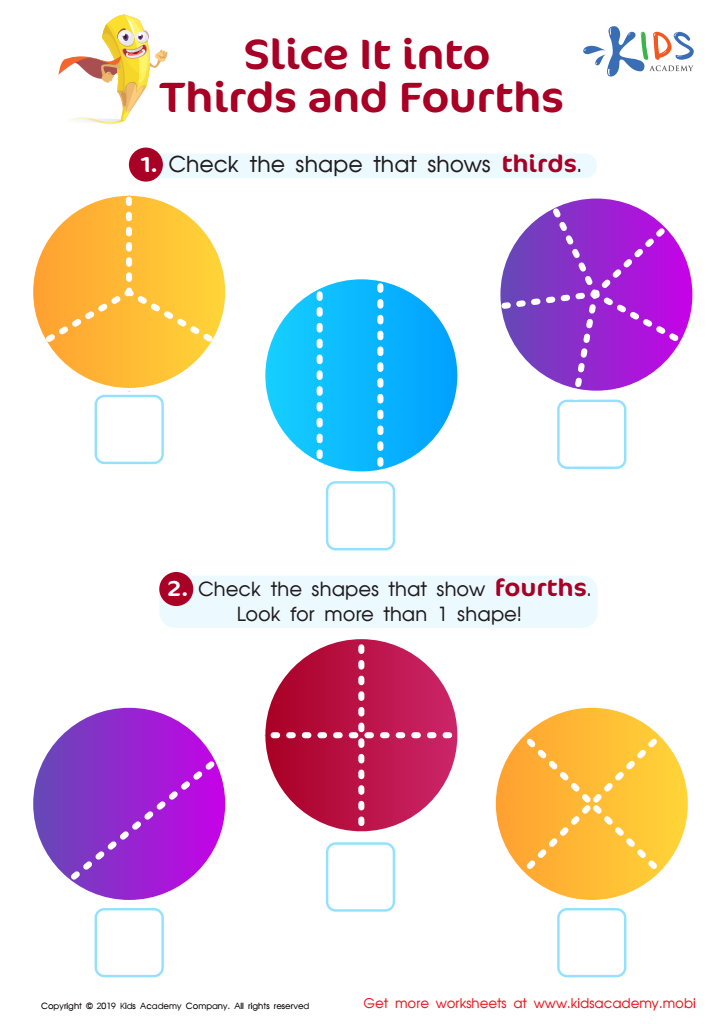
Slice in Thirds Fourths Worksheet
This worksheet helps kids learn fractions visually by dividing circles into thirds and fourths. They will learn that fractions must be equal parts, not just sets, by choosing the right colorful circles. It's an easy way to master fractions and have fun doing it!
 Assign to My Students
Slice in Thirds Fourths Worksheet
Worksheet
Join Kids Academy for Free
Who is primarily going to use this learning content?





.jpg)

Understanding fraction identification is crucial for children aged 7-9, as it lays the foundation for mathematical skills they will use for years to come. At this stage, kids are transitioning from basic arithmetic to more complex concepts, and mastering fractions is essential for their overall numeracy.
Fractions help children comprehend part-to-whole relationships, enabling them to grasp percentages, ratios, and proportions later on. This early math skill is not only important academically but also practically. For instance, understanding fractions aids in real-life situations like cooking, where measuring ingredients involves fractional quantities, or when sharing items equally among friends.
Moreover, fraction identification enhances critical thinking and problem-solving skills. As children learn to visualize and manipulate fractions through visual aids and everyday scenarios, they develop logical reasoning and spatial awareness.
Parents and teachers play a vital role by incorporating fun and engaging activities, such as fraction games, cooking together, or art projects that use fractions. Their encouragement fosters a positive attitude towards math, making it less intimidating and more enjoyable. By prioritizing fraction education, parents and teachers set children up for future academic success, building a strong geometric and algebraic foundation for advanced math topics.








