Number Sequencing Math Worksheets for Ages 7-9 - Page 2
27 filtered results
-
From - To
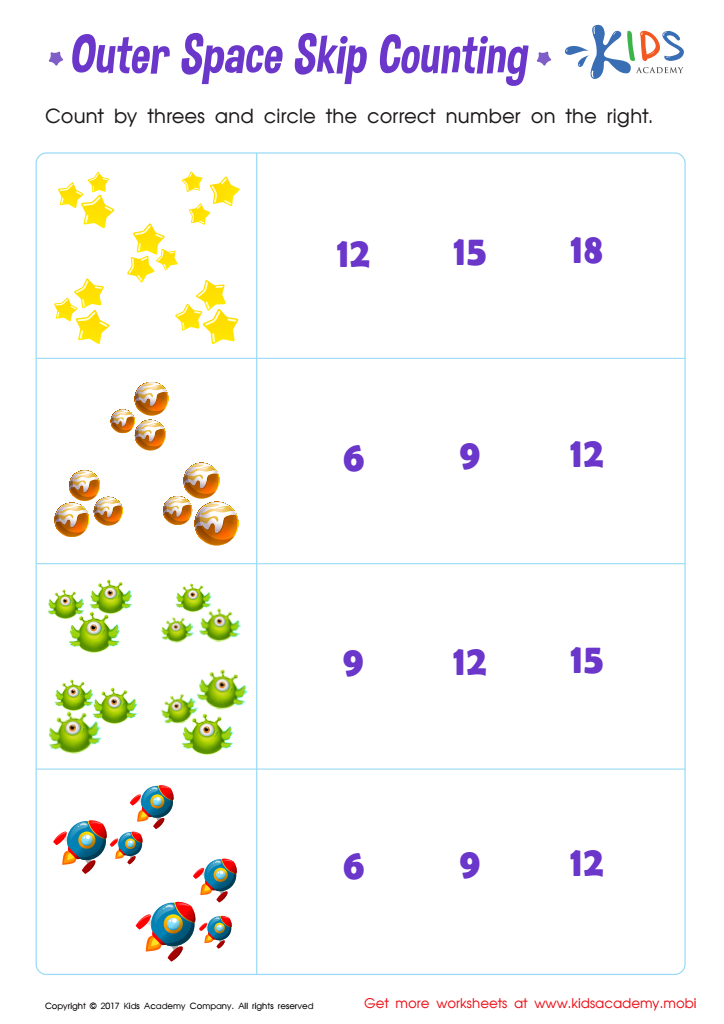
Skip Counting by 3s: Outer Space Skip Counting Printable
 Assign to My Students







Number sequencing is fundamental for children ages 7-9 as it enhances their numerical literacy and problem-solving skills, laying the groundwork for more advanced mathematical concepts. Understanding number sequences helps children to grasp the logical order of numbers, recognize patterns, and predict what comes next, critical skills in everyday math and more complex subjects like algebra and data analysis later on.
For parents and teachers, focusing on number sequencing means fostering a child's confidence in handling both simple arithmetic and more intricate calculations. This understanding empowers children to engage with counting, addition, subtraction, and even multiplication and division more effectively. Activities like skip counting, recognizing even and odd numbers, and ordering numbers sharpen their logical reasoning and attention to detail.
Furthermore, mastering number sequencing aids in the development of a child's intuitive sense of number magnitude and mental math abilities. This can significantly boost their efficiency in mathematics in general. In real-world contexts, this translates to better time management through understanding the concept of seconds and hours, making sense of schedules, and arranging books or shoes by size. A strong foundation in number sequencing builds a child's mathematical confidence and opens doors to STEM fields in their future education, thus making it crucial for parents and teachers to prioritize it.








