
Story sequencing Math Worksheets for Ages 7-9
3 filtered results
Difficulty Level
Grade
Age
-
From - To
Subject
Activity
Standards
Discover our engaging Story Sequencing Math Worksheets designed specifically for children aged 7-9. These worksheets not only enhance math skills but also nurture critical thinking and comprehension abilities by encouraging students to sequence events in a story context. With a variety of fun exercises, these resources enable learners to visualize mathematical problems and relate them to real-life situations, making math both enjoyable and meaningful. Ideal for classroom activities or at-home practice, our worksheets are crafted to provide a balanced mix of challenge and skill-building. Explore the delightful world of story sequencing to inspire young mathematicians today!
Favorites
With answer key
Interactive
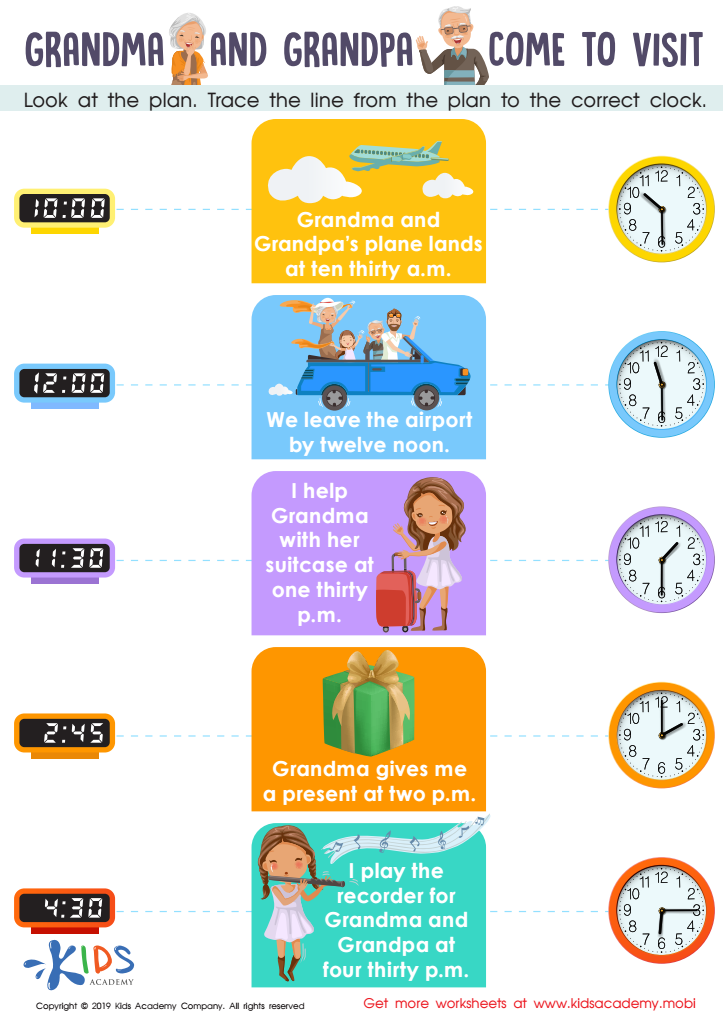
Grandpa and Grandma Come to Visit Worksheet
Have your kids learn about time using this worksheet. It contains pictures, accompanying texts and a clock, which you can use to help them trace the plan. Grandparents' visits and trips to their house are the perfect opportunity to practice this skill. Talk to your kids about the plan and watch them trace it to the correct clock.
 Assign to My Students
Grandpa and Grandma Come to Visit Worksheet
Worksheet
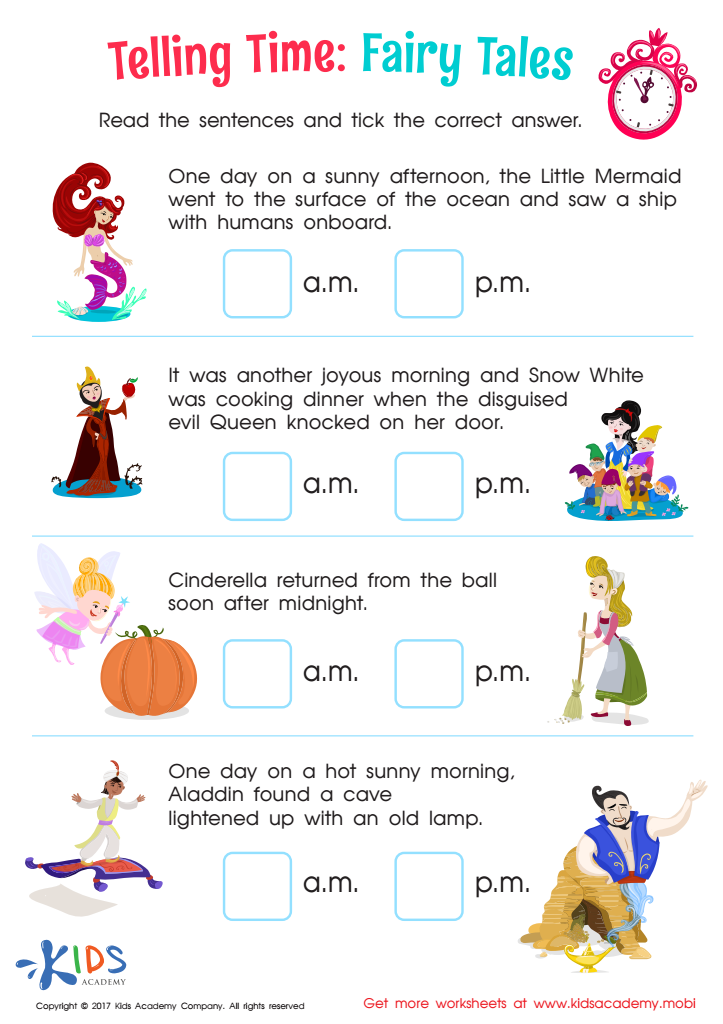
Telling Time: Fairy Tales Worksheet
Bring your child's imagination to life with classic fairy tales! This colorful telling time worksheet has it all: The Little Mermaid, Cinderella, and more! Plus, your child will have fun learning to distinguish a.m. from p.m. with this charming worksheet.
Telling Time: Fairy Tales Worksheet
Worksheet
Join Kids Academy for Free
Who is primarily going to use this learning content?








Story sequencing in math is essential for children aged 7-9, as it actively engages them in both storytelling and numerical problem-solving. At this developmental stage, children are refining their cognitive and critical thinking skills, and story sequencing helps build these abilities in an enjoyable way. By presenting mathematical concepts through narratives, children can understand complex ideas in a context they find relatable, thus making math more meaningful.
Additionally, story sequencing encourages logical reasoning and comprehension skills. When children recount a sequence of events in math problems, they are trained to analyze situations and apply appropriate operations in order, reinforcing their understanding of cause-and-effect relationships. This process not only enhances their mathematical reasoning but also fosters language development, as they learn to articulate their thoughts clearly and effectively.
Moreover, integrating storytelling into math helps cater to diverse learning styles. Visual learners can visualize sequences, while auditory learners can engage with spoken or written stories. Ultimately, supporting story sequencing in math promotes a holistic approach to education, helping children see math as a fun and integral part of everyday life, while building crucial foundational skills that will benefit them in advanced studies. For parents and teachers, mastering this integrative method means nurturing well-rounded learners prepared for future challenges.








