
Time calculation skills Math Worksheets for Ages 7-9
3 filtered results
Difficulty Level
Grade
Age
-
From - To
Subject
Activity
Standards
Introducing our "Time Calculation Skills Math Worksheets for Ages 7-9" from Kids Academy! These engaging worksheets are designed to help children master essential time-telling skills. Featuring a variety of exercises, including reading analog clocks, understanding digital time, and calculating time intervals, our worksheets provide a fun and effective way for kids to build confidence in time management. Perfect for classrooms or at-home learning, these activities promote critical thinking and problem-solving skills. Download today and watch your child's math abilities soar as they learn to navigate the world of time with ease and accuracy!
Favorites
With answer key
Interactive
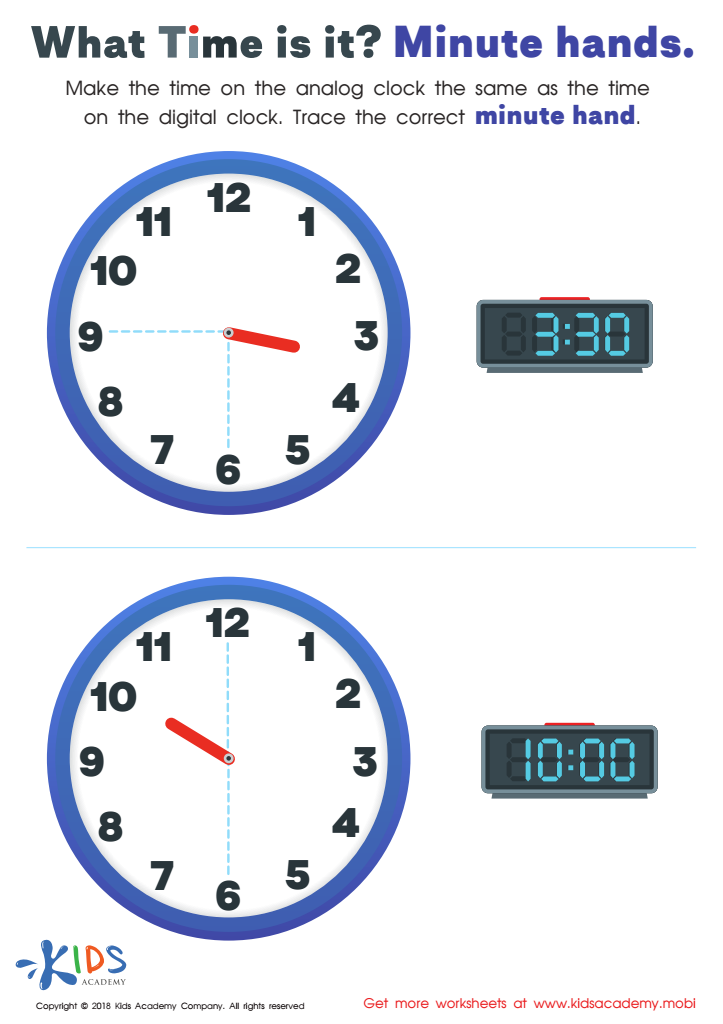
What Time Is it? Minute Hands Worksheet
Help your kids telling time with the minute hand correctly with this tracing sheet. Trace the correct minute hand to make the time on the analog clock the same as the time on the digital clock. Give them a pictured demonstration of how to do it and you'll be all set!
 Assign to My Students
What Time Is it? Minute Hands Worksheet
Worksheet
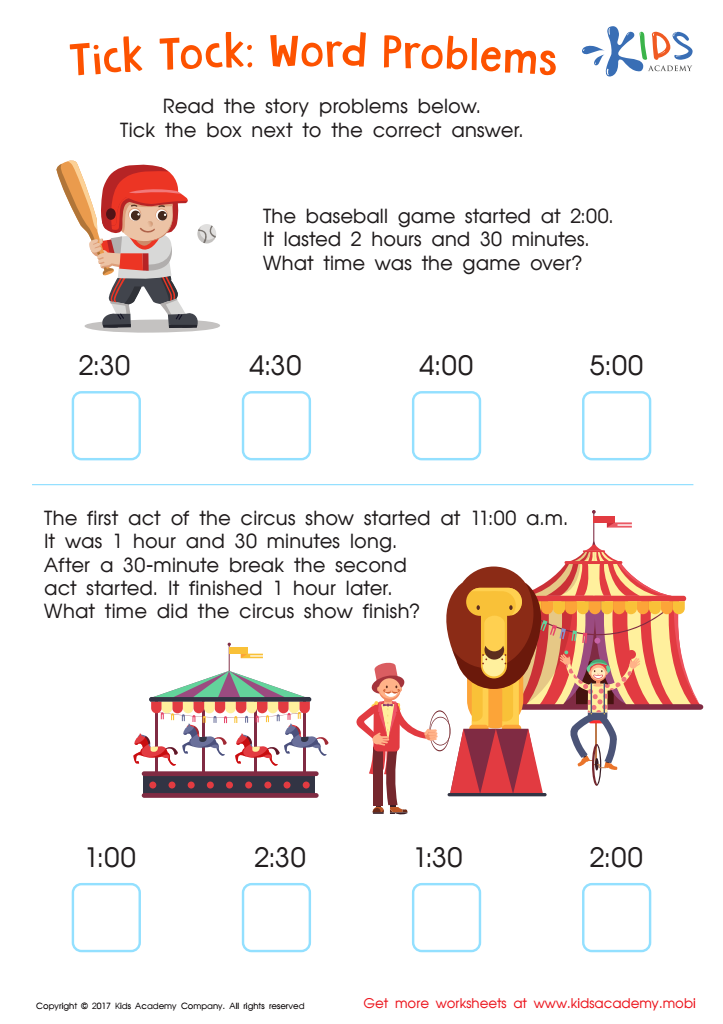
Tick Tock Word Problems Time Worksheet
Mix math and fun with this telling time word problems worksheet! Your child will love solving the events' finishing times using the vivid colors and joyful illustrations. Tick Tock!
Tick Tock Word Problems Time Worksheet
Worksheet
Join Kids Academy for Free
Who is primarily going to use this learning content?







Developing time calculation skills in children aged 7-9 is crucial for several reasons. First, these skills lay the foundation for essential life management abilities. Understanding time helps children grasp daily routines, plan activities, and adhere to schedules, fostering a sense of responsibility and independence.
Secondly, time calculation enhances mathematical proficiency. Learning to read clocks, differentiate between hours and minutes, and solve time-related problems strengthens numerical understanding and improves problem-solving skills. This, in turn, boosts overall academic performance in math and other subjects.
Additionally, mastering time management early on can reduce future stress. Children who can effectively track time are better equipped to balance schoolwork, extracurricular activities, and leisure, leading to healthier, more productive habits.
Social development is another key aspect. When kids understand time, they can better coordinate meetups with friends, remember important dates, and manage their social engagements, enriching their interpersonal relationships.
Finally, digital literacy in our tech-driven world often includes the use of timers, calendars, and scheduling apps. Early familiarity with time concepts aids in the seamless adoption of these modern tools.
In summary, time calculation skills are foundational to both academic and personal success, aiding in effective time management, enhanced mathematical ability, stress reduction, social interaction, and digital literacy. Parents and teachers should prioritize fostering these skills to support well-rounded child development.








