Understanding adjectives Math Worksheets for Ages 7-9
5 filtered results
-
From - To
Discover our engaging "Understanding Adjectives Math Worksheets" tailored specifically for children aged 7 to 9. These interactive resources combine language learning with mathematical concepts, helping young learners identify and use adjectives effectively. Our worksheets encourage critical thinking and creativity, allowing students to practice describing objects, spaces, and scenarios while solving math problems. With clear instructions and colorful visuals, these worksheets make learning fun and accessible. Enhance your child’s vocabulary, comprehension, and problem-solving skills all in one place. Perfect for homeschooling, classroom activities, or supplemental learning, our worksheets foster a deeper understanding of adjectives in a fun and meaningful context.
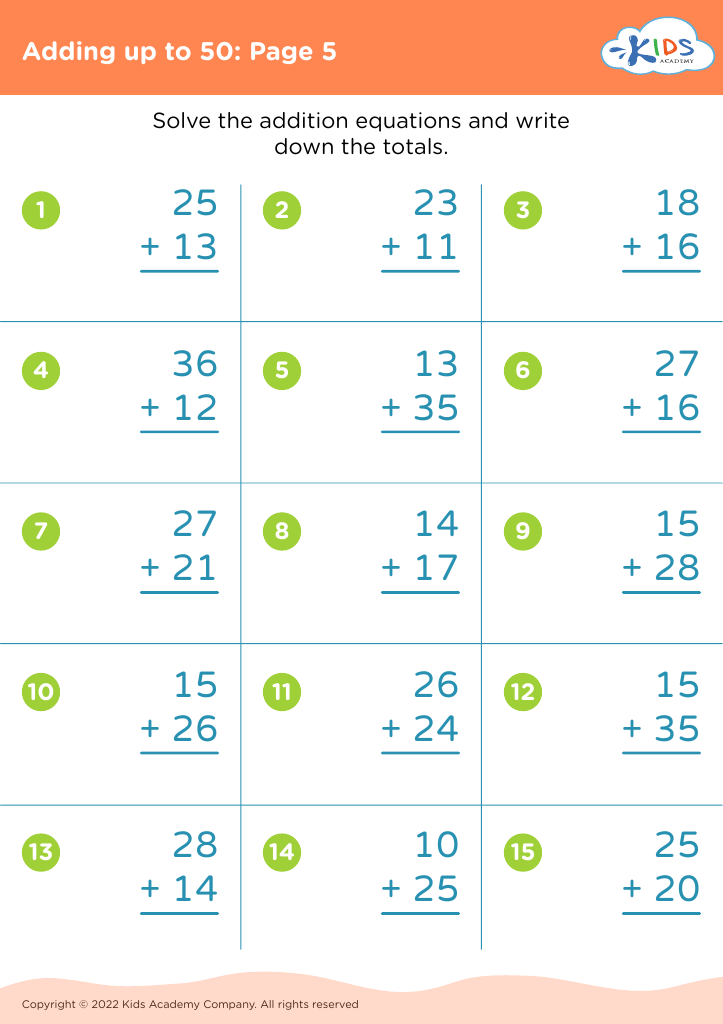








Understanding adjectives in the context of Math for children aged 7-9 is crucial for several reasons. First, adjectives play a significant role in how young learners describe and comprehend mathematical concepts. For instance, when children use descriptive terms like "greater," "smaller," "even," or "odd," they enhance their understanding of numbers and their relationships. This vocabulary enables them to articulate their thought processes more clearly, facilitating discussions in classrooms or at home.
Moreover, following along with word problems often requires children to identify and interpret adjectives. By strengthening their grasp of adjectives, children improve their reading comprehension skills, allowing them to tackle complex problems confidently. This foundational skill also transfers to other subjects, boosting overall academic performance.
Additionally, a solid understanding of adjectives nurtures critical thinking. For example, in geometry, adjectives can describe shapes and sizes, enabling kids to classify objects, understand properties, and make connections between concepts. Helping children grasp these descriptive words fosters a richer math vocabulary and enhances communication skills, supporting social interactions throughout their educational journey.
Involving parents and teachers in this learning process is essential for reinforcing the importance of adjectives, creating a holistic environment that enhances youth learning.








