
Understanding mass Math Worksheets for Ages 7-9
3 filtered results
Difficulty Level
Grade
Age
-
From - To
Subject
Activity
Standards
Welcome to our "Understanding Mass" Math Worksheets designed for children aged 7-9! Our engaging resources help young learners grasp the concept of mass through enjoyable activities and practical applications. The worksheets feature a variety of problems and interactive tasks that will enhance their understanding of measurement units like grams and kilograms. With colorful illustrations and clear instructions, these worksheets cater to different learning styles, making math fun and accessible. Perfect for classroom use or homeschooling, our materials encourage critical thinking and problem-solving skills. Empower your child with the knowledge of mass today—download our worksheets and watch their confidence grow!
Favorites
With answer key
Interactive
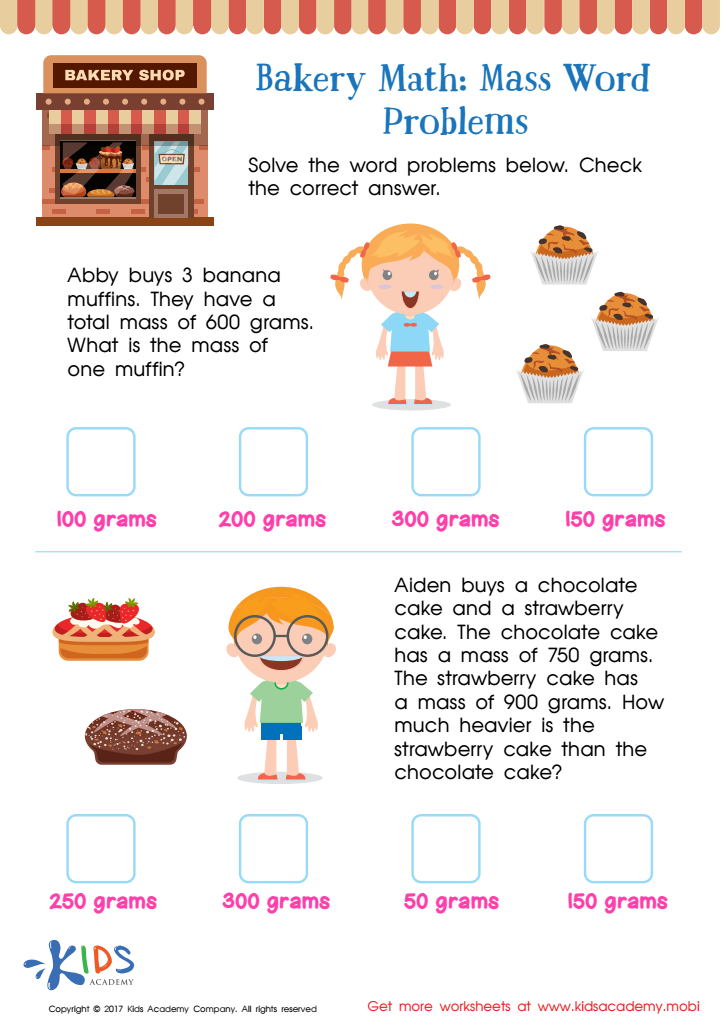
Mass Word Problems Worksheet
This worksheet challenges kids with tricky mass word problems. It offers valuable practice with grams. Through division and subtraction, children gain experience handling mass.
 Assign to My Students
Mass Word Problems Worksheet
Worksheet
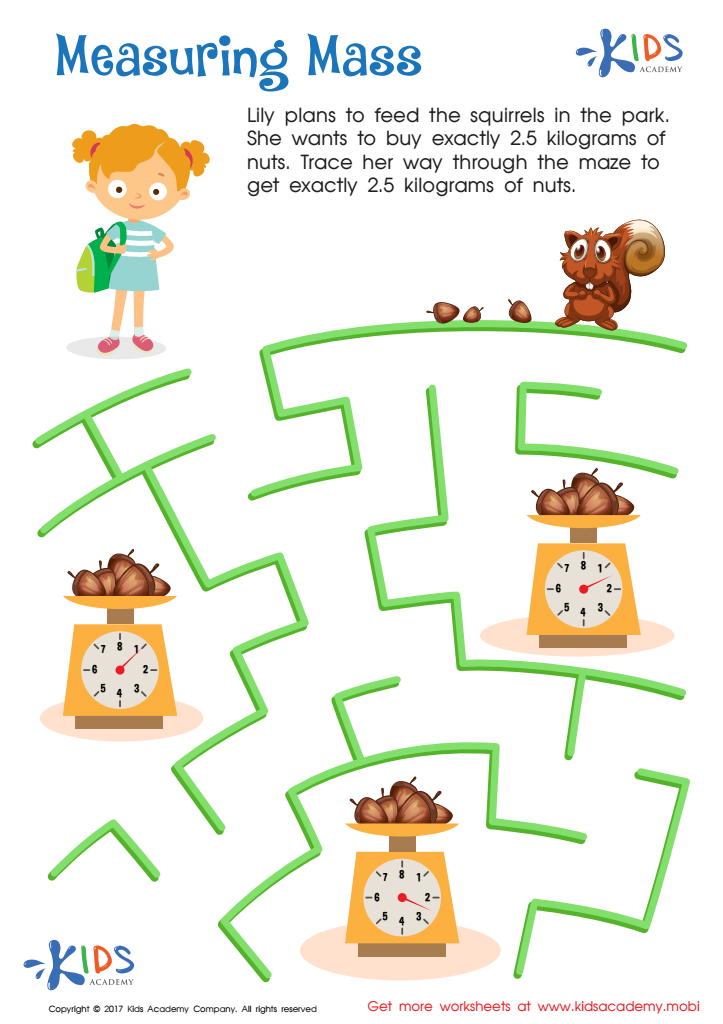
Measuring Mass Worksheet
Lily needs your child's help to find the right number of nuts to feed the squirrels. Ideal for 3rd grade!
Measuring Mass Worksheet
Worksheet
Join Kids Academy for Free
Who is primarily going to use this learning content?






Understanding mass and its applications is crucial for children aged 7-9, as it lays the groundwork for foundational math concepts and real-world problem-solving skills. At this age, kids are starting to explore measurements beyond basic numeracy, learning how to quantify and compare objects. This understanding fosters critical thinking and enhances their ability to navigate everyday situations, such as cooking, shopping, and even understanding science concepts.
For parents and teachers, emphasizing mass helps children make connections between math and practical life experiences. It introduces them to units of measurement, encouraging careful observation and analytical skills when assessing weight in various contexts. This skill is particularly important as it serves as a stepping-stone to more complex mathematical concepts later on, such as volume or mass in science experiments.
Moreover, engaging children in hands-on activities, such as weighing ingredients for a recipe or comparing weights of different objects, can make learning more relatable and enjoyable. By recognizing the importance of mass, parents and teachers can cultivate a greater appreciation for math in children's everyday lives, empowering them with confidence and enabling them to approach various subjects with a more comprehensive skill set. Investing time in understanding mass helps secure a strong educational foundation.








