Understanding quadrilaterals Math Worksheets for Ages 7-9
4 filtered results
-
From - To
Discover our engaging "Understanding Quadrilaterals" math worksheets designed for ages 7-9! These resources make learning about four-sided shapes fun and accessible for young learners. With a variety of exercises, your child will master identifying and classifying different types of quadrilaterals, such as squares, rectangles, and trapezoids. Our worksheets enhance geometry skills while promoting critical thinking and problem-solving. Perfect for classroom or at-home practice, these printable worksheets provide a solid foundation for future math success. Help your child confidently navigate the world of quadrilaterals with our expertly crafted materials. Unlock their potential and make math enjoyable today!
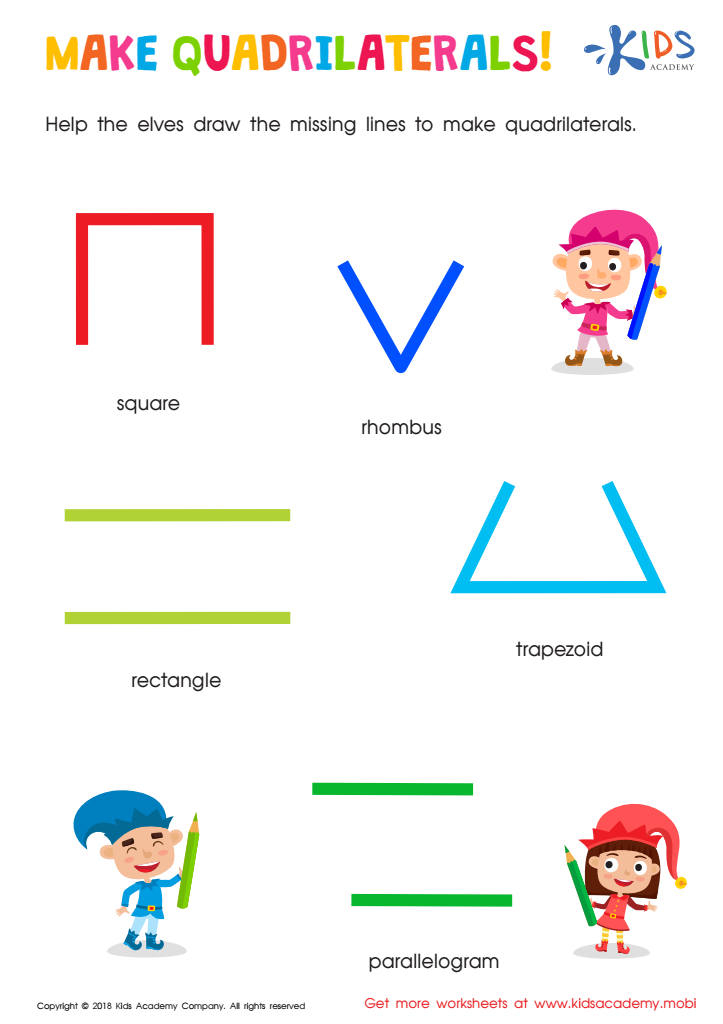
Make Quadrilaterals Worksheet
 Assign to My Students
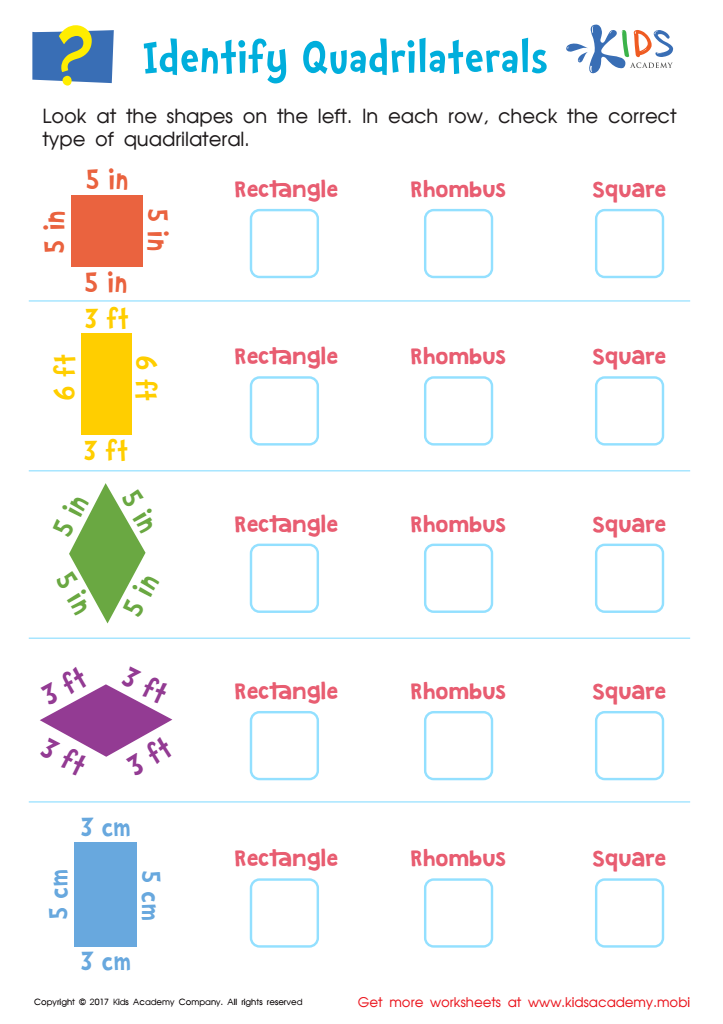
Identify Quadrilaterals Worksheet
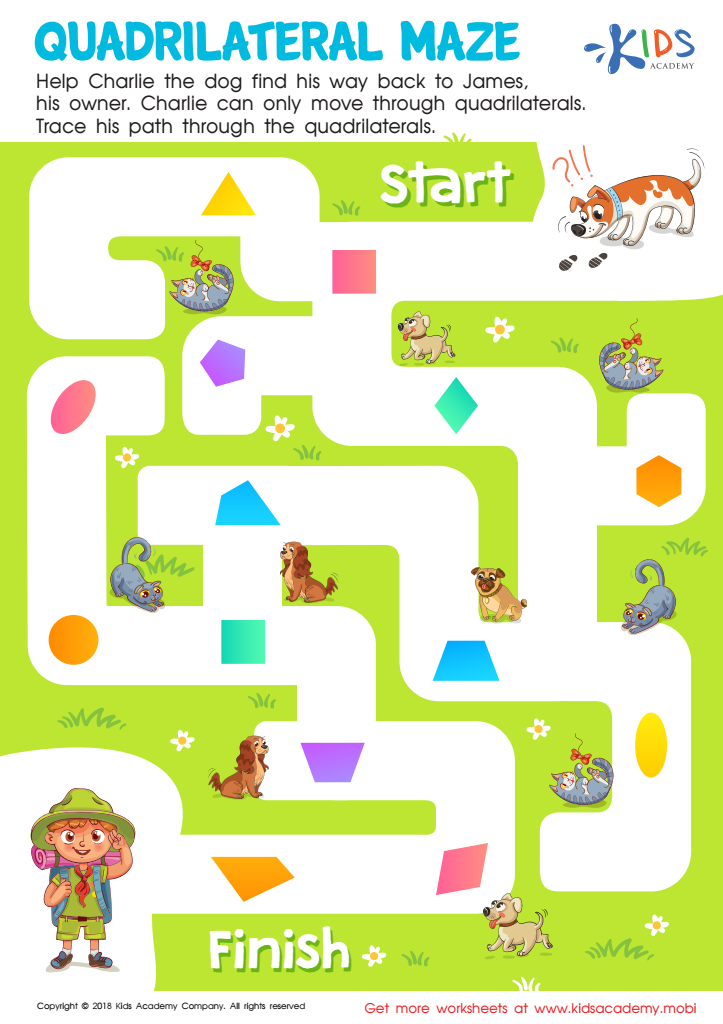
Quadrilateral Maze Worksheet
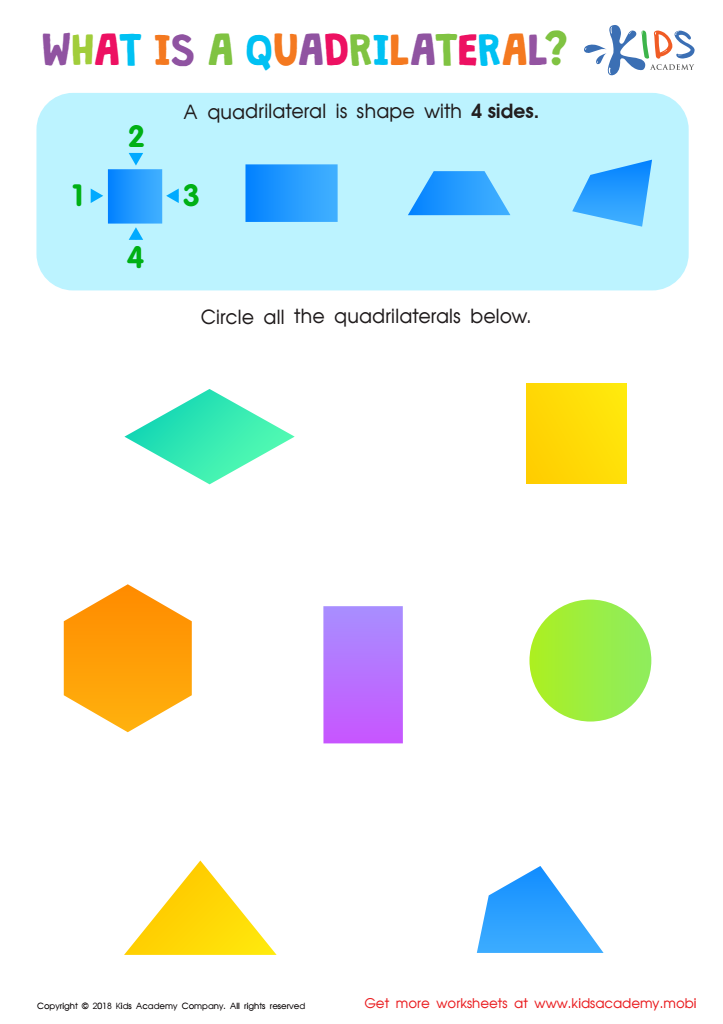
What Is a Quadrilateral? Worksheet








Understanding quadrilaterals is essential for young learners aged 7-9 because it lays a strong groundwork for future mathematical concepts and everyday problem-solving skills. Quadrilaterals, including squares, rectangles, trapezoids, and parallelograms, are a fundamental category of shapes that children encounter regularly. Developing an early comprehension of these shapes promotes not only geometric reasoning but also spatial awareness.
For parents and teachers, fostering this understanding supports children's cognitive development. At this stage, children build critical thinking and improve their ability to classify objects based on their attributes, such as the number of sides or types of angles. This helps in developing organizational and categorization skills, which are crucial across various subjects.
Moreover, a sound grasp of quadrilaterals enhances a child’s confidence in math by providing a stepping stone to more complex topics like area, perimeter, and eventually, higher-dimensional geometry. Practically speaking, children learn to recognize and apply these shapes in their environment, from tiles in a kitchen to pages of a book, making sense of the world around them.
Ultimately, understanding quadrilaterals equips children with a foundational understanding that extends beyond academic performance, nurturing an affinity for mathematics and its real-world applications. By investing in this early learning, parents and teachers pave the way for a child's long-term success in both mathematics and broader analytical skills.








