Understanding symmetry Math Worksheets for Ages 7-9 - Page 2
30 filtered results
-
From - To
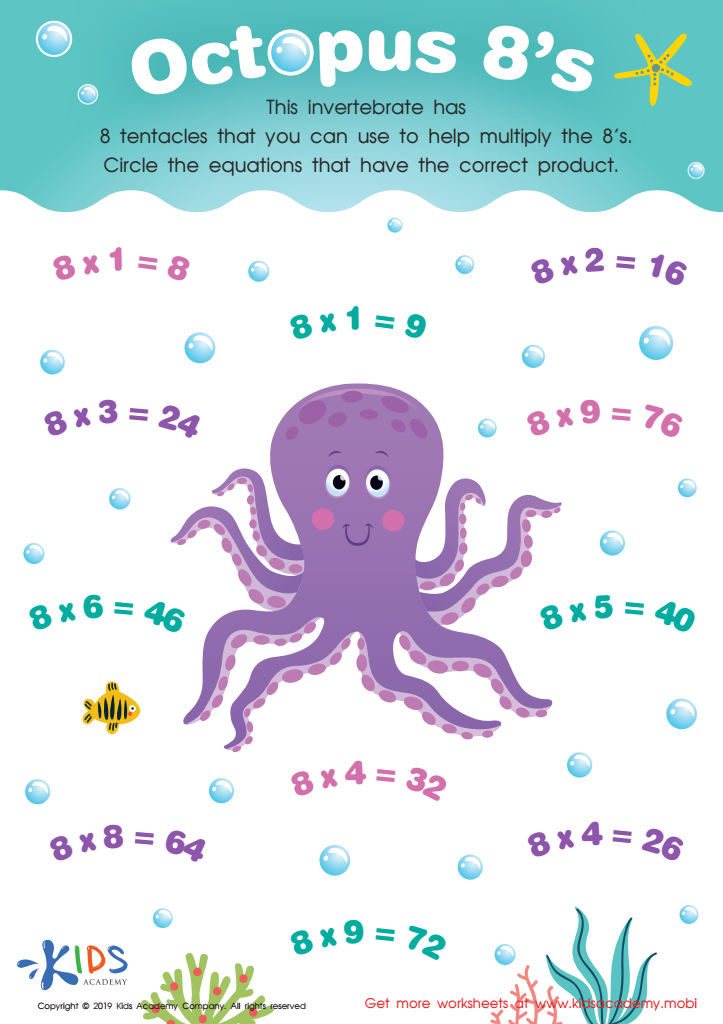
Octopus 8’s Worksheet
 Assign to My Students







Understanding symmetry in math is crucial for children aged 7-9, as it lays the groundwork for their overall cognitive development and mathematical skills. At this stage, children are becoming more proficient in recognizing patterns, shapes, and relationships, and symmetry serves as an engaging entry point into these concepts.
Learning about symmetry sharpens critical thinking and spatial awareness. It encourages children to visualize and manipulate objects, skills that are essential not only in math, but also in fields like engineering, art, and architecture. Symmetry also enhances creativity, as children discover how balance and harmony play roles in both nature and human-made designs.
Furthermore, comprehending symmetry introduces children to more complex mathematical ideas, including geometry and transformations. These foundational concepts lead to improved problem-solving abilities and encourage a growth mindset when facing challenges. As parents and teachers support this exploration, they cultivate a positive attitude towards math, setting students up for future success.
Lastly, engaging with symmetry can be a fun, interactive experience, allowing families and classrooms to bond over hands-on activities. This shared enjoyment fosters a supportive learning environment where children feel encouraged to explore and express their understanding of mathematics.








