
Fraction comparison Building Vocabulary Worksheets for Ages 7-9
6 filtered results
Difficulty Level
Grade
Age
-
From - To
Subject
Activity
Standards
Enhance your child's understanding of fractions with our "Fraction Comparison Building Vocabulary Worksheets" designed for ages 7-9. These engaging worksheets help young learners practice comparing fractions through a variety of interactive exercises. By using relatable examples and visual aids, students will develop their vocabulary related to fractions while gaining confidence in their math skills. Perfect for classroom or homeschooling settings, these worksheets encourage critical thinking and reinforce foundational concepts. Foster a love for math as your child becomes proficient in comparing fractions, paving the way for future success in mathematics. Unlock their potential with our fun and educational resources!
Favorites
With answer key
Interactive
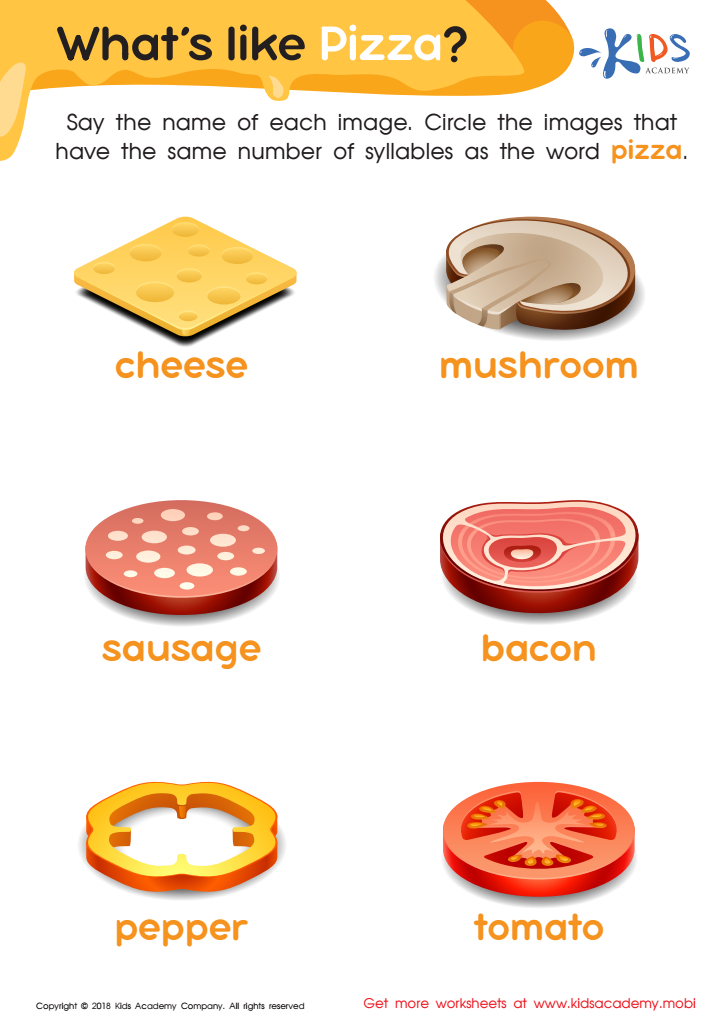
What's Like Pizza? Worksheet
Encourage your kids to exercise their minds with this pizza worksheet! Ask them to name the ingredients they like on their favourite pizzas. Then, help them circle the images that have the same number of syllables as 'pizza'. They'll have fun while learning too!
 Assign to My Students
What's Like Pizza? Worksheet
Worksheet











Join Kids Academy for Free
Who is primarily going to use this learning content?








Understanding fraction comparison is crucial for children aged 7-9 as it lays the foundation for more advanced mathematical concepts and everyday decision-making. Parents and teachers should prioritize building vocabulary related to fractions not only to enhance computational skills but also to improve comprehension. When children learn terms like "numerator," "denominator," "greater than," "less than," and "equivalent," they become more adept at discussing and solving fraction problems. This vocabulary promotes clear communication, enabling kids to better articulate their thought processes.
Moreover, developing a strong vocabulary around fractions helps students establish connections between mathematical concepts and real-life situations, such as measuring ingredients in cooking or dividing items among friends. Engaging students with various vocabulary exercises can also cultivate a deeper understanding of fractions beyond rote memorization.
Lastly, building vocabulary fosters confidence in problem-solving and encourages a growth mindset while dealing with challenging concepts. When students are equipped with the right language, they are less likely to be intimidated by mathematics, making learning more enjoyable and less stressful. By investing in fraction comparison vocabulary, parents and teachers are empowering children for both academic success and practical, real-world functioning.








