Basic geometry knowledge Worksheets for 7-Year-Olds
3 filtered results
-
From - To
Enhance your child's mathematical skills with our engaging Basic Geometry Knowledge Worksheets designed for 7-year-olds. These worksheets provide a fun and interactive way to introduce essential geometric concepts, including shapes, lines, and spatial understanding. Each worksheet is crafted to foster creativity and critical thinking while reinforcing foundational skills in geometry. Perfect for classroom use or at-home practice, these resources encourage youngsters to explore and identify various shapes, improving their understanding of geometry in their everyday world. Empower your child’s learning journey with our thoughtfully designed worksheets that make geometry enjoyable and accessible for young learners!
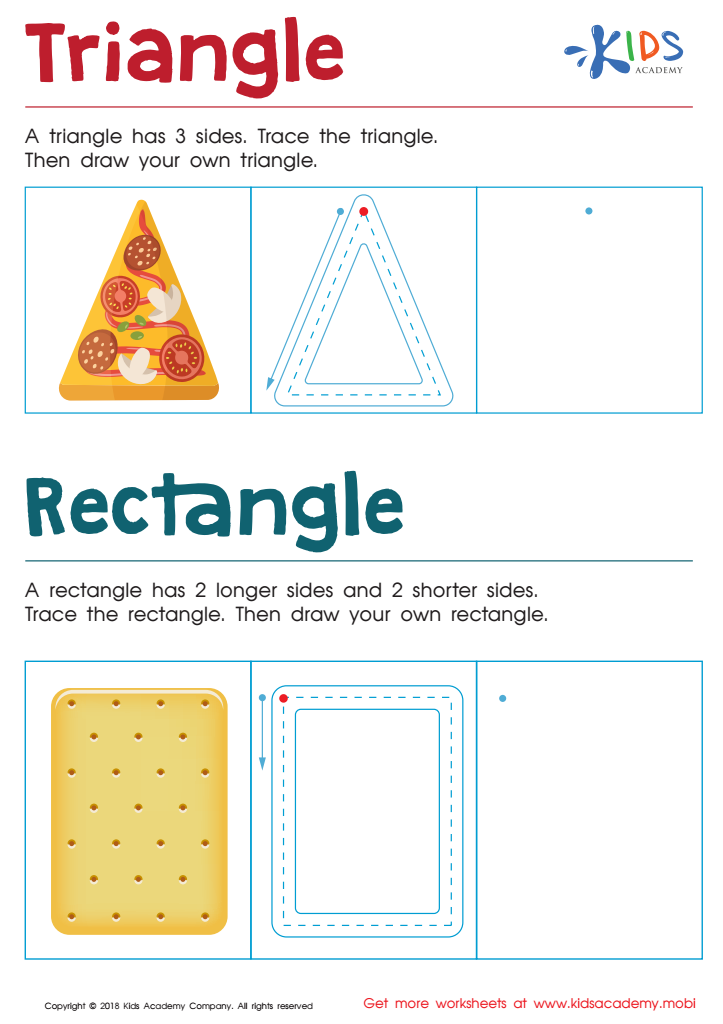
Triangle Rectangle Worksheet
 Assign to My Students
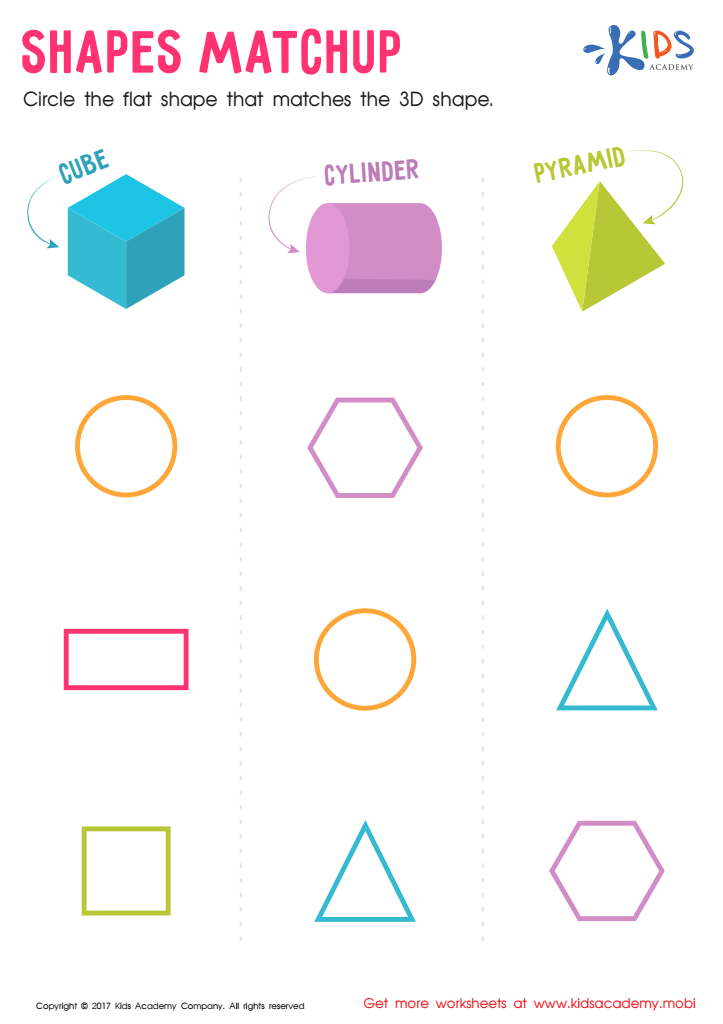
Shapes Matchup Worksheet




.jpg)



Basic geometry knowledge is crucial for 7-year-olds as it lays the foundation for important cognitive and problem-solving skills. At this stage, children are naturally curious, and engaging them with geometric concepts helps sharpen their spatial awareness and critical thinking. Understanding shapes, sizes, and relative positions encourages them to observe their surroundings and develop analytical abilities.
Geometry also plays a significant role in daily life. From recognizing shapes in the environment to understanding time through analog clocks, geometric concepts are ubiquitous. By familiarizing children with basic geometric terms and properties, parents and teachers equip them with essential life skills that support their mathematical learning as they progress to higher grades.
Moreover, introducing geometry early enhances creativity and artistic expression. Many activities, like building with blocks or drawing, rely on geometric understanding, blending mathematical concepts with creative pursuits. This not only broadens a child's learning experience but also fosters a love for math through play and exploration.
Finally, early geometry education helps address potential learning gaps. Foundation knowledge in geometry ensures that students are prepared for more complex mathematical experiences in the future, promoting overall academic success and confidence in mathematics. As such, parents and teachers play a vital role in nurturing these essential skills.








