
Understanding forces Worksheets for 7-Year-Olds
3 filtered results
Difficulty Level
Grade
Age
-
From - To
Subject
Activity
Standards
Explore our engaging "Understanding Forces Worksheets" designed specifically for 7-year-olds! These interactive worksheets introduce young learners to fundamental concepts of forces, such as push and pull, gravity, and friction. With colorful illustrations and simple language, kids will enjoy writing and answering questions that enhance their comprehension of these essential scientific principles. Perfect for classroom use or at-home learning, these worksheets promote critical thinking and encourage curiosity about how forces affect everyday life. Download now to give your child a head start in science while having fun through hands-on activities and problem-solving exercises! Ignite their passion for learning today!
Favorites
With answer key
Interactive
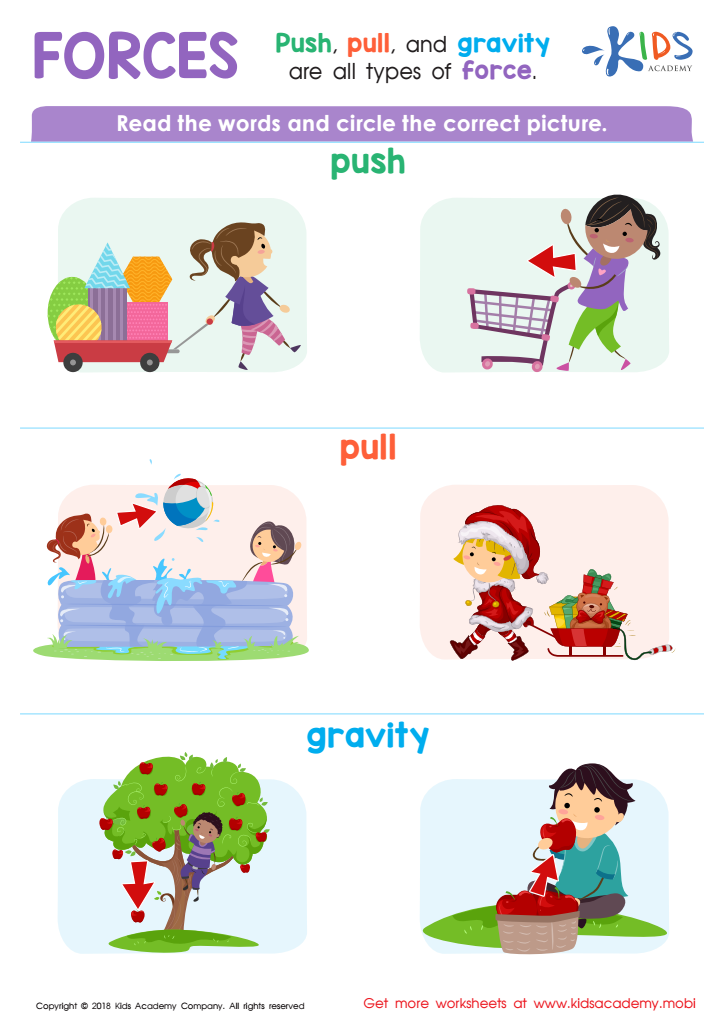
Forces Worksheet
Teach your child about forces! Ask them to identify which of six pictures shows push, pull or gravity. Read the words beside each picture and have them circle the correct one. It's a great way to learn about forces; push, pull and gravity!
 Assign to My Students
Forces Worksheet
Worksheet
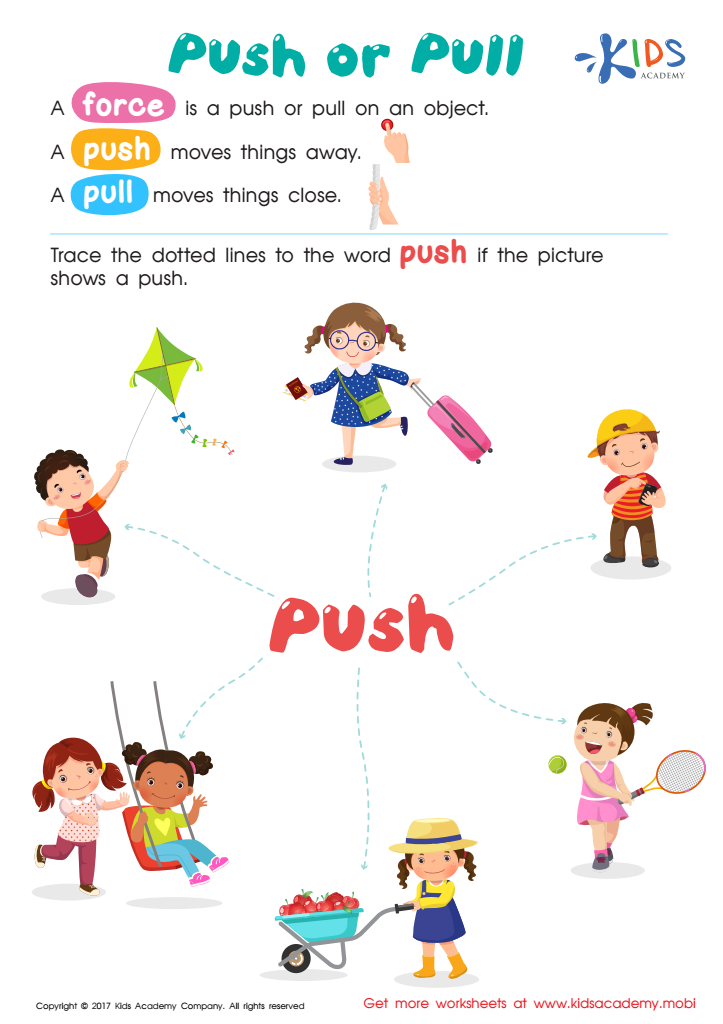
Push or Pull Worksheet
and which involve pulling! With this fun worksheet, your child will learn about force and its simple application in everyday activities. Get them started with Push or Pull! (80 words)
Push or Pull Worksheet
Worksheet
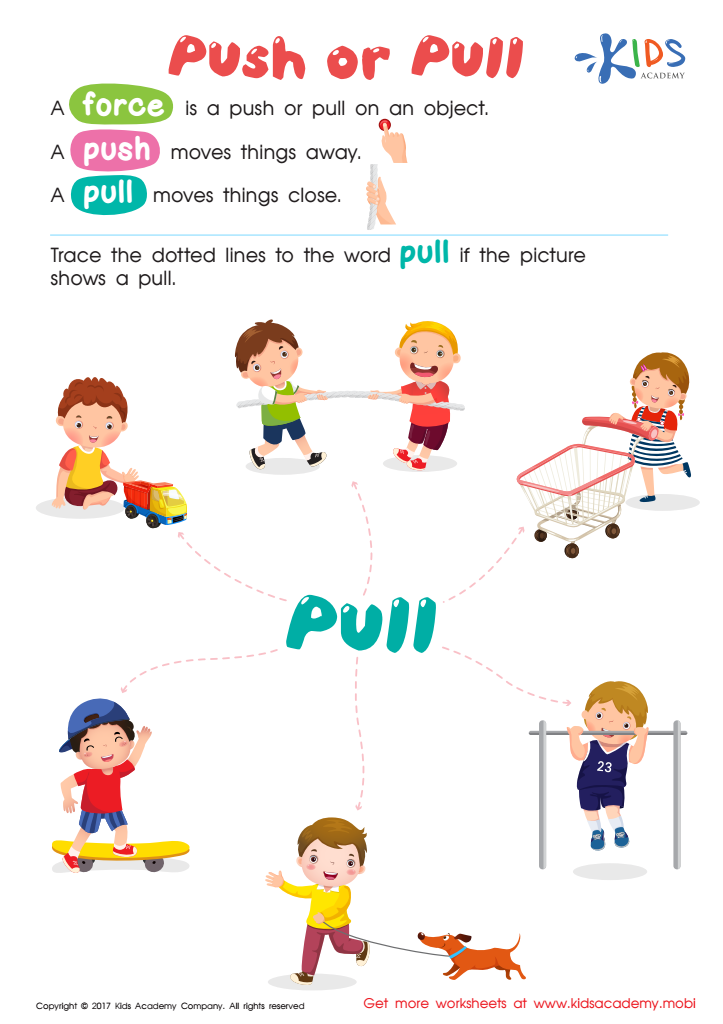
Pull or Push Worksheet
With this fun worksheet, they'll explore physics by sorting objects into categories according to their mode of motion. It's a great way to get them interested in science.
Pull or Push Worksheet
Worksheet
Join Kids Academy for Free
Who is primarily going to use this learning content?





.jpg)
Understanding forces is crucial for 7-year-olds as it lays the foundation for their comprehension of the physical world. At this age, children are naturally curious and eager to explore how things work. By teaching them about forces, such as push, pull, gravity, and friction, parents and teachers can enhance their critical thinking skills and scientific literacy.
Learning about forces helps kids understand everyday phenomena, from riding bikes to playing ball games. It empowers them to ask questions, experiment, and develop problem-solving skills. For example, when a child pushes their toy car, they witness firsthand how the amount of force affects its speed and distance. This hands-on exploration fosters a sense of wonder and encourages a lifelong love of learning.
Moreover, grasping the basics of forces introduces children to fundamental concepts of physics that will be important in higher education. Early exposure to scientific principles encourages inquiry and resilience, equipping children with the tools to tackle challenges in both academic and personal contexts. By prioritizing lessons on forces, parents and teachers are nurturing informed, imaginative, and industrious future thinkers who can navigate, question, and innovate in an increasingly complex world.








