
Comparison Skills Addition Worksheets for 7-Year-Olds
4 filtered results
Difficulty Level
Grade
Age
-
From - To
Subject
Activity
Standards
Boost your child’s math proficiency with our "Comparison Skills Addition Worksheets" designed specifically for 7-year-olds. These engaging worksheets help young learners enhance their addition skills while fostering their ability to compare numbers. Through fun and interactive exercises, children will practice vital comparison concepts, such as identifying larger and smaller values, and mastering greater-than and less-than relationships. Our user-friendly resources support independent learning and build confidence in young mathematicians. Whether used in the classroom or at home, these worksheets make learning math a joyful experience. Help your child navigate the world of numbers with ease and excitement!
Favorites
With answer key
Interactive
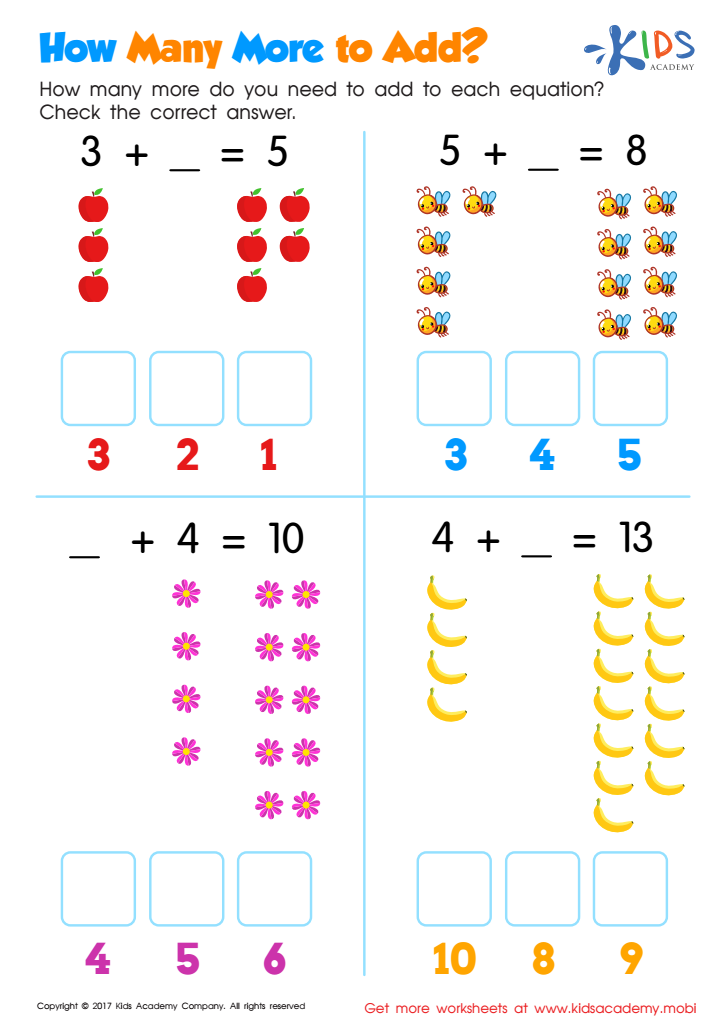
How Many More to Add Worksheet
Sharpen your child's math skills with this pdf worksheet. Help them figure out how many apples, bees, flowers and bananas are needed to reach the answer given. The possible answers are provided at the bottom of the boxes. Have some fun doing some addition and subtraction magic together and get those math skills sharpened!
 Assign to My Students
How Many More to Add Worksheet
Worksheet
Join Kids Academy for Free
Who is primarily going to use this learning content?








Comparison skills in addition are essential for 7-year-olds, as they contribute significantly to their mathematical understanding and overall cognitive development. At this age, children are transitioning from basic arithmetic to more complex problem-solving tasks. Teaching them how to compare numbers helps deepen their comprehension of quantity, which is foundational for later math concepts such as subtraction, multiplication, and division.
When children learn to compare numbers, they develop critical thinking skills. They start to identify relationships between numbers, recognize patterns, and make educated guesses about sums before performing the actual addition. This analytical approach enhances their ability to discuss and reason about math concepts, fostering a deeper understanding than rote memorization alone can provide.
Moreover, comparison skills play a role in real-life decision-making, such as making choices about measurements, budgeting, or evaluating information. By encouraging these skills early on, parents and teachers empower children to become confident math learners who can navigate challenges with confidence.
Ultimately, by focusing on comparison skills, adults help children build a robust mathematical foundation, facilitating smoother transitions into more advanced topics and promoting lifelong learning skills.








