
Basic arithmetic understanding Math Worksheets for 7-Year-Olds
4 filtered results
Difficulty Level
Grade
Age
-
From - To
Subject
Activity
Standards
Explore our engaging Basic Arithmetic Understanding Math Worksheets, specially designed for 7-year-olds! These worksheets provide a fun and interactive way for young learners to master essential math concepts, including addition, subtraction, multiplication, and division. With colorful visuals and varied exercises, our resources help to reinforce number sense and build a strong foundation in arithmetic skills. Each worksheet encourages critical thinking and problem-solving, making learning enjoyable. Perfect for homeschoolers, classroom use, or extra practice at home, these worksheets foster confidence in mathematics while aligning with educational standards. Unlock your child's potential with our comprehensive math materials today!
Favorites
With answer key
Interactive
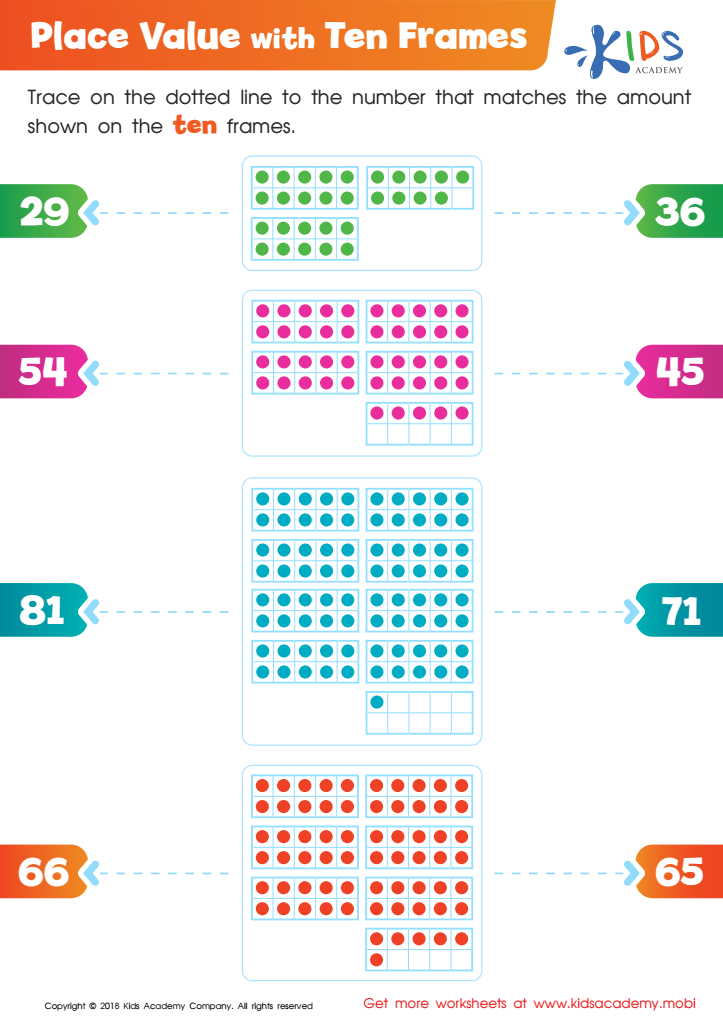
Place Values with Ten Frames Worksheet
Assist your child in counting the dots in each of the framed numbers. Then, guide them as they trace the dotted lines to the number that matches the amount shown. This worksheet will help them learn more about mathematics, as well as how to count numbers.
 Assign to My Students
Place Values with Ten Frames Worksheet
Worksheet
Join Kids Academy for Free
Who is primarily going to use this learning content?








Basic arithmetic understanding is crucial for 7-year-olds for several compelling reasons that concern both parents and teachers. At this age, children are transitioning from concrete to more abstract thinking. A solid foundation in arithmetic helps them grasp fundamental concepts of addition, subtraction, multiplication, and division, fostering their confidence and problem-solving abilities. Early mastery enables them to tackle more complex math concepts in subsequent grades, establishing a strong educational trajectory.
Moreover, arithmetic skills are essential beyond the classroom. Everyday life activities, such as shopping, budgeting, or cooking, often involve basic math. By instilling these skills early, parents and teachers prepare children for practical, real-world applications of mathematics. This competence not only promotes independence but also encourages a positive attitude toward learning.
Additionally, research indicates that early math proficiency correlates with academic success throughout a child's educational journey. Engaging children in fun, interactive activities that promote arithmetic understanding can enhance their logical reasoning and critical thinking skills. Investing time and resources in nurturing a strong arithmetic foundation allows parents and teachers to cultivate lifelong learners—children who are well-equipped to face future challenges, both academically and personally. Thus, prioritizing arithmetic understanding is not just beneficial; it is vital for a child's overall development.








