
Comparing shapes Math Worksheets for 7-Year-Olds
5 filtered results
Difficulty Level
Grade
Age
-
From - To
Subject
Activity
Standards
Introducing our engaging "Comparing Shapes Math Worksheets" designed specifically for 7-year-olds! These worksheets provide a fun and interactive way for young learners to explore the world of shapes through comparison activities. Students will enhance their critical thinking skills by identifying similarities and differences between various shapes, such as circles, squares, triangles, and more. With vibrant illustrations and age-appropriate challenges, our worksheets make math enjoyable and accessible. Ideal for classroom use or at-home learning, these resources will help kids build a strong foundation in geometry while sparking their curiosity. Start comparing shapes today and watch your child's confidence soar!
Favorites
With answer key
Interactive
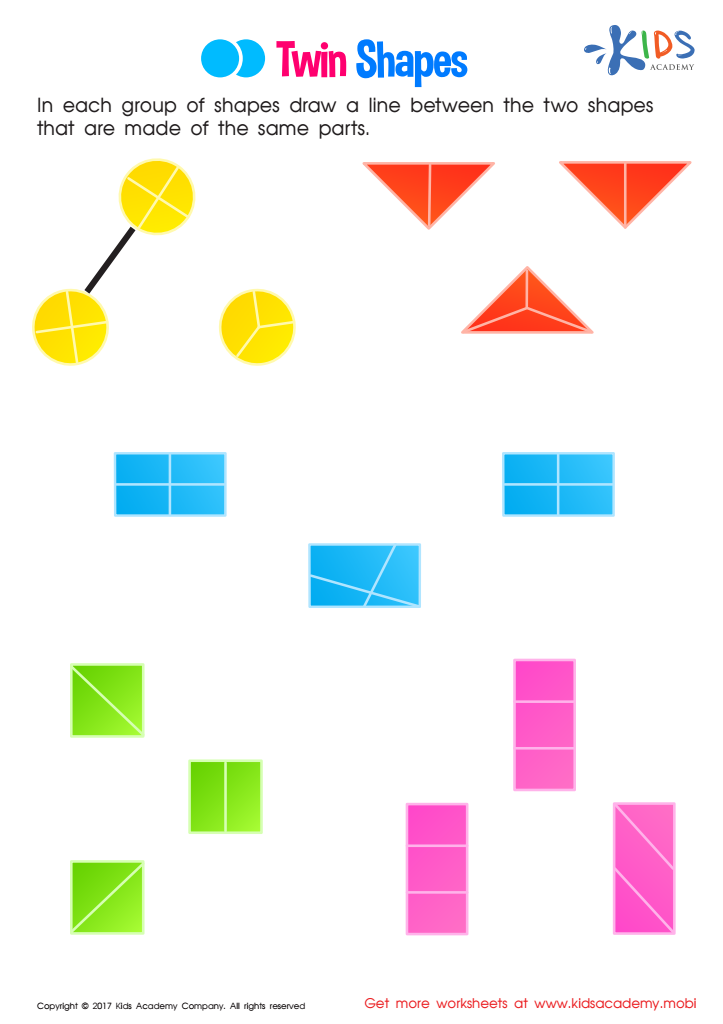
Twin Shapes Worksheet
Your students' goal in this worksheet is to find the twin shapes: drawing a line between two shapes made of the same parts. Likely, the first shapes encountered were circles, triangles, rectangles and squares - examples of which are seen frequently in everyday life. Encourage them to apply what they know and work out which is the twin shape!
 Assign to My Students
Twin Shapes Worksheet
Worksheet
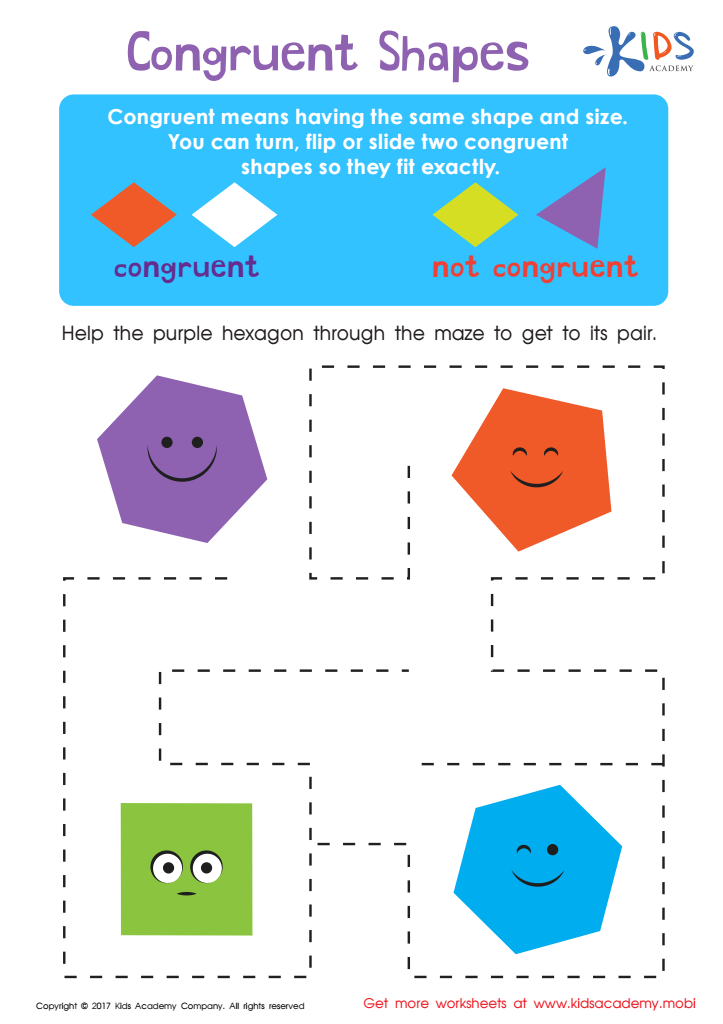
Congruent Shapes Worksheet
Help your child find the twin of the purple hexagon! This congruent shapes worksheet is great for increasing vocabulary while challenging mental rotation skills.
Congruent Shapes Worksheet
Worksheet
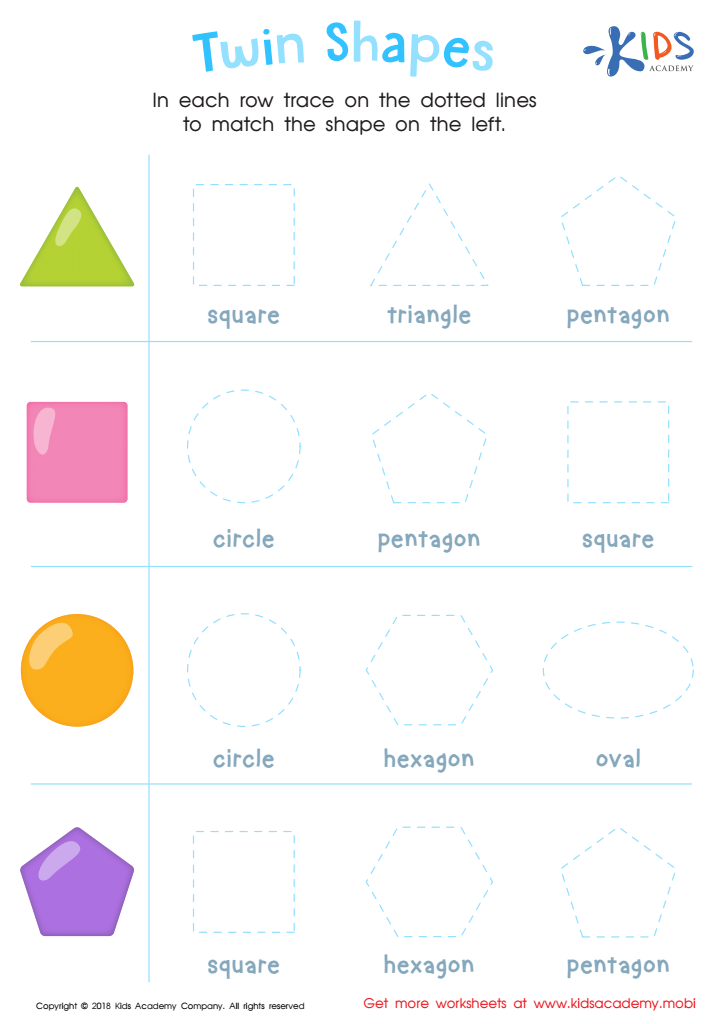
Twin Shapes Dot-to-Dot Worksheet
Test your child's ability to copy with this worksheet. Ask them to find and name the four shapes on the left. Then, they must match each with the dotted lines on the right. Help your child with all four shapes in this fun exercise.
Twin Shapes Dot-to-Dot Worksheet
Worksheet
Join Kids Academy for Free
Who is primarily going to use this learning content?







Comparing shapes is a fundamental mathematical skill that serves as a building block for a child's overall cognitive development, particularly for 7-year-olds. At this age, children are naturally curious and actively exploring their environment, making it an ideal time for them to engage with geometric concepts. By comparing shapes, children learn to identify differences and similarities, develop critical thinking skills, and enhance their problem-solving abilities.
In addition, this activity promotes spatial awareness, which is essential for understanding more complex mathematical concepts in later years, such as area, volume, and symmetry. Moreover, shape comparison integrates elements of language development; children learn to describe shapes using appropriate vocabulary, fostering effective communication skills.
For parents and teachers, encouraging shape exploration also invites opportunities for hands-on learning through play and interaction, whether by using simple household items or structured activities. This makes math engaging and relatable, reducing math anxiety and building a positive attitude towards the subject. Ultimately, supporting children's understanding of shapes will not only nourish their mathematical journey but also lay a well-rounded foundation for their analytical skills as they progress through their education. Thus, caring about this aspect of math is essential for holistic child development.








