
Pattern recognition Math Worksheets for 7-Year-Olds
10 filtered results
Difficulty Level
Grade
Age
-
From - To
Subject
Activity
Standards
Unlock the power of patterns with our engaging Pattern Recognition Math Worksheets designed for 7-year-olds! These expertly crafted worksheets help young learners enhance their critical thinking and problem-solving skills through fun and interactive activities. By identifying, analyzing, and creating patterns, children strengthen their foundational math skills while enjoying the process. Perfect for classroom or at-home use, our worksheets cover a variety of patterns involving shapes, numbers, and colors. Foster your child's love for math with challenging yet enjoyable exercises that transform learning into an exciting adventure. Visit us and discover the wonderful world of patterns today!
Favorites
With answer key
Interactive
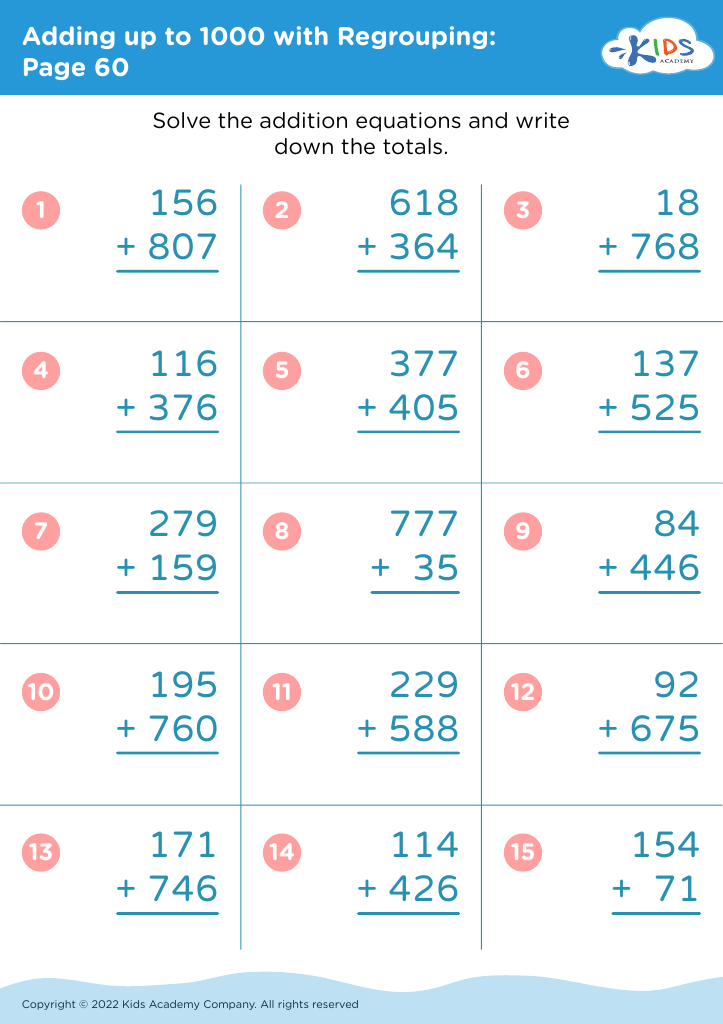
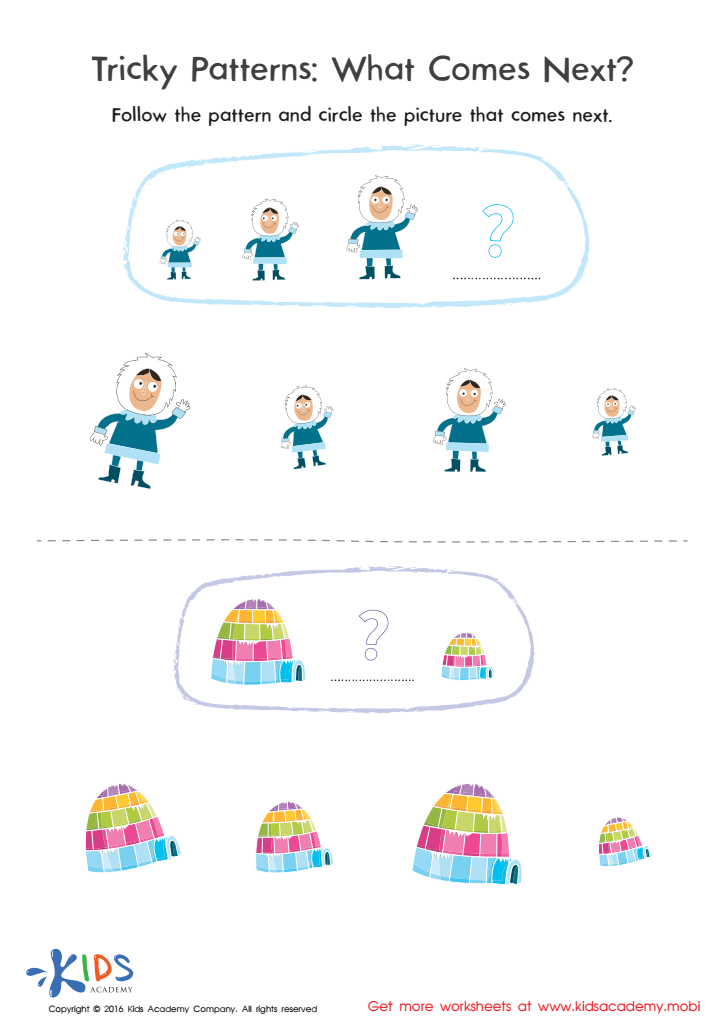
Tricky Patterns Size Worksheet
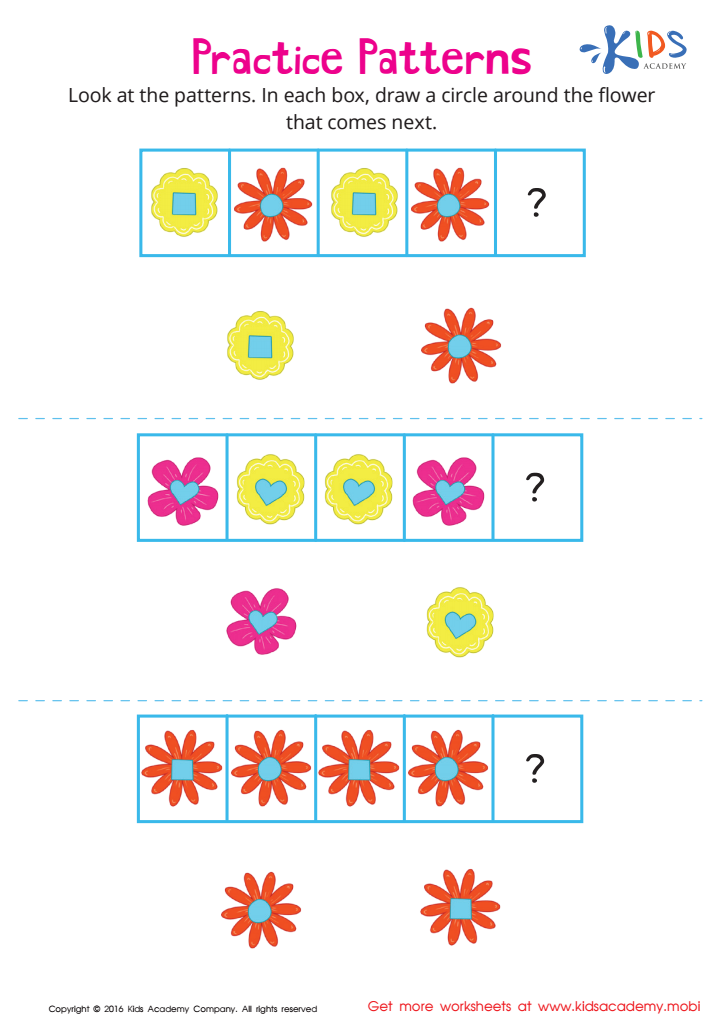
Give your child a head start on critical thinking with this picture pattern worksheet! It's an intriguingly fun way to help them master important skills like spatial reasoning, critical thinking, and logical reasoning. They'll differentiate between shapes, complete the pattern with a logical answer, and look for and understand patterns. It's the perfect foundation for future math skills, setting them up for future success!
 Assign to My Students
Tricky Patterns Size Worksheet
Worksheet
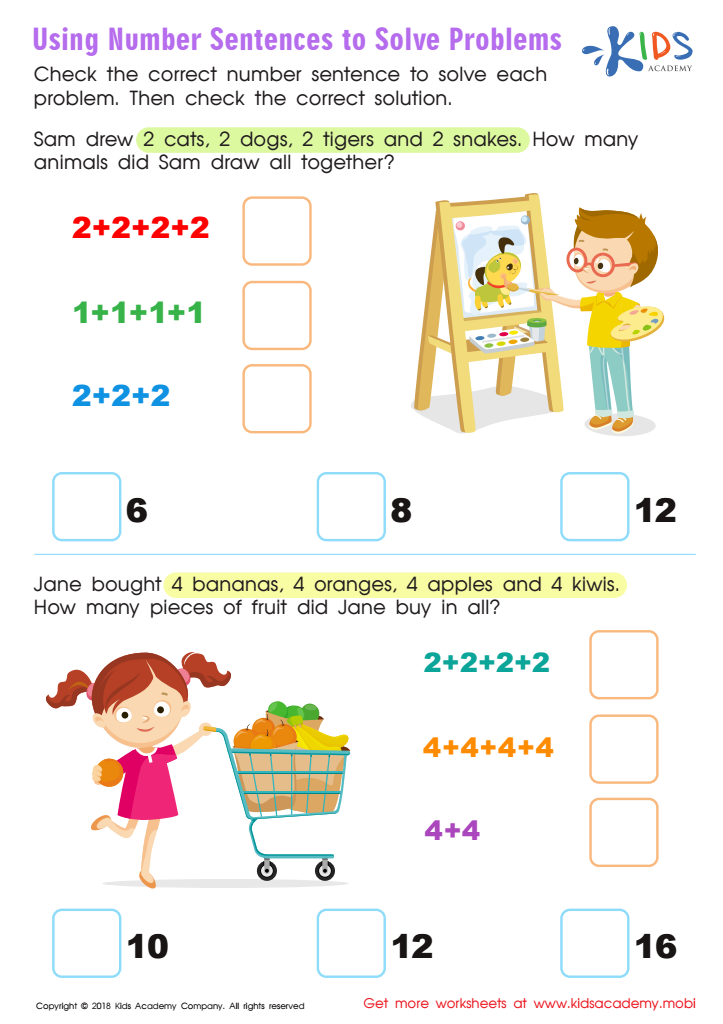
Using Number Sentences to Solve Problems Worksheet
Solving math problems requires an efficient strategy. Picture representation can help young mathematicians with basic addition problems, especially when it involves repeated addends. As they gain confidence, they'll be able to apply their number sentence solving abilities to more complex equations.
Using Number Sentences to Solve Problems Worksheet
Worksheet
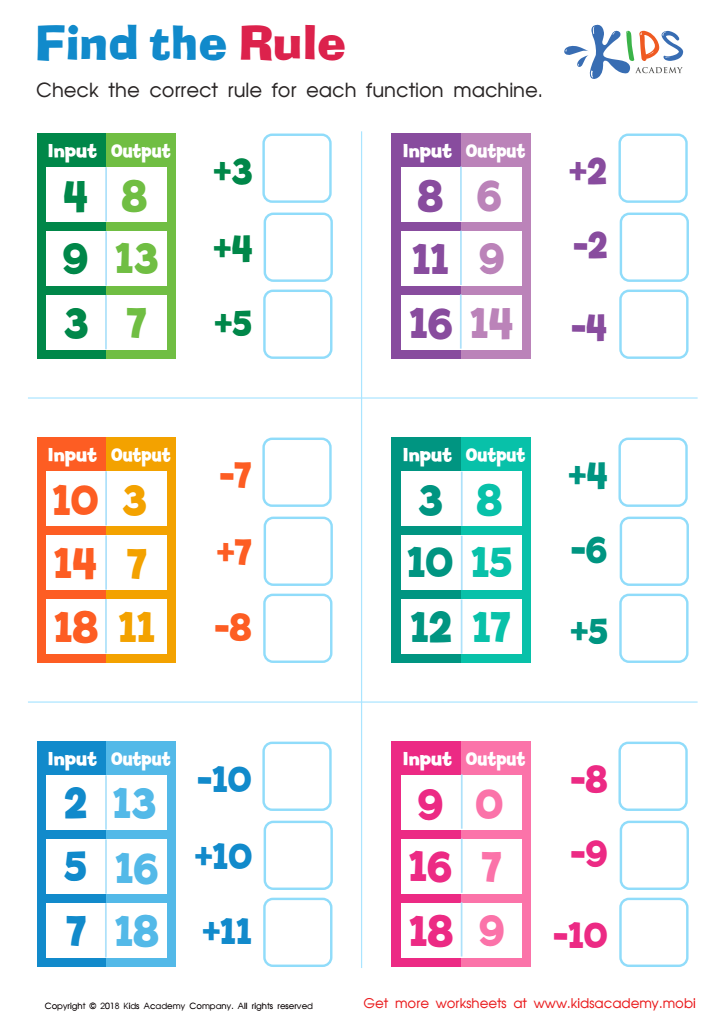
Find the Rule Worksheet
A function machine is an elementary math tool used to find an output by applying a rule, like addition or subtraction, to an input. Children use the diagram to understand the relationship between each input and output, with this worksheet helping them to analyze the machine and find the rule being used.
Find the Rule Worksheet
Worksheet
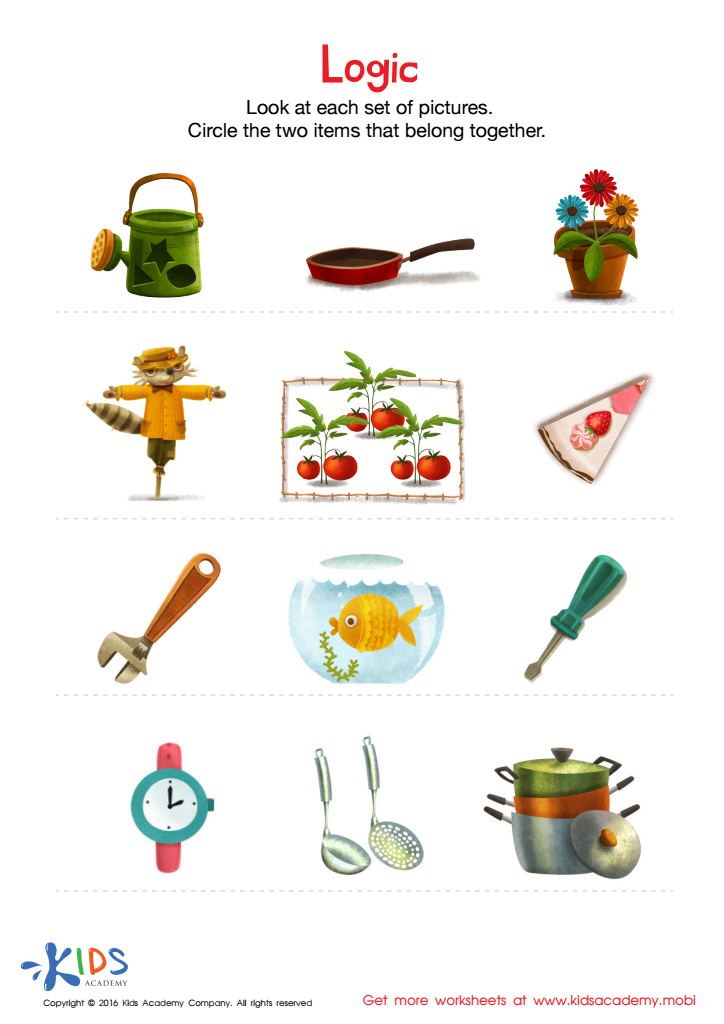
Logic Game Sorting Worksheet
Start your child's logic and reasoning development early with this fun matching worksheet! Through cute images and simple conversations, your little one can learn problem-solving, categorization, and matching skills. Plus, it's a great way for children to explore how items are used in real life. Try it and watch them boost skills with ease and fun!
Logic Game Sorting Worksheet
Worksheet
Join Kids Academy for Free
Who is primarily going to use this learning content?








Pattern recognition is a vital component of early mathematical development and has significant implications for the cognitive growth of 7-year-olds. At this tender age, children are beginning to form foundational thinking skills that will support various aspects of learning in later years. Recognizing patterns enhances a child's ability to detect order, predict outcomes, and establish a sense of symmetry and structure, which are the basic building blocks for higher-level mathematics and logical reasoning.
When parents or teachers prioritize pattern recognition skills, they contribute to strengthening children's number sense, which involves understanding numbers' relationships and values. This skill not only supports mathematical concepts such as addition, subtraction, multiplication, and division but also extends to real-life problem-solving. For instance, discerning patterns helps in daily tasks such as organizing belongings, following schedules, and even in creative activities like music and art, where rhythm and visual patterns play a crucial role.
Moreover, engaging in pattern recognition activities fosters a sense of achievement and boosts children's confidence in their ability to solve problems independently. Providing a well-rounded approach to education, focusing on pattern recognition, ensures a strong foundation for future academic success and cognitive capabilities, ultimately laying the groundwork for a lifelong appreciation and understanding of mathematics.








