Recognizing shapes Math Worksheets for 7-Year-Olds - Page 2
32 filtered results
-
From - To
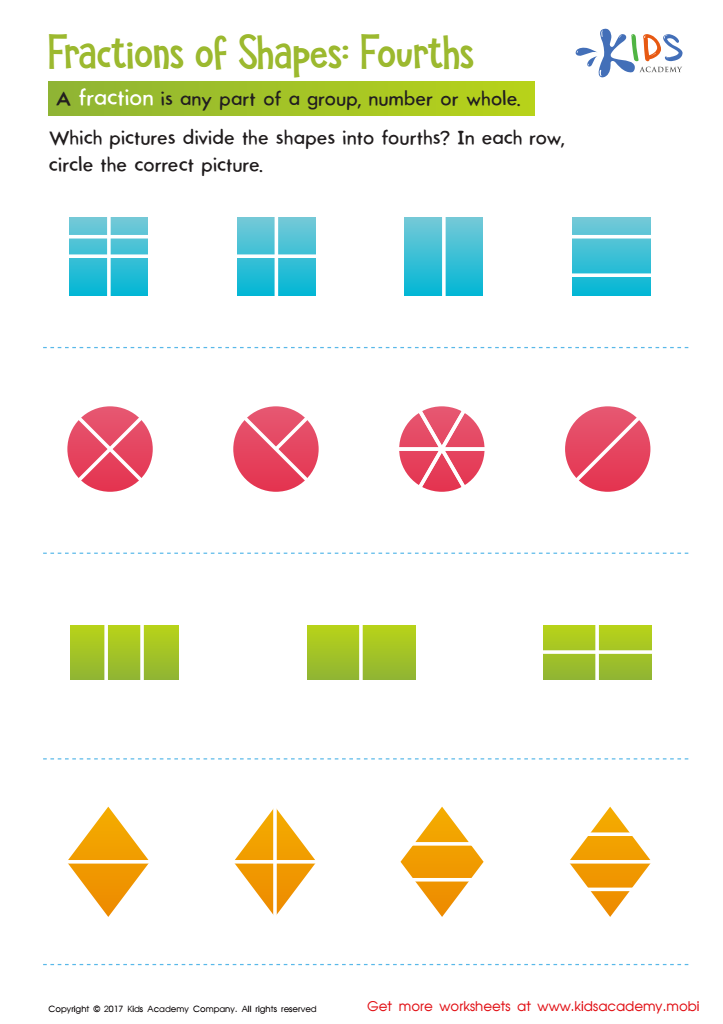
Fractions of Shapes Worksheet
 Assign to My Students








Recognizing shapes is a fundamental math skill that has far-reaching implications for a 7-year-old's cognitive development and everyday life. At this age, children are not only developing basic geometric understanding but also cultivating critical thinking and spatial awareness. Teachers and parents should care about this skill because it lays the groundwork for more advanced math concepts, such as measurement, fractions, and problem-solving, which will be crucial as the child progresses through school.
Shape recognition also plays a role in enhancing observational skills; as kids learn to identify and categorize shapes, they become more attentive to their environment. This attentiveness can foster creativity in art and design, as children learn to manipulate shapes in various contexts. Furthermore, understanding shapes is beneficial for everyday activities, from organizing objects to basic engineering tasks, thus preparing them for real-world applications.
Ultimately, by prioritizing shape recognition in early education, teachers and parents are ensuring a well-rounded curriculum that promotes logical reasoning, effective communication, and a foundational appreciation for math. Building these skills in early childhood empowers children, enriches their learning experiences, and sets them up for future academic success.








