
Understanding time Time Worksheets for 7-Year-Olds
3 filtered results
Difficulty Level
Grade
Age
-
From - To
Subject
Activity
Standards
Explore our "Understanding Time Worksheets for 7-Year-Olds" to help young learners grasp the essential concept of time. Designed with engaging activities, these worksheets cover reading clocks, understanding hours and minutes, and differentiating between AM and PM. Our resources encourage kids to practice time-telling skills through fun illustrations and interactive exercises, reinforcing their learning in a playful way. Perfect for classroom use or at-home practice, these worksheets are an invaluable tool for building confidence and comprehension in time management. Your 7-year-old will enjoy mastering this crucial skill while developing a strong foundation in math! Download and start learning today!
Favorites
With answer key
Interactive
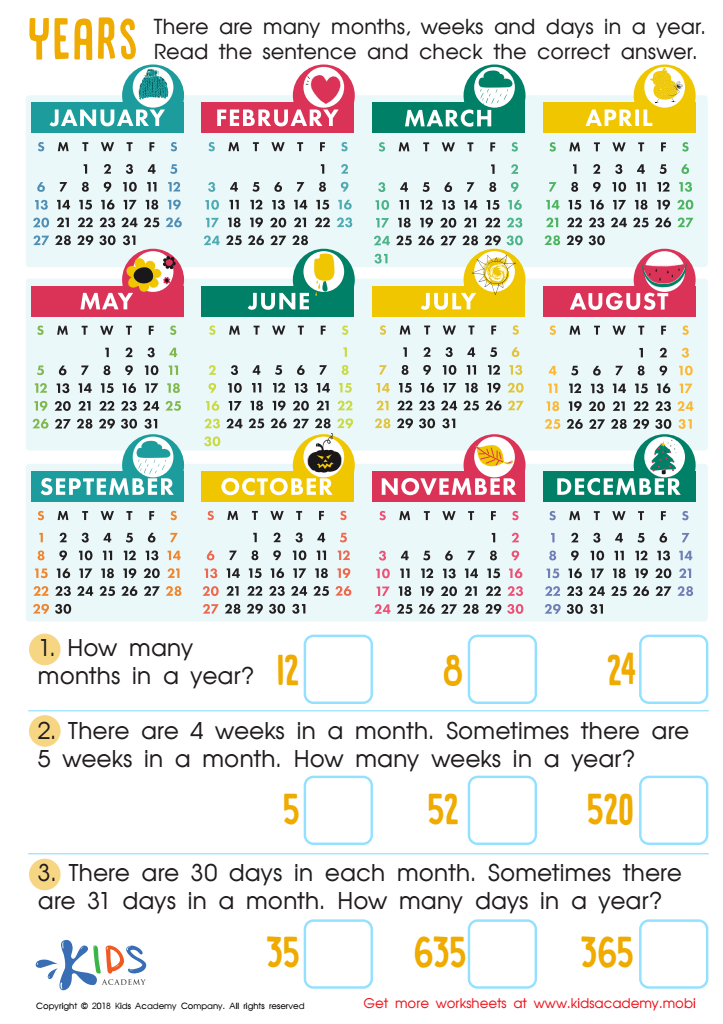
Years Worksheet
This worksheet is a great way to test your children's knowledge of the calendar. Ask them if they can name the days of the week and months in a year. Read and discuss the questions with them and help them find the right answers. Encourage them to check their answers.
 Assign to My Students
Years Worksheet
Worksheet
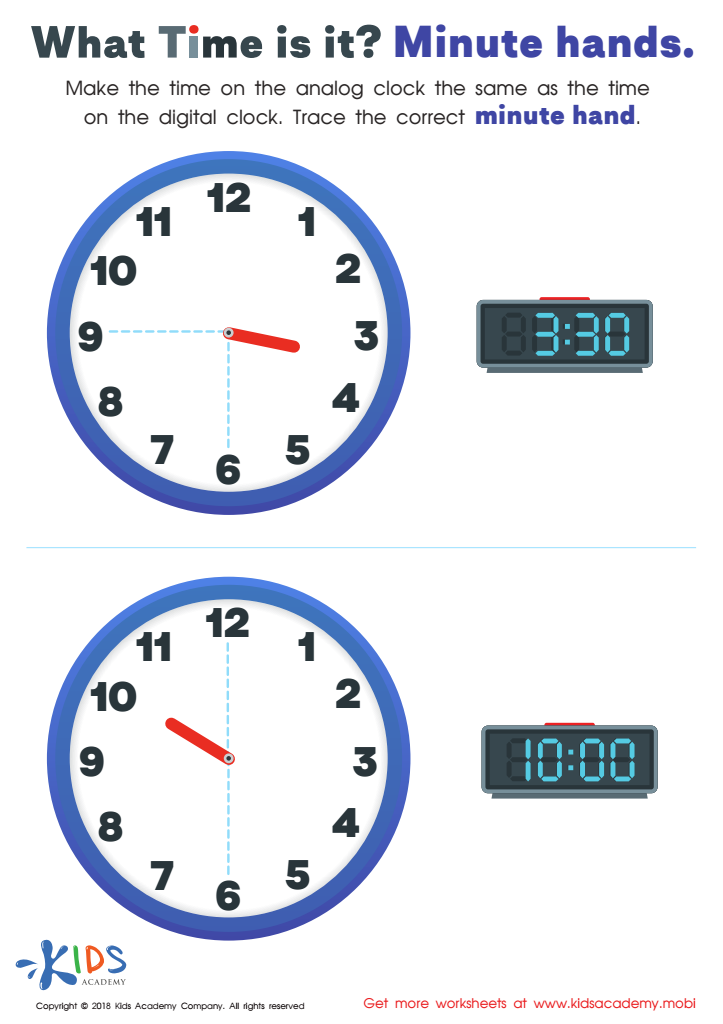
What Time Is it? Minute Hands Worksheet
Help your kids telling time with the minute hand correctly with this tracing sheet. Trace the correct minute hand to make the time on the analog clock the same as the time on the digital clock. Give them a pictured demonstration of how to do it and you'll be all set!
What Time Is it? Minute Hands Worksheet
Worksheet
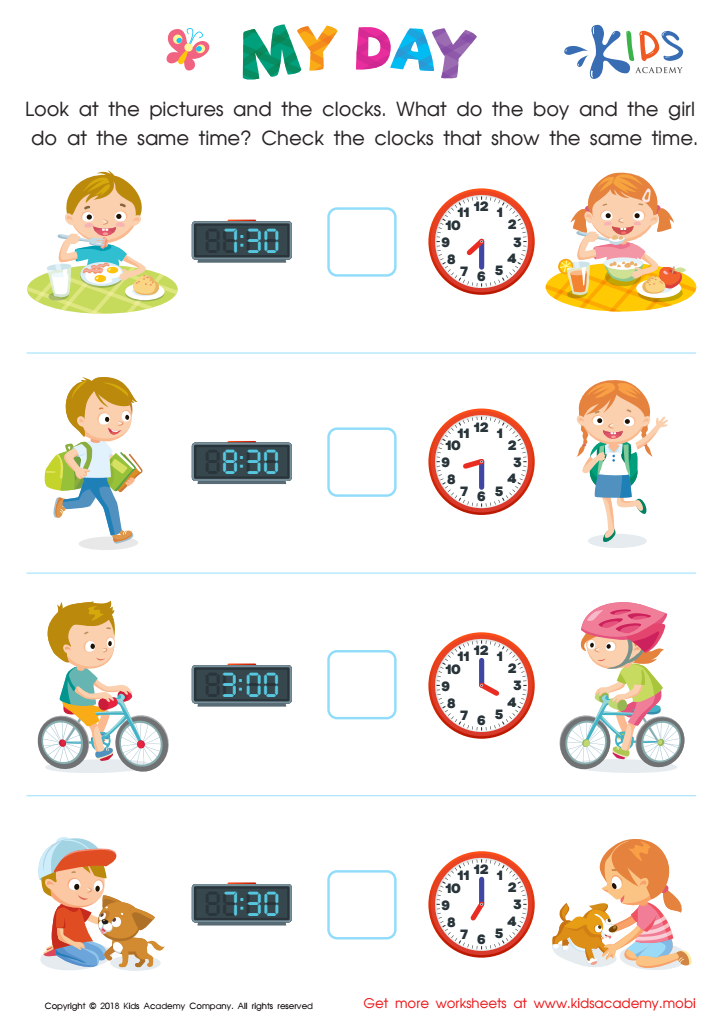
My Day Worksheet
Show your students the pictures and clocks in the colorful worksheet. Ask what the boy and girl are doing in each, then what time the clocks show. Finally, ask what activities they both do at the same time. Help them check the clocks showing the same time in both pictures.
My Day Worksheet
Worksheet
Join Kids Academy for Free
Who is primarily going to use this learning content?







Understanding time is fundamental for the cognitive and social development of 7-year-olds, making it a key area of focus for parents and teachers. At this age, children are beginning to grasp not just the concept of time but also its relevance to daily life, routines, and future planning. Learning to tell time fosters critical thinking and problem-solving skills, helping children to understand sequences of events and manage their responsibilities effectively.
Moreover, time management instills a sense of independence and confidence. Children who understand how to read a clock and appreciate the passage of time can follow schedules, navigate transitions between activities smoothly, and develop good habits around delays and deadlines.
Socially, understanding time facilitates better interactions with peers; for example, knowing when to be on time for playdates or school. It also forms the basis for understanding broader concepts, such as day and night, seasons, and the importance of punctuality.
Encouragement from parents and teachers is vital. Engaging children in discussions about time, using practical lessons to reinforce learning, and incorporating relevant activities can help deepen their understanding. Cultivating this skill is beneficial for academic success and life skills and contributes to the child's eventual ability to navigate the world confidently.








