Reading analog clocks Worksheets for Ages 8-9
5 filtered results
-
From - To
Enhance your child's time-telling skills with our Reading Analog Clocks Worksheets, designed specifically for ages 8-9. These engaging and educational resources help young learners master the concept of time using analog clocks. Each worksheet encourages practice in reading clock faces, identifying hour and minute hands, and solving real-life time problems. With a variety of activities, including matching times, coloring, and puzzles, students will gain confidence in their ability to read and interpret clocks. Reinforce essential math skills and make learning fun! Perfect for classroom use or home study, help your child become a time-telling expert today.
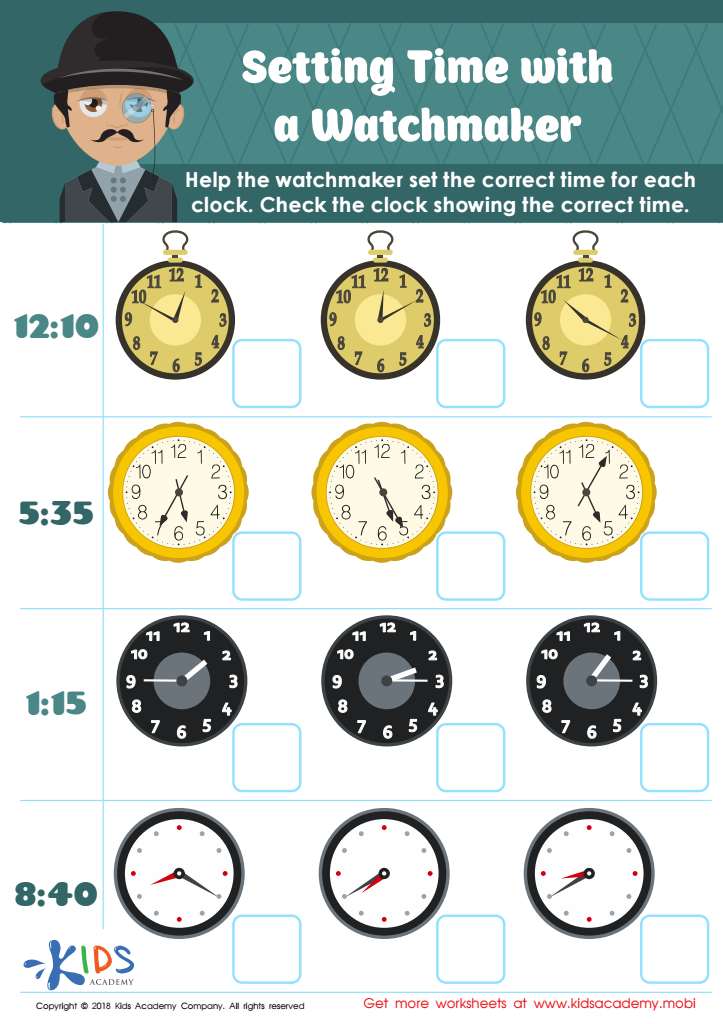
Setting Time with Watchmaker Worksheet
 Assign to My Students







.jpg)
Reading analog clocks is an essential skill for children ages 8-9, as it fosters not only time-telling abilities but also critical cognitive development necessary for everyday life. Understanding how to read an analog clock enhances numerical skills, such as addition and subtraction while reinforcing the concept of fractions—seconds, minutes, and hours are all divisions of an hour.
For parents and teachers, emphasizing this skill can build children's confidence and independence. Unlike digital displays, analog clocks require more engagement and critical thinking, allowing children to interpret visual cues and develop spatial awareness. By mastering this skill, children grasp real-world applications of math, enhancing their problem-solving skills.
Additionally, analog clocks are often prevalent in public spaces, schools, and traditional contexts, meaning children who lack this skill may struggle in these settings. Teaching them can encourage responsibility, as they learn to manage their schedules—arriving on time for school or participating in scheduled activities. Therefore, understanding and reading analog clocks is not just about knowing the time; it's a foundational skill that nurtures mathematical understanding, autonomy, and adaptability in a rapidly changing world. Parents and teachers should prioritize this learning experience to equip children with necessary life skills.








