Understanding symmetry Worksheets for Ages 8-9 - Page 2
29 filtered results
-
From - To
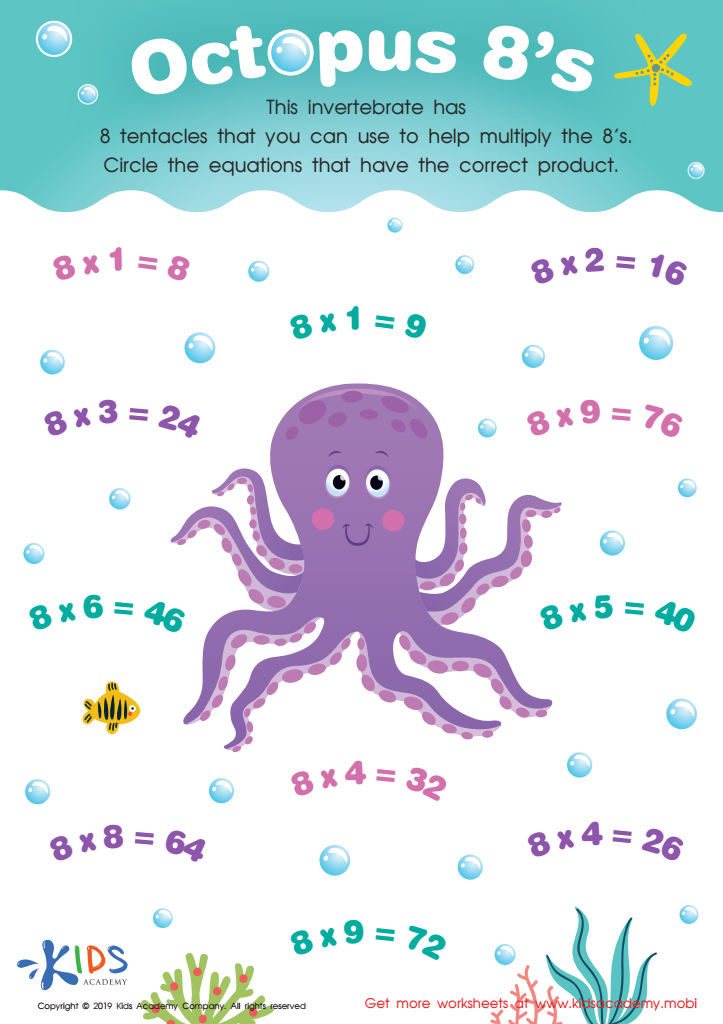
Octopus 8’s Worksheet
 Assign to My Students








Understanding symmetry is essential for children aged 8-9 as it plays a pivotal role in their cognitive and mathematical development. At this age, children begin to refine their problem-solving skills, and grasping symmetry fosters logical thinking and spatial awareness. It recurrently appears in everyday life, from nature—like butterflies and flowers—to architecture and art, making it a tangible concept that connects learning to the real world.
Symmetry exercises promote critical thinking. By identifying and creating symmetrical patterns, children enhance their analytical skills and learn to recognize relationships and transformations. Additionally, this understanding helps develop foundational geometric concepts, an essential part of the math curriculum. Mastery of symmetry can also lead to success in more complex mathematical topics, laying a robust groundwork for future learning.
Moreover, engagement with symmetry nurtures creativity. Art projects involving symmetrical designs or structures encourage self-expression while honing fine motor skills, thus blending art with math.
Overall, emphasizing symmetry boosts children's confidence in mathematics, enhances their problem-solving abilities, and encourages creativity, making it a vital area of focus for parents and teachers during these formative years. Understanding symmetry not only enriches children's education but also cultivates a deeper appreciation for the world around them.








