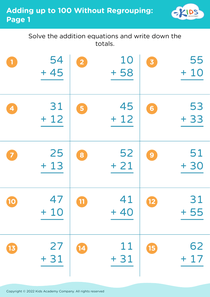
Recognize patterns Adding up to 100 with Regrouping Worksheets for Ages 8-9
3 filtered results
-
From - To
Welcome to our engaging "Recognize Patterns Adding Up to 100 with Regrouping Worksheets" designed specifically for children aged 8-9. These worksheets help young learners develop essential skills in mathematics through recognizing patterns and mastering the concept of regrouping. With a playful approach, students will enhance their addition skills while tackling problems that require them to think critically and identify numeric relationships. This interactive learning experience ensures that children build confidence and proficiency in their mathematical abilities, setting a solid foundation for future success. Explore our resources today and watch your child thrive in recognizing and applying patterns in addition!
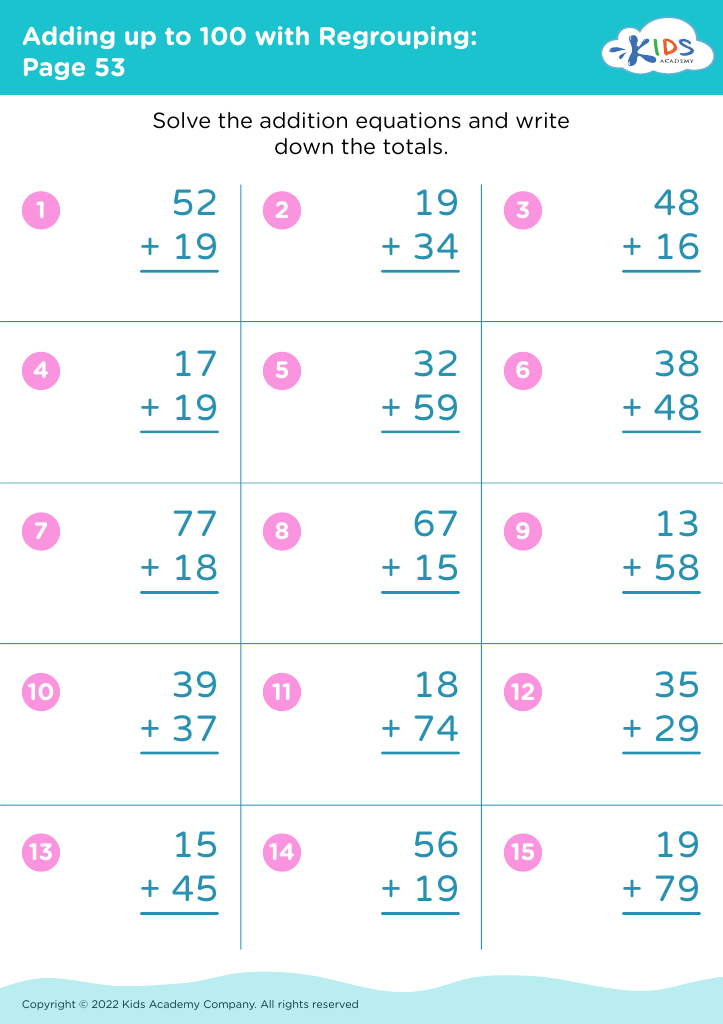
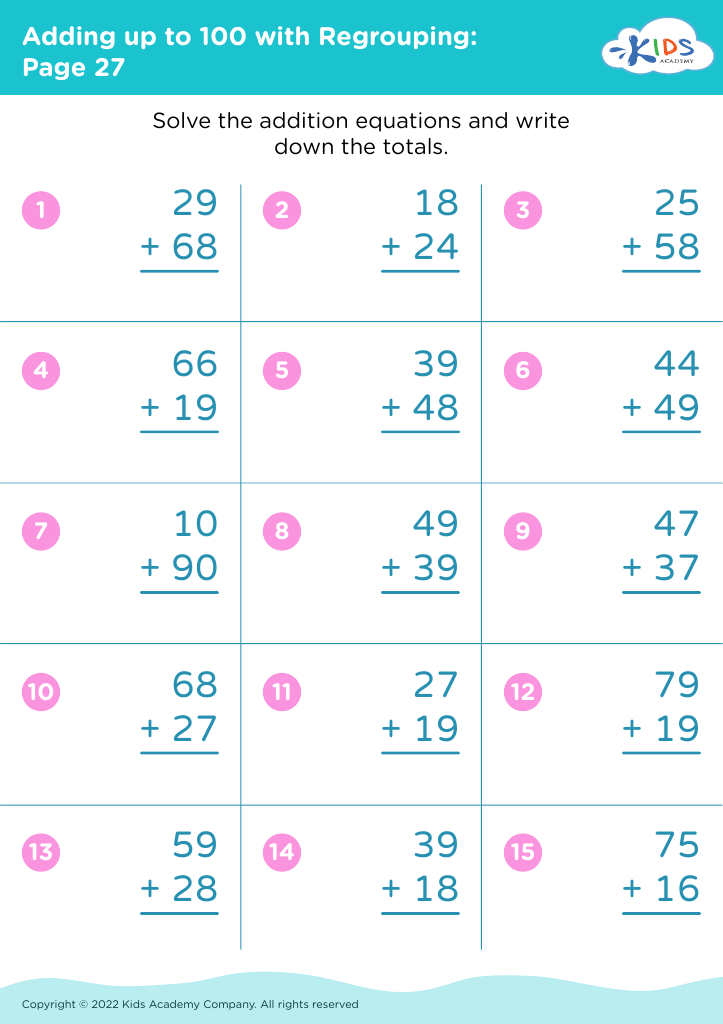
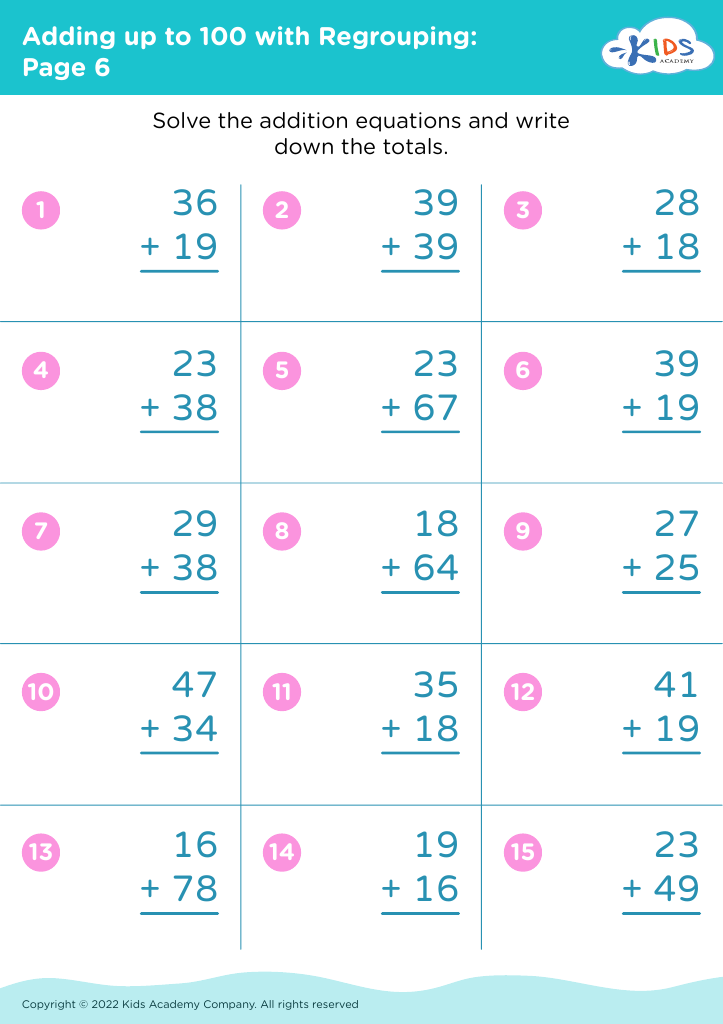




Recognizing patterns in addition and mastering regrouping concepts are crucial skills for children aged 8 to 9, as they form the foundation for more complex mathematical operations. At this stage, children are not just learning to add numbers; they are developing critical thinking and problem-solving abilities that will benefit them in various subjects.
By understanding how to recognize patterns, students become more efficient in addition, particularly when working with numbers that add up to 100. This skill promotes number sense, enabling kids to make connections between different mathematical concepts, such as addition and subtraction. It helps them visualize and internalize mathematical relationships, making it easier to tackle larger numbers in the future.
Additionally, regrouping—or carrying over—teaches students about place value and the significance of tens and ones, fostering a deeper comprehension of the base-10 number system. When parents and teachers emphasize these concepts, they encourage a mindset of persistence and creativity in problem-solving.
Ultimately, by prioritizing pattern recognition and regrouping, adults support children's mathematical literacy, preparing them for future academic challenges and instilling a positive attitude toward learning mathematics. This foundational skill set equips them for success not just in school, but in real-life situations where mathematical reasoning is essential.