Developing math skills Adding up to 100 Worksheets for Ages 8-9
3 filtered results
-
From - To
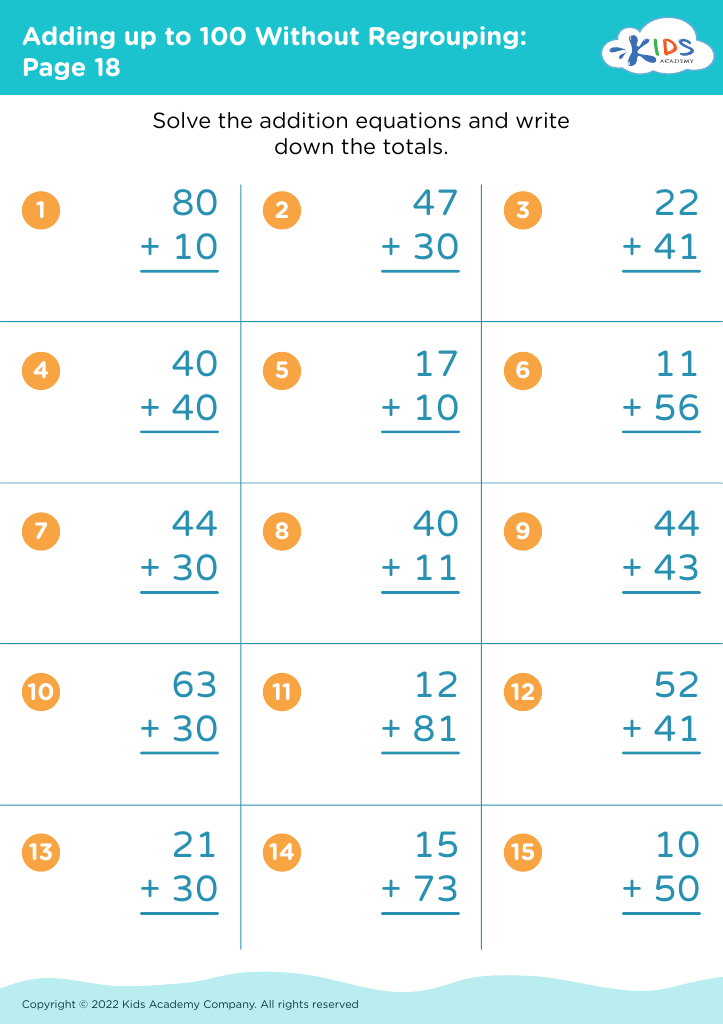
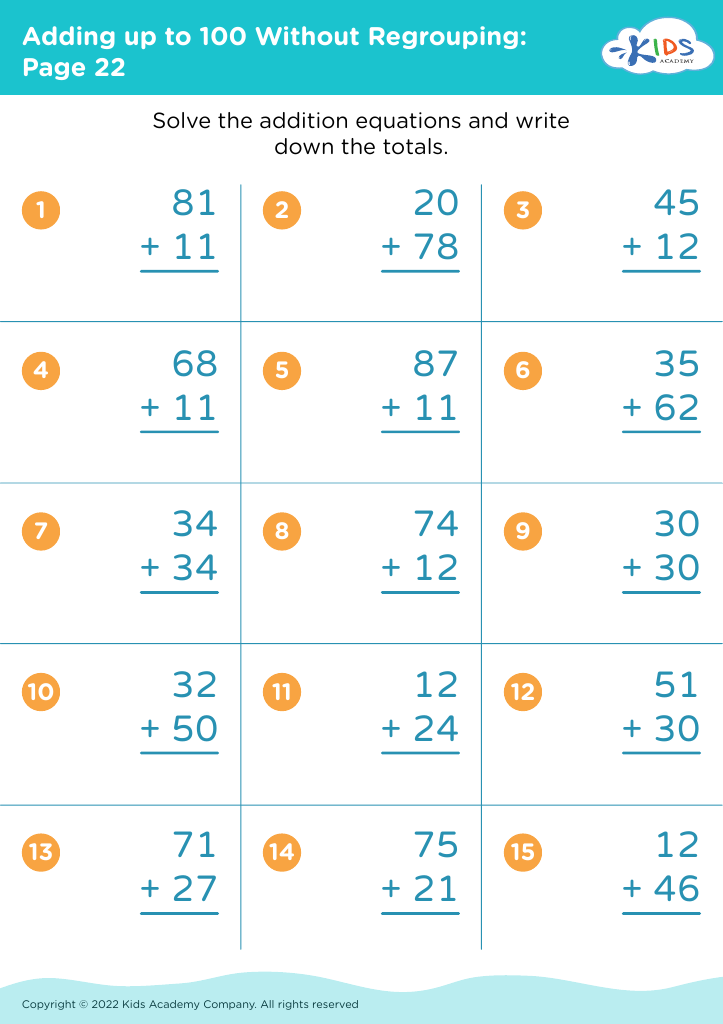
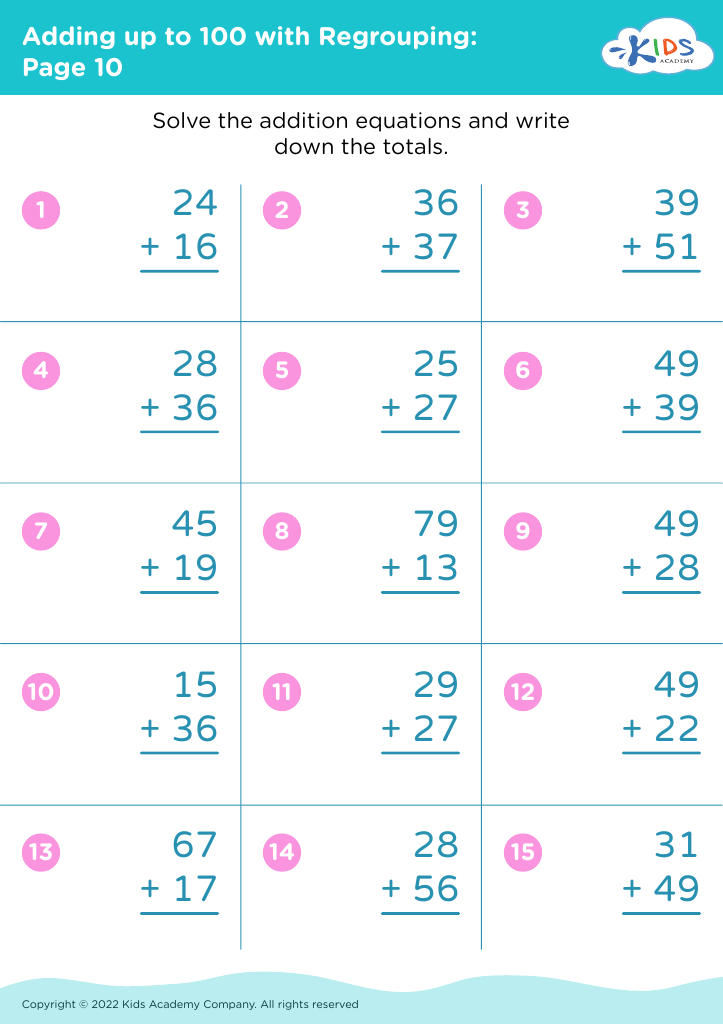
Enhance your child's arithmetic abilities with our "Developing Math Skills: Adding up to 100 Worksheets for Ages 8-9." These engaging worksheets are designed to improve addition skills by offering various exercises that challenge and entertain. Through structured practice, kids strengthen their mental math capability and build a solid foundation for future math concepts. Featuring colorful, intuitive designs and context-based problems, these worksheets make learning fun, keeping children motivated and focused. Equip your young learner with the tools they need to excel in math and develop a lifelong love for numbers with our expertly crafted resources.



%20(1).jpg)



Developing math skills, specifically the ability to add up to 100, is crucial for children aged 8-9, as it lays the foundation for more advanced mathematical concepts they will encounter throughout their education and everyday life. At this developmental stage, mastering addition up to 100 enhances cognitive functions, such as logical thinking and problem-solving, fostering curiosity and confidence in handling numbers. This skill is fundamental for understanding more complex arithmetic operations like multiplication, division, and fractions, which build on basic addition principles.
For parents and teachers, focusing on this area supports children's academic growth and competence in essential life skills, such as money management and time calculation. It encourages a positive attitude towards math by providing a solid grasp of fundamental numeracy. By making sure children achieve proficiency in additive tasks, caregivers ensure they are well-prepared for standardized testing and future STEM-related opportunities.
Moreover, competence in numeracy, including adding up to 100, contributes to overall cognitive development, enhancing skills like memory, attention to detail, and the ability to categorize information efficiently. Ensuring children excel in these basic mathematical skills prepares them for lifelong learning and practical applications in daily activities. Hence, parents and teachers play a critical role in reinforcing these essential arithmetic concepts during these formative years.








