Develop critical thinking Adding up to 50 Worksheets for Ages 8-9
3 filtered results
-
From - To
Discover how our "Adding up to 50 Worksheets for Ages 8-9" enhance critical thinking skills in young minds. Designed by education experts, these engaging worksheets go beyond basic arithmetic, challenging students to solve problems, identify patterns, and apply logical reasoning. Perfect for classroom use or additional practice at home, they encourage a deep understanding of math concepts while fostering a love for learning. Keep your child's mathematical journey exciting and impactful with activities tailored precisely for their developmental stage. Enhance their problem-solving abilities and watch them thrive academically and beyond. Download today for a brighter, smarter tomorrow!
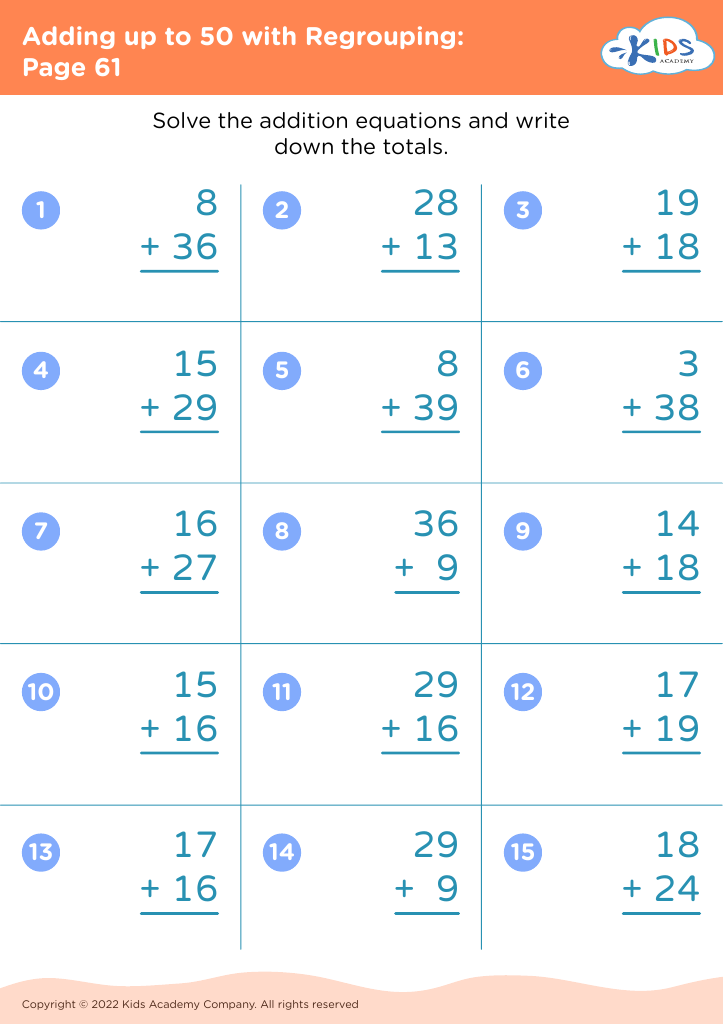
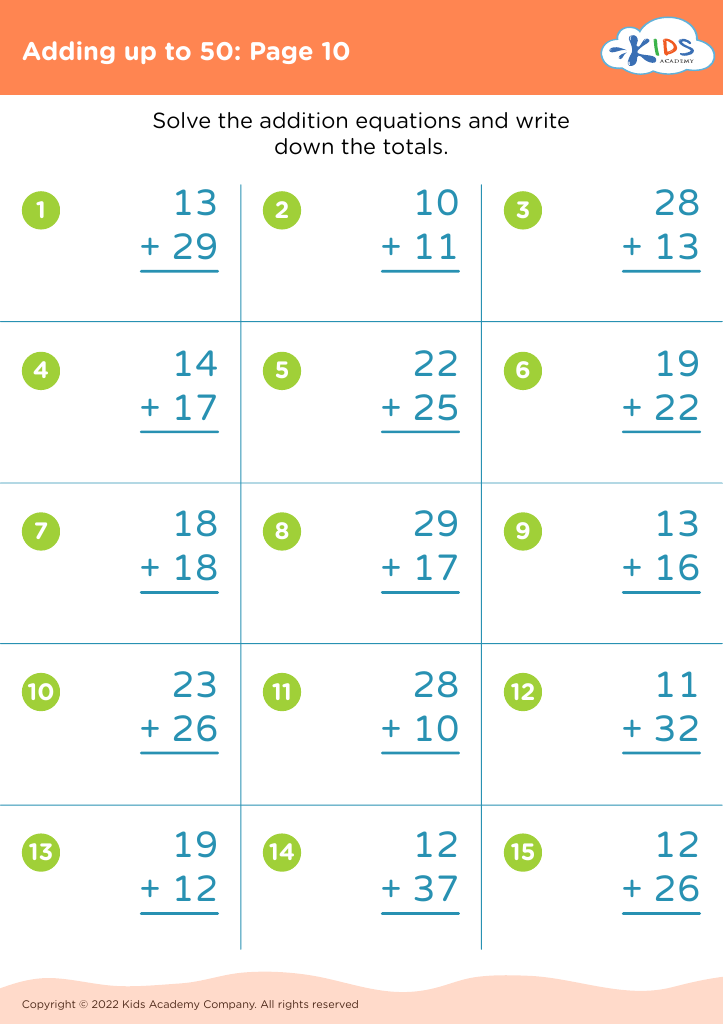
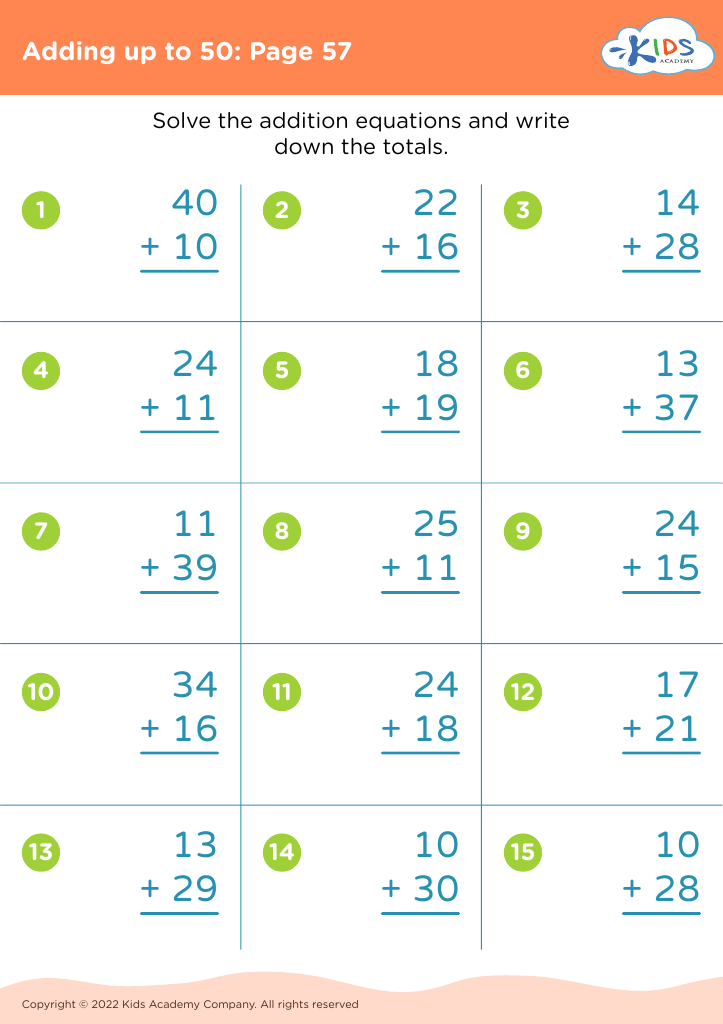




Developing critical thinking is essential, even for 8-9 year-olds, especially in mathematical tasks such as adding numbers up to 50. At this age, children are not just memorizing facts but building the foundational skills that will support all future learning. Critical thinking allows them to understand the 'why' and 'how' behind their actions, encouraging deeper comprehension.
By focusing on critical thinking when adding up to 50, children learn to recognize patterns, use strategies, and understand number relationships rather than just performing rote calculations. For example, when a child knows that 25 + 25 equals 50, they can break that down into smaller steps, identifying that 25 is halfway to 50, promoting a sense of numerical value and estimation skills.
Moreover, fostering critical thinking helps children become problem solvers and independent thinkers. It aids them in decision-making, enhancing other subjects and everyday life skills. This intellectual empowerment helps them grow into more confident learners.
Parents and teachers should prioritize these skills because they create a sturdy academic foundation, stimulate intellectual curiosity, and make learning more engaging and meaningful. Ensuring children grasp the importance of critical thinking in basic tasks like adding up to 50 lays the ground for more complex problem-solving in later education stages.








