
Geography knowledge Addition & Subtraction Worksheets for Ages 8-9
3 filtered results
Difficulty Level
Grade
Age
-
From - To
Subject
Activity
Standards
Enhance your child’s math and geography skills with our innovative Geography Knowledge Addition & Subtraction Worksheets, specially designed for ages 8-9. These engaging worksheets combine fundamental arithmetic operations with intriguing geographical facts and activities. Your child will practice addition and subtraction while simultaneously expanding their knowledge of world countries, capitals, landmarks, and maps. Perfect for classroom use or at-home learning, these worksheets make arithmetic practice enjoyable and educational by integrating multidisciplinary learning. Boost your child's confidence in math and spark their interest in geography with our expertly crafted resources, ensuring a well-rounded and fun learning experience.
Favorites
With answer key
Interactive
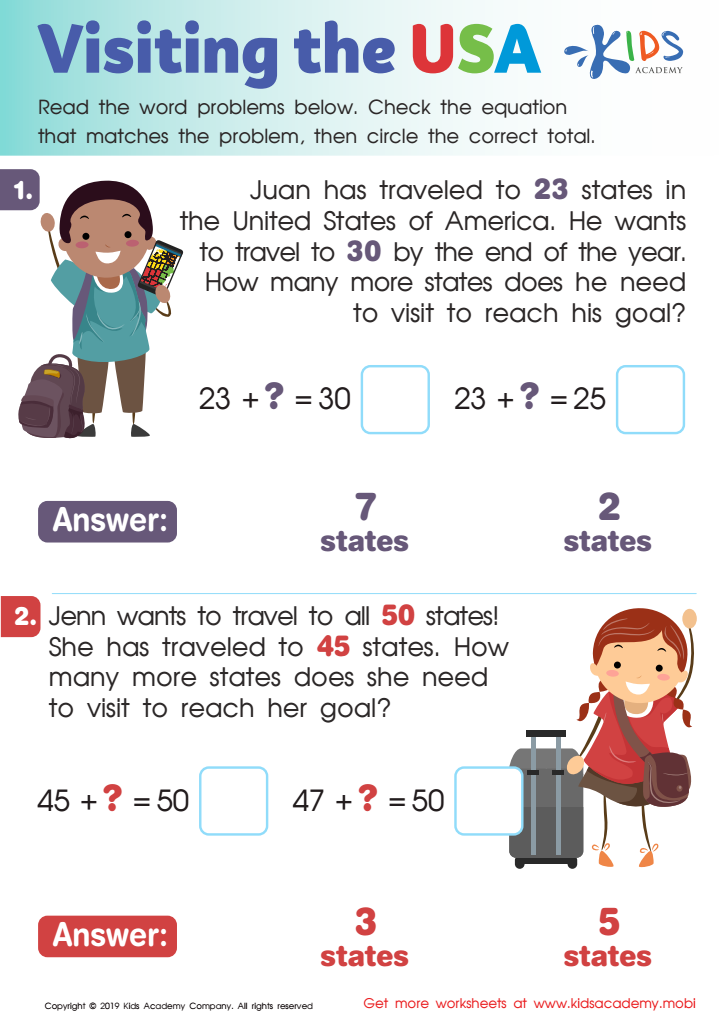
Visiting the USA Worksheet
Do your kids love travelling? Ask them why and find out what they look forward to the most. People travel for a variety of reasons, such as adventure, holiday, or business. Juan and Jenn in the picture travel for adventure and have a goal they want to achieve. Read the word problems to your kids and help them pick the right equation and match the total.
 Assign to My Students
Visiting the USA Worksheet
Worksheet
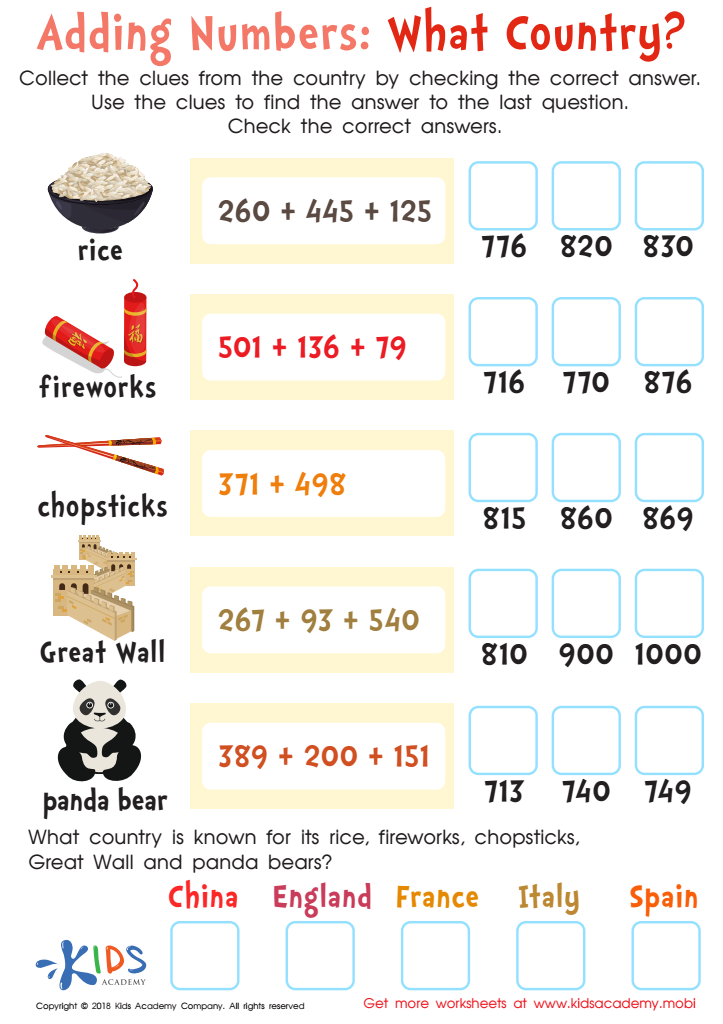
Adding Numbers: What Country Worksheet
Students can use this worksheet to learn more about different countries. Have them collect clues from the worksheet to answer the last question. Help them check the correct answer, and they'll gain knowledge about each country's food, animals, celebrations, and landmarks.
Adding Numbers: What Country Worksheet
Worksheet
Join Kids Academy for Free
Who is primarily going to use this learning content?








Parents and teachers should prioritize teaching geography and math, particularly addition and subtraction, to children aged 8-9 because these subjects lay the foundation for essential cognitive and practical skills. Geography fosters global awareness, cultural understanding, and spatial thinking. It helps children appreciate diverse environments and communities, broadening their perspectives and nurturing respectful global citizens.
Math skills, on the other hand, are fundamental to daily life and academic success. Addition and subtraction are the building blocks of all mathematical concepts, enabling students to solve problems, reason logically, and think analytically. For ages 8-9, who are typically in third or fourth grade, mastering these operations is crucial for progression to more complex arithmetic and algebra.
Integrating geography with math exercises enhances learning by making it contextually meaningful. Children can practice addition and subtraction using real-world scenarios like calculating distances on a map or understanding population statistics. This interdisciplinary approach not only makes lessons engaging but also improves retention, as students see the practical application of their knowledge. By investing in these areas, parents and teachers equip children with skills that are essential for future academic challenges and everyday decision-making processes.








