
Math skills improvement Addition Worksheets for Ages 8-9
3 filtered results
Difficulty Level
Grade
Age
-
From - To
Subject
Activity
Standards
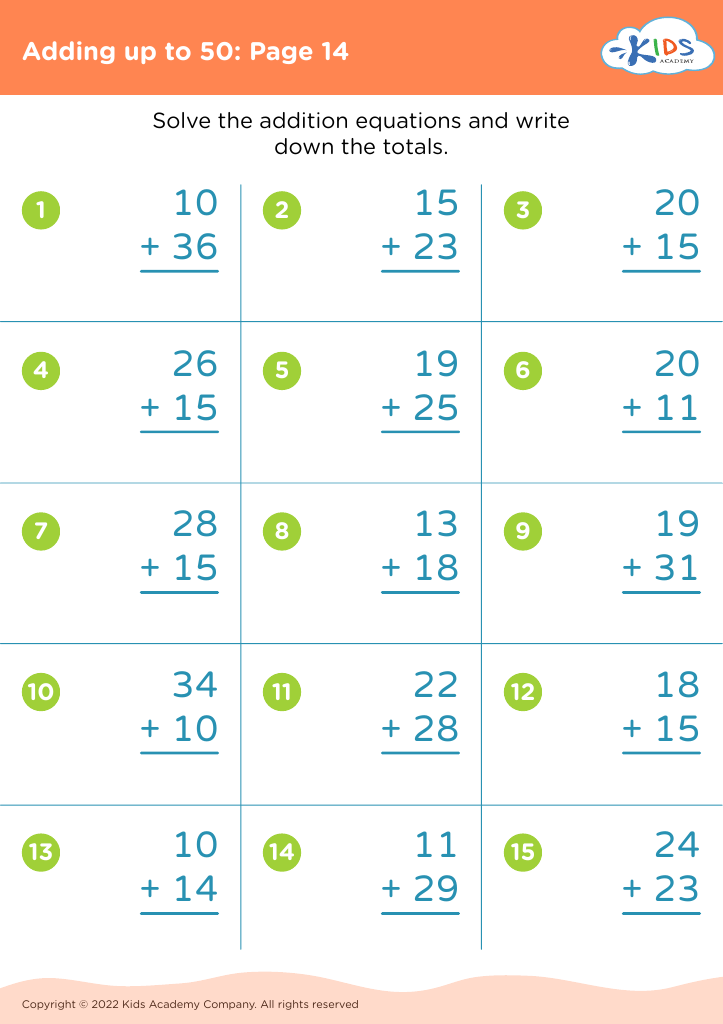
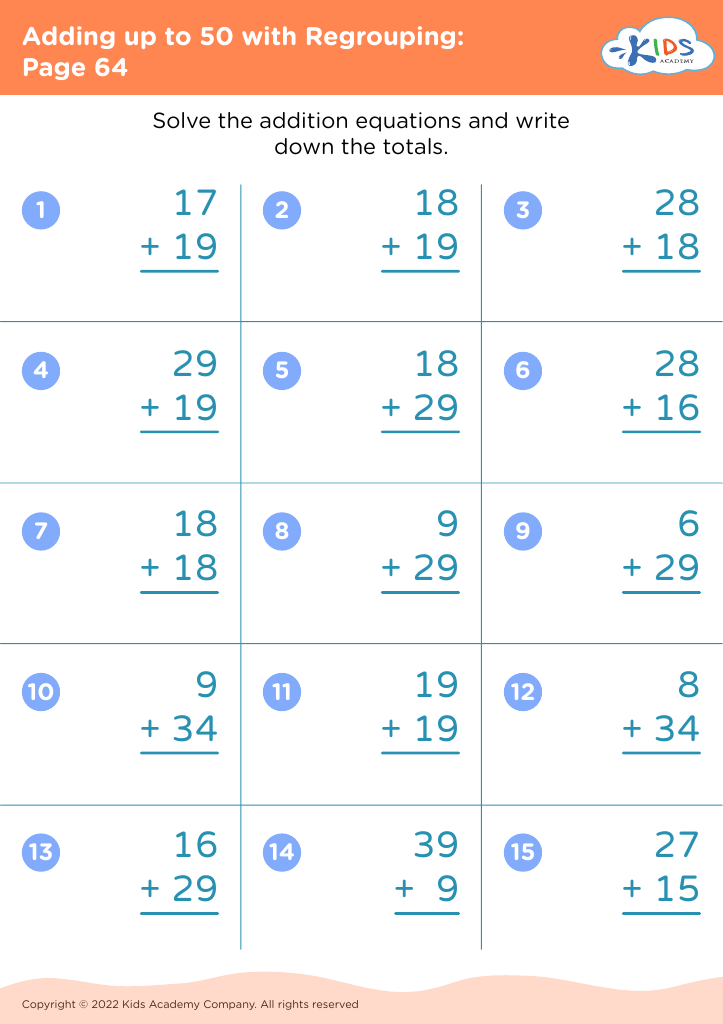
Enhance your child's math proficiency with our Addition Worksheets designed specifically for ages 8-9. These engaging and interactive resources focus on improving essential addition skills through a variety of activities that cater to different learning styles. Covering basic operations, word problems, and various difficulty levels, our worksheets make math practice both fun and effective. Each worksheet is crafted to reinforce concepts and build confidence, ensuring your child becomes a math whiz in no time. Perfect for home or school use, our Addition Worksheets offer a supportive and enjoyable environment for young learners. Start their journey toward math mastery today!
Favorites
With answer key
Interactive
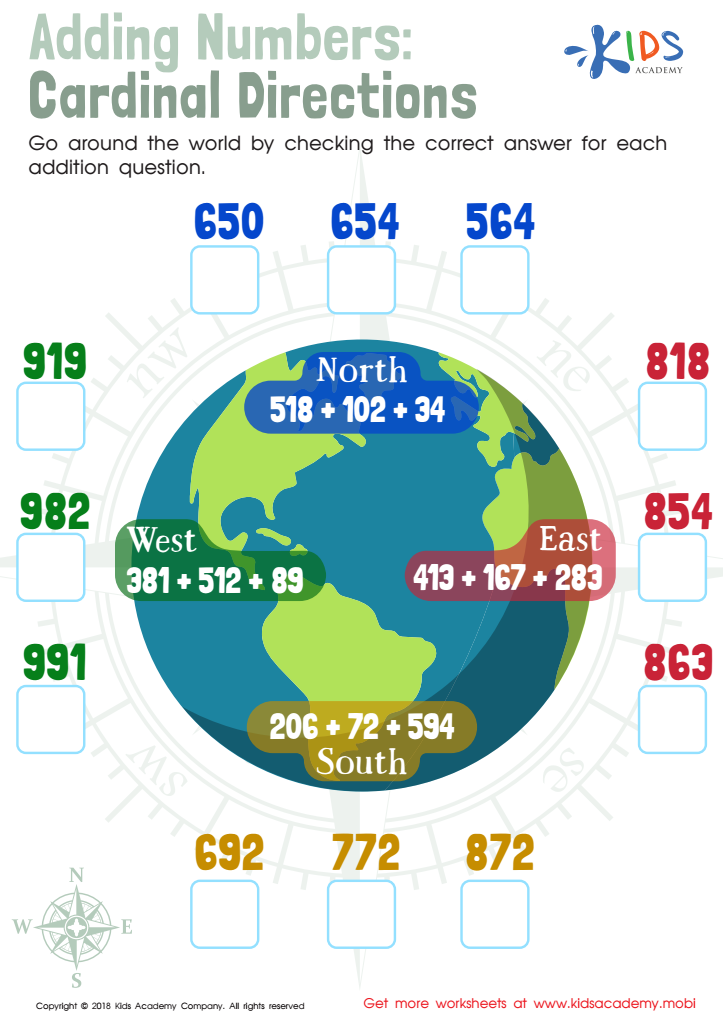
Adding Numbers: Cardinal Directions Worksheet
Are your students familiar with cardinal points? Teach them there are four: North, South, East, West. Used to navigate and mark places, use this worksheet to have your kids go round the world by checking the correct answer for each addition question in the pdf.
 Assign to My Students
Adding Numbers: Cardinal Directions Worksheet
Worksheet
Join Kids Academy for Free
Who is primarily going to use this learning content?








Parents and teachers should prioritize improving addition skills in 8-9 year-olds because this foundational mathematical concept is crucial for future learning and everyday life. At this age, children are transitioning from basic arithmetic to more complex problem-solving. Proficient addition skills enable them to tackle larger numbers, understand place value, and start to engage with concepts like multiplication and division effectively.
Moreover, strong addition skills build confidence in children, fostering a positive attitude toward math. When children feel competent in fundamental operations, they are more likely to participate actively in math-related activities and explore advanced concepts. Math skills also translate to practical life situations—helping children understand money management, time calculations, and budgeting as they grow older.
Additionally, early mastery of addition has a long-term impact on academic performance. By enhancing their addition abilities, students develop critical-thinking skills necessary for science, technology, engineering, and mathematics (STEM) fields, which are increasingly important in today’s economy.
Ultimately, improving addition skills helps children lay a robust academic foundation, cultivates their analytical abilities, and prepares them for lifelong success in multiple areas, both academically and in real-world applications. Investing in these skills now is essential for their bright futures.








