Comparing Fractions Math Worksheets for Ages 8-9 - Page 4
90 filtered results
-
From - To
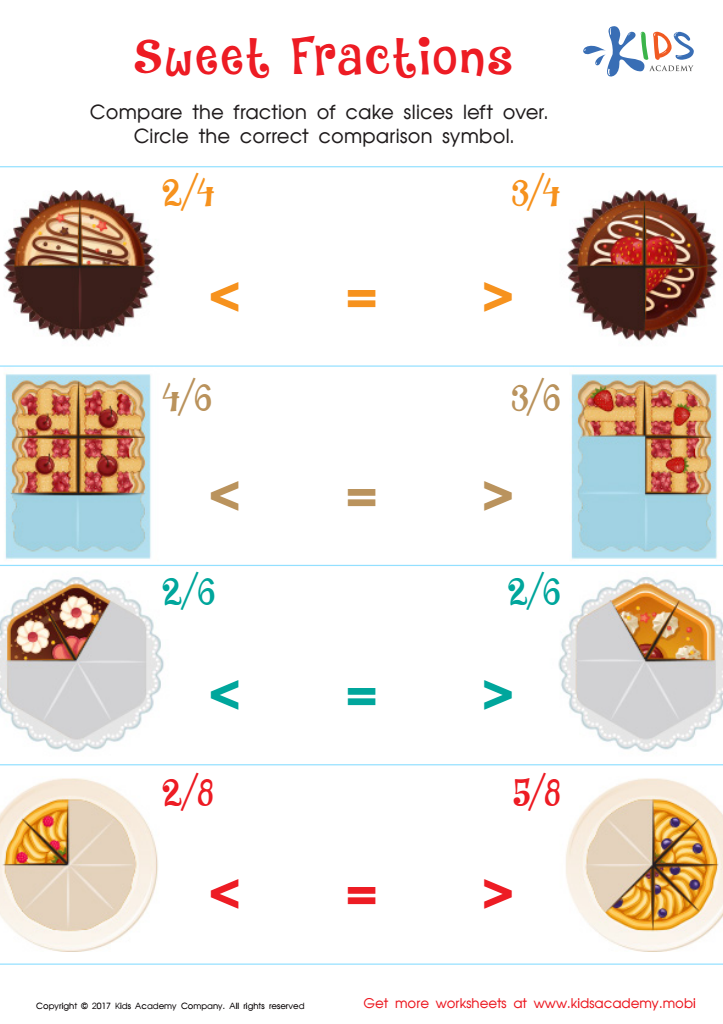
Compare Fractions Worksheet
 Assign to My Students






Parents and teachers should care about teaching children aged 8-9 to compare fractions because it is a critical foundational skill that boosts their understanding of more complex mathematical concepts. Mastering the ability to compare fractions helps enhance a child's number sense, which is their innate ability to understand, relate, and connect numbers.
When students grasp comparing fractions, it aids them in making sense of proportions, ratios, and decimals later on. This understanding is pivotal for various real-life applications, such as cooking, budgeting, and measuring, which rely on knowing how to relate different quantities. For young students, visual tools like fraction bars and pie charts make learning more engaging, impacting their attitude positively toward math.
By comparing fractions, children also develop problem-solving and critical-thinking skills. They learn strategies to tackle problems independently and logically, such as finding common denominators or using benchmarks like 1/2. This boosts their confidence and capability in math, setting them up for success in future academic pursuits.
Overall, prioritizing the teaching of comparing fractions equips children with essential math skills, instills confidence, and fosters a robust mathematical foundation, necessary for everyday decision-making and academic achievement.








