
Fine motor skills (writing numbers) Math Worksheets for Ages 8-9
4 filtered results
Difficulty Level
Grade
Age
-
From - To
Subject
Activity
Standards
Enhance your child's fine motor skills with our specially designed math worksheets focused on writing numbers for ages 8-9. These engaging activities not only help improve handwriting but also reinforce essential math concepts. As your child practices writing numbers, they'll develop better control and coordination, making math more accessible and enjoyable. Our worksheets feature a variety of exercises, including number tracing, writing drills, and fun math challenges, fostering a solid foundation in numeracy. Perfect for homework, classroom use, or extra practice at home, these resources will inspire confidence and encourage a love for learning in every young mathematician.
Favorites
With answer key
Interactive
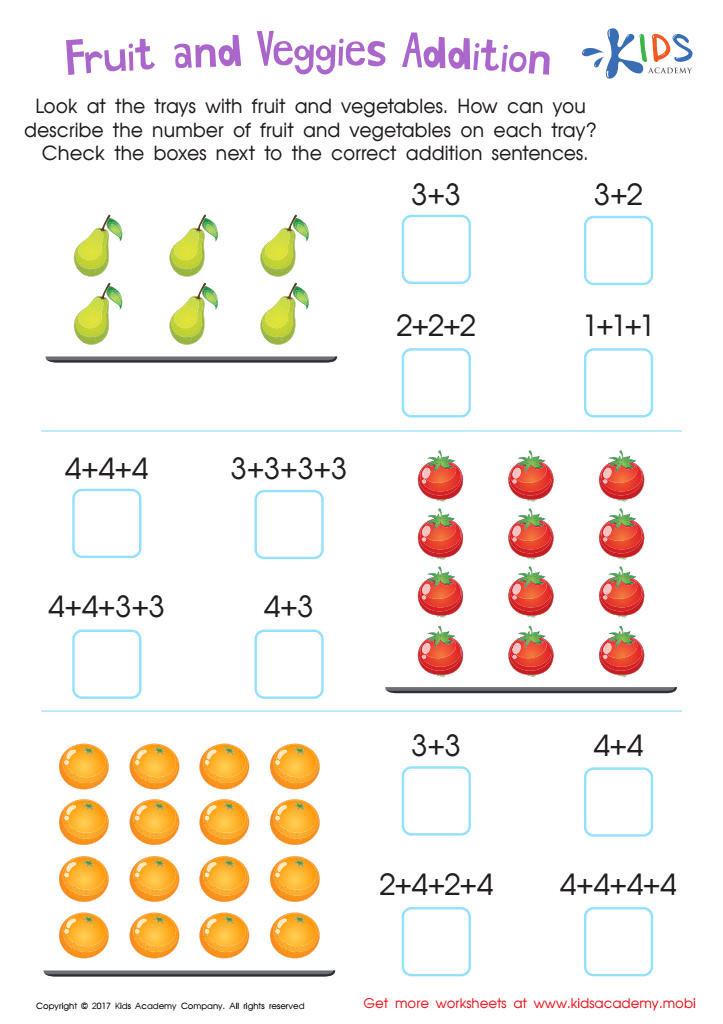
Fruit and Veggies Worksheet
It promotes problem-solving and analytical skills as kids match pictures to correct addition sentences. Help your child go beyond simple addition with this PDF worksheet!
 Assign to My Students
Fruit and Veggies Worksheet
Worksheet

A Hundred Pineapples Worksheet
Can your child count in tens? Show them how to count 100 boxes in stacks of tens. A worksheet can help them understand the concept. Ask them to count boxes of pineapples in stacks of tens and circle the truck with 100 pineapples.
A Hundred Pineapples Worksheet
Worksheet
Join Kids Academy for Free
Who is primarily going to use this learning content?








Fine motor skills are crucial for children aged 8-9, particularly in contexts like writing numbers and engaging with mathematics. At this developmental stage, robust fine motor skills contribute to a child's overall academic proficiency, especially in subjects that require precision and attention to detail, like math.
Writing numbers is not just about physical ability; it aids cognitive development. When children practice writing, they're enhancing their hand-eye coordination, spatial awareness, and dexterity. These skills facilitate better classroom participation, increased confidence in completing math tasks, and improved problem-solving abilities.
Furthermore, fine motor skills are essential for developing logical thinking, as children learn to draw shapes, manage space on a page, and express mathematical concepts through diagrams and charts. Strong motor skills also reduce frustration during activities, leading to a positive, confident attitude toward learning.
Parents and teachers should prioritize fine motor development not only to ensure effective number writing but also to lay a foundation for future learning in STEM fields. Investing time in activities like drawing, crafting, and practicing handwriting fosters both academic and personal growth. By emphasizing fine motor skills, adults can significantly impact a child's learning journey, helping cultivate successful, engaged learners.








