
Identifying fractions Math Worksheets for Ages 8-9
5 filtered results
Difficulty Level
Grade
Age
-
From - To
Subject
Activity
Standards
Explore our engaging "Identifying Fractions Math Worksheets" designed specifically for children ages 8-9. These worksheets provide a variety of fun, interactive exercises that help young learners grasp the concept of fractions through visual aids, real-life examples, and step-by-step instructions. Each worksheet encourages children to identify, compare, and understand fractions, fostering essential math skills critical at this age. Whether your child is enhancing their classroom learning or practicing at home, our worksheets make fractions accessible and enjoyable. Download now to give your child the tools they need to excel in mathematics while cultivating confidence and competence in their math abilities!
Favorites
With answer key
Interactive
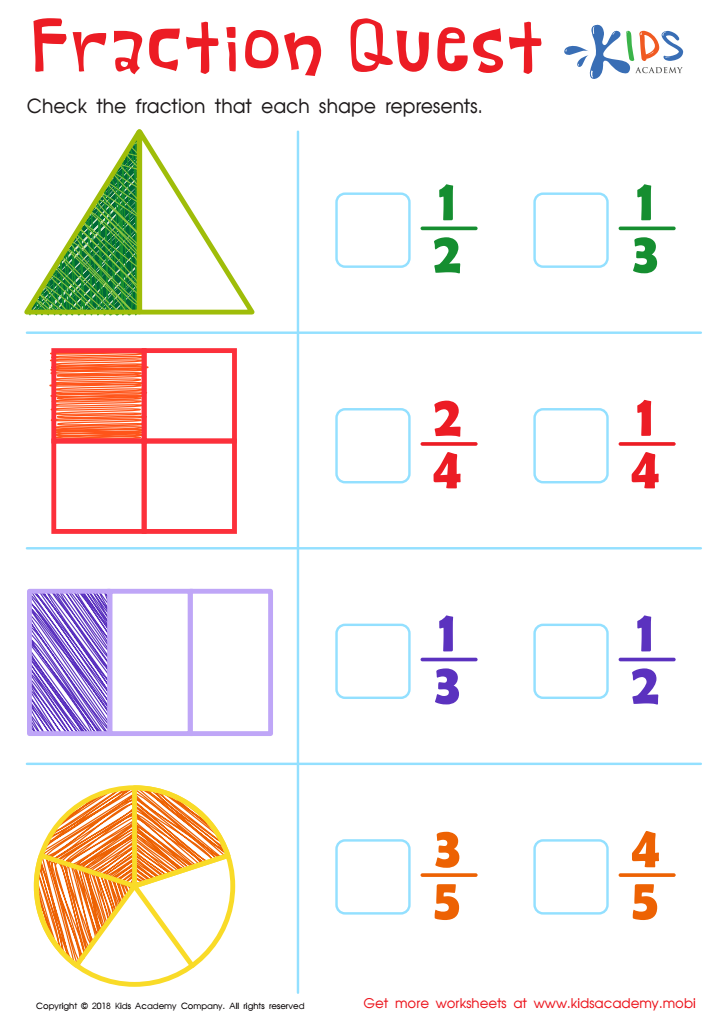
Fraction Quest Worksheet
This colorful and educative worksheet can help kids conquer their fractions struggles. Ask them to identify the four shapes, then the fractions they represent. They can then check the correct answers from the options given.
 Assign to My Students
Fraction Quest Worksheet
Worksheet
Join Kids Academy for Free
Who is primarily going to use this learning content?








Understanding fractions is a vital mathematical concept for children aged 8-9, laying the foundation for more advanced math skills while enhancing their problem-solving abilities. At this age, children are naturally curious and ready to explore the idea of parts and wholes, which is the essence of fractions.
By mastering fractions, students develop critical thinking and make connections between their mathematical knowledge and real-world applications, such as cooking, sharing, or measuring. Teachers and parents should foster this understanding during these formative years to create confidence and a sense of achievement in young learners.
Identifying fractions encourages the development of analytical skills, enabling them to compare sizes and quantities and understand ratios. Additionally, learning fractions supports the introduction of other key concepts such as decimals, percentages, and ultimately, algebra.
Furthermore, as children encounter more complex math in higher grades, a solid foundation in fractions ensures they won't feel overwhelmed. Engaging with fractions through hands-on activities and real-life situations can make this learning enjoyable and accessible, promoting a positive attitude towards math and establishing a lifelong love for learning. Advocating for this foundational skill truly benefits children’s future academic endeavors and daily life experiences.








