Observational skills Math Worksheets for Ages 8-9
3 filtered results
-
From - To
Unlock the full potential of your child's mathematical journey with our meticulously designed Observational Skills Math Worksheets for Ages 8-9 at Kids Academy. These engaging worksheets are crafted to enhance your child's ability to observe, analyze, and interpret data. Through a variety of stimulating activities such as pattern recognition, chart analysis, and problem-solving tasks, your child will develop essential math skills in a fun and interactive way. Perfect for reinforcing classroom lessons or providing extra practice at home, our worksheets are a valuable resource for fostering critical thinking and building strong foundations in mathematics. Let's make learning exciting!
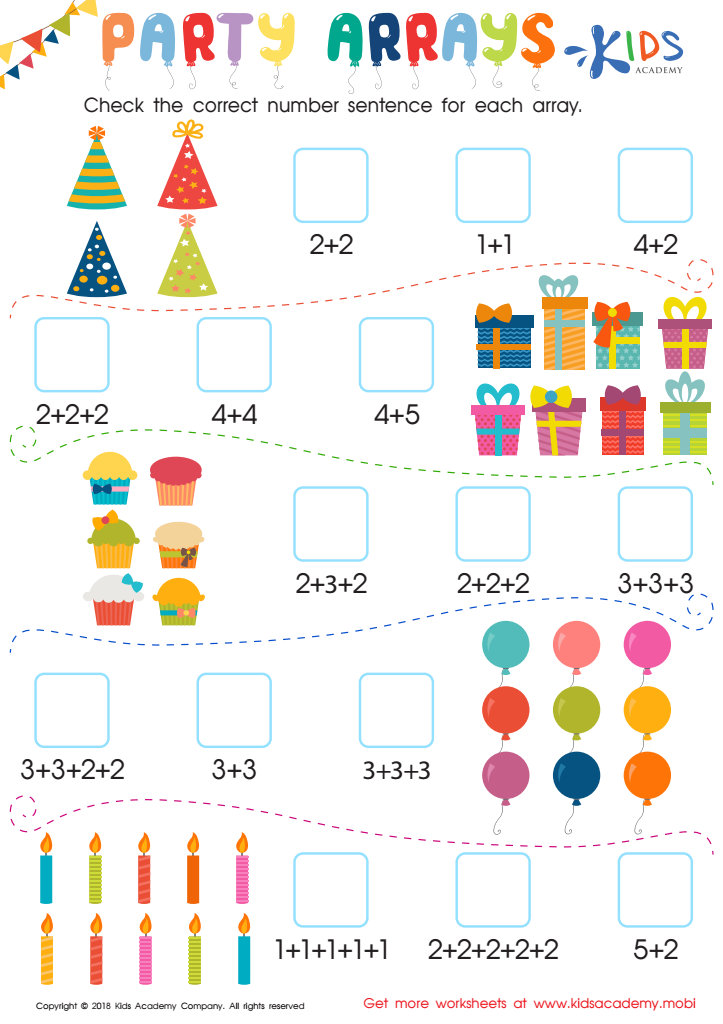
Party Arrays Worksheet
 Assign to My Students







Observational skills in math for children aged 8-9 are essential as they form the foundation for critical thinking and problem-solving abilities. At this developmental stage, students are transitioning from concrete to more abstract thinking, and strong observational skills enable them to notice patterns, analyze data, and understand mathematical relationships.
For parents and teachers, fostering these skills means students can better grasp concepts such as multiplication, division, and fractions, which are crucial for advanced math learning. When children can observe and interpret visual data like graphs, charts, or geometric shapes, they build a deeper understanding of math concepts rather than just memorizing formulas.
Additionally, strong observational skills encourage curiosity and engagement. When children are adept at noticing details and patterns, they become more interested in exploring math problems and finding solutions. For educators, incorporating activities that enhance observational skills—like games, puzzles, and hands-on projects—can make learning math fun and interactive.
Ultimately, investing in observational skills at this age helps build a strong mathematical foundation, setting children up for future academic success. It prepares them for more challenging concepts in later grades and enhances their ability to apply math in real-life situations, a crucial competency for their overall development.








