
Reading analog clocks Math Worksheets for Ages 8-9
5 filtered results
Difficulty Level
Grade
Age
-
From - To
Subject
Activity
Standards
Discover our engaging "Reading Analog Clocks" math worksheets designed specifically for children aged 8-9. These worksheets are perfect for enhancing time-telling skills, helping students gain confidence in reading analog clocks. With a variety of fun and interactive exercises, children will learn to identify hours, minutes, and understand the concepts of time while building essential math abilities. Each worksheet is carefully crafted to encourage critical thinking and reinforce learning through practical application. Whether at home or in the classroom, our resources provide an effective and enjoyable way to master time-telling skills. Let’s help your child embrace the world of clocks!
Favorites
With answer key
Interactive
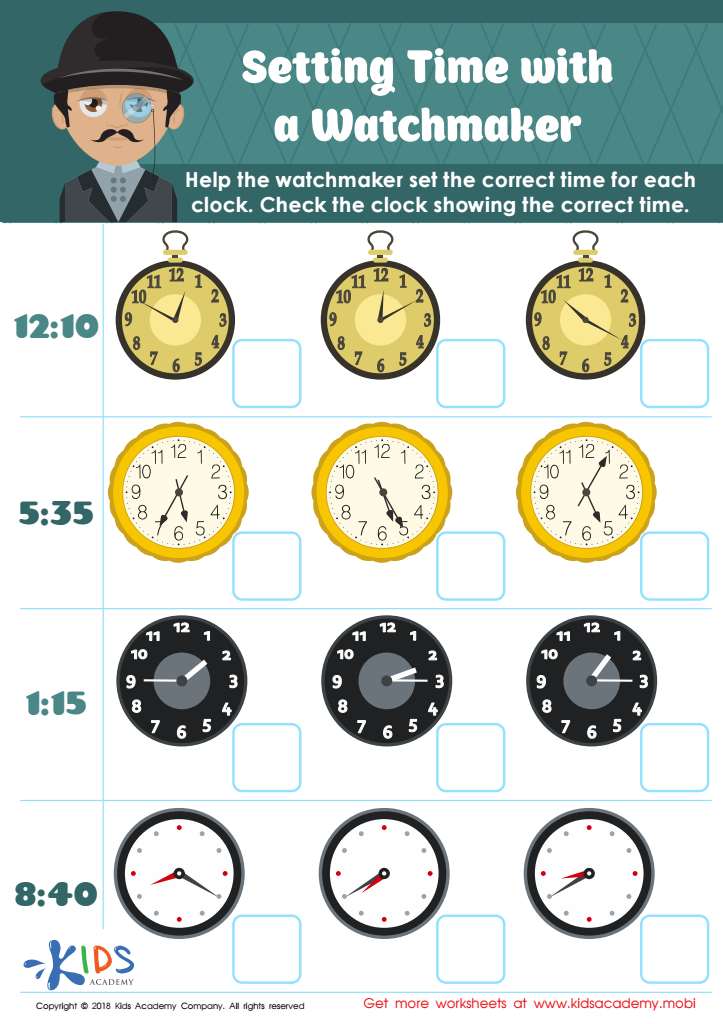
Setting Time with Watchmaker Worksheet
Can your kids tell the time? If so, this worksheet should be easy. Help them set the time for each clock: look at the time written on the left side and find the clock on the right side that matches.
 Assign to My Students
Setting Time with Watchmaker Worksheet
Worksheet
Join Kids Academy for Free
Who is primarily going to use this learning content?






Understanding how to read analog clocks is crucial for children aged 8-9 as it enhances their math skills and real-life application of time management. Mastering this skill involves various mathematical concepts, such as counting, understanding fractions, and recognizing patterns. By learning to interpret the positions of the hour and minute hands, children develop critical reasoning and problem-solving abilities.
Analog clocks also provide a valuable opportunity for hands-on learning and engagement. They allow students to visualize how time progresses in specific intervals, bridging the gap between abstract concepts and their practical uses. As children become proficient in reading an analog clock, they gain confidence in their mathematical abilities, which is essential for their overall academic success.
Moreover, being able to read analog clocks fosters independence. It enables children to manage their own schedules and enhances their understanding of daily routines. In a technology-driven world where digital clocks abound, the ability to interpret analog clocks reinforces a fundamental skill that may otherwise be overlooked. Overall, parents and teachers should prioritize this learning, as it lays the groundwork for future mathematical concepts and helps promote responsible time management in children's lives.








