Understanding instructions Math Worksheets for Ages 8-9
3 filtered results
-
From - To
Help your child master the essential skill of understanding instructions with our Math Worksheets for Ages 8-9. These carefully crafted worksheets from Kids Academy enhance mathematical comprehension by encouraging children to follow detailed instructions accurately. From basic arithmetic to more complex problems, each worksheet is designed to improve concentration, logical thinking, and problem-solving abilities. Ideal for home or classroom use, our engaging and age-appropriate exercises ensure that your child builds a solid foundation in math while developing the critical skill of following instructions. Empower your child's learning journey with our expertly designed math resources!
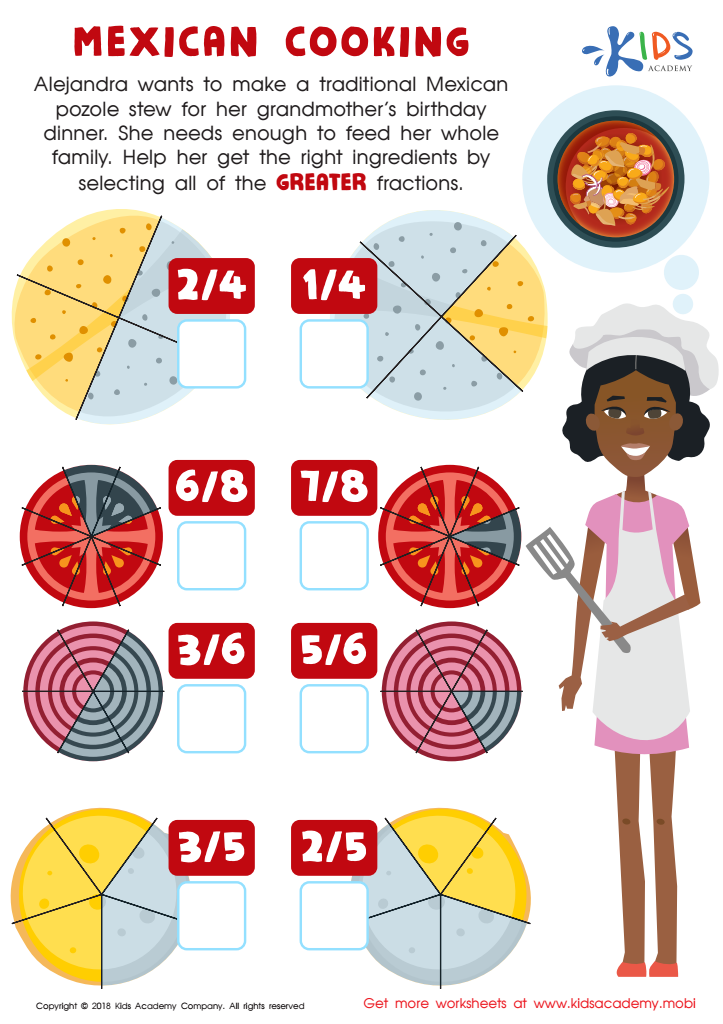
Mexican Cooking Worksheet
 Assign to My Students








Understanding instructions in math for ages 8-9 is crucial for both parents and teachers to prioritize because it sets the foundation for future academic success. At this stage, children are developing concrete operational thinking, allowing them to grasp more complex and abstract mathematical concepts. Clear instructions help them decode problems accurately, employ appropriate strategies, and build confidence in their problem-solving abilities. When children misunderstand instructions, they can easily form misconceptions, leading to gaps in knowledge that might affect their long-term mathematical abilities.
Parents' and teachers' involvement plays a pivotal role in reinforcing these skills. At home, parents can provide real-world examples and encourage a positive attitude towards math, making it less intimidating and more relatable. In the classroom, teachers can tailor instructions to match developmental needs, using visual aids, group activities, and interactive learning to engage students.
Moreover, mastering the skill of understanding instructions prepares children for standardized testing and curriculum-based assessments, where comprehension is often tested alongside problem-solving skills. Critical thinking and precision, essential not only in math but in all areas of learning, originate from the ability to comprehend tasks accurately. Thus, focusing on understanding math instructions at this critical age lays the groundwork for academic and everyday success, making children more independent and proficient learners.








