
Visual interpretation Math Worksheets for Ages 8-9
5 filtered results
Difficulty Level
Grade
Age
-
From - To
Subject
Activity
Standards
Our Visual Interpretation Math Worksheets for Ages 8-9 enhance your child's learning by transforming complex math concepts into engaging, easy-to-understand visuals. Designed to align with educational standards, these worksheets focus on interpreting graphs, charts, and diagrams, making math both fun and accessible. Each worksheet is crafted by educational experts to stimulate critical thinking and problem-solving skills. Perfect for classroom use or at-home practice, they cater to different learning styles and help students confidently navigate visual information. Empower your child with the tools to excel in math by incorporating our printable visual interpretation worksheets into their learning routine.
Favorites
With answer key
Interactive
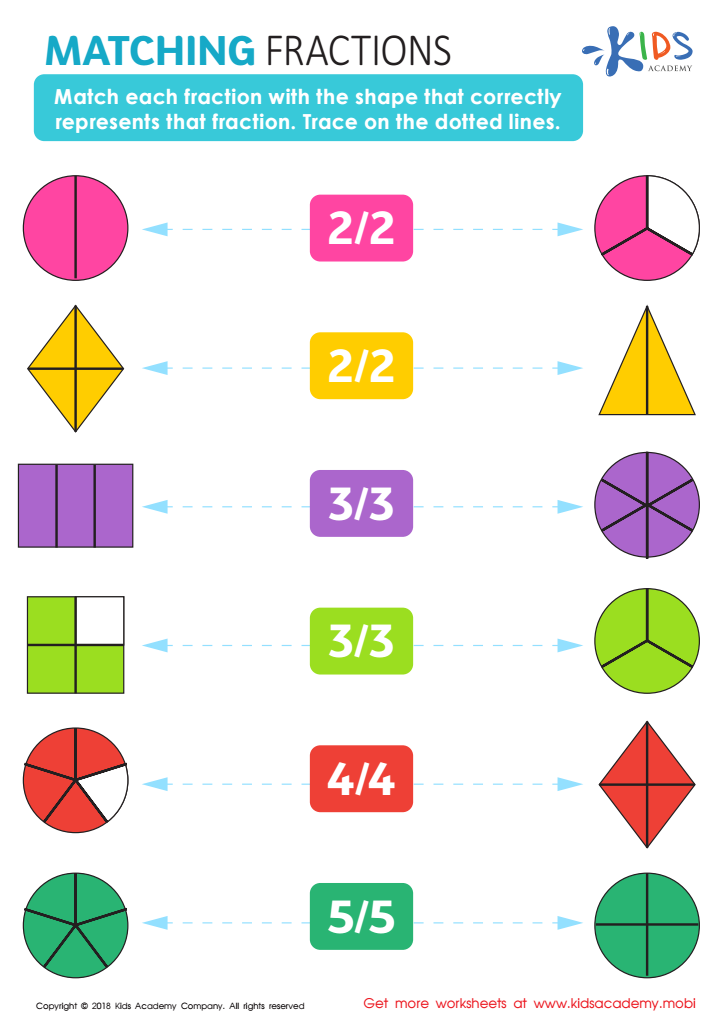
Matching Fractions Worksheet
This worksheet uses colorful images to engage students. On the left are six shapes, mirrored on the right, with fractions in the middle. Students must match up the fraction with the right shape. It's a fun way to sharpen fractions skills!
 Assign to My Students
Matching Fractions Worksheet
Worksheet
Join Kids Academy for Free
Who is primarily going to use this learning content?








Visual interpretation of math is crucial for children ages 8-9 because it aligns with their developmental stage and learning needs. At this age, children move from concrete to more abstract thinking, making visual aids essential for their understanding and engagement.
Firstly, visual tools like graphs, charts, and manipulatives help break down complex concepts into simpler forms. They make abstract ideas tangible, acting as bridges to higher-level math skills. For example, a pie chart can make fractions more comprehensible and less intimid ating, promoting a stronger grasp of proportional relationships.
Secondly, visualization engages multiple senses and learning styles, increasing retention and understanding. Children often learn better when they can see and touch objects. Incorporating tools like number lines or geometrical shapes makes learning more interactive, which is particularly helpful for visual and kinesthetic learners.
Additionally, visual interpretation fosters problem-solving and critical thinking. When children see problems laid out visually, it encourages them to analyze and strategize effectively. This can enhance their overall cognitive development and academic performance.
Lastly, visual math can boost confidence. Success in understanding visual problems can reduce math anxiety and build a positive attitude towards learning math.
In summary, utilizing visual interpretation in early math teaching enhances comprehension, caters to diverse learning styles, cultivates critical thinking, and builds confidence—all essential for foundational math skills.








