
Understanding greater/less than Worksheets for 8-Year-Olds
3 filtered results
Difficulty Level
Grade
Age
-
From - To
Subject
Activity
Standards
Discover a fun and engaging way to teach 8-year-olds the concept of greater than and less than with our printable worksheets! These resources are specifically designed to help young learners master comparison skills through appealing visuals and interactive exercises. Children will confidently identify and use the greater than (>) and less than (<) symbols as they practice through colorful activities and real-life scenarios. Our worksheets cater to various learning styles, ensuring every child enjoys developing their numerical understanding. Enhance your teaching experience and support your child's math journey with these educational tools that foster critical thinking and number sense in a playful manner!
Favorites
With answer key
Interactive
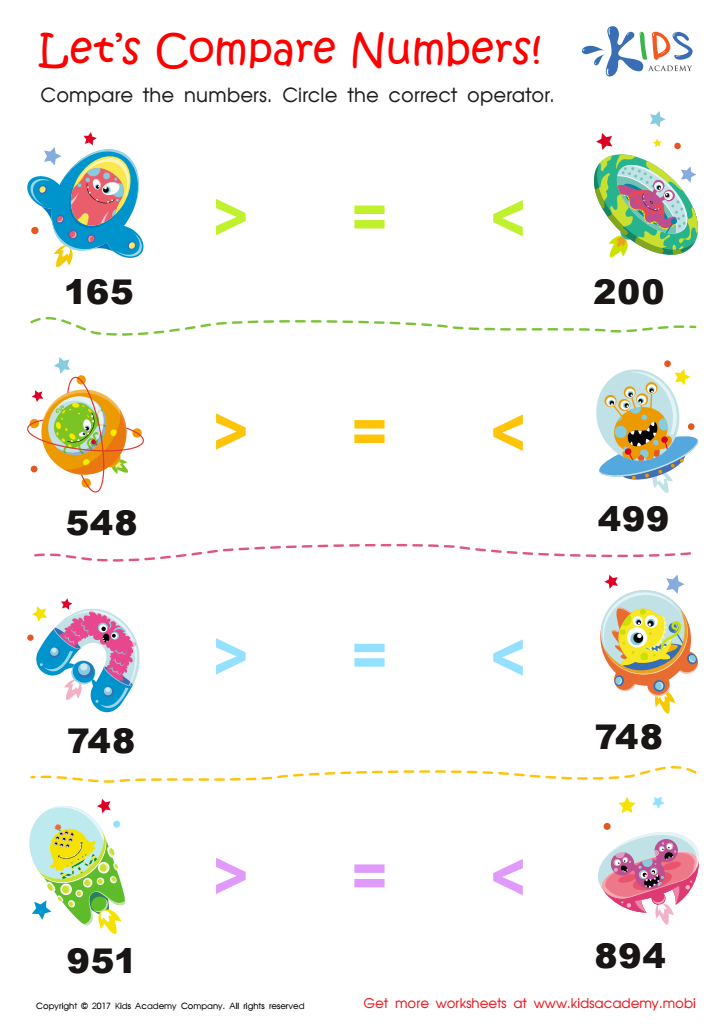
Comparing Numbers Worksheet for 2nd Grade
Alien friends are back to help your child learn to compare numbers using >, < and = symbols. This 2nd grade worksheet will challenge them with larger numbers!
 Assign to My Students
Comparing Numbers Worksheet for 2nd Grade
Worksheet
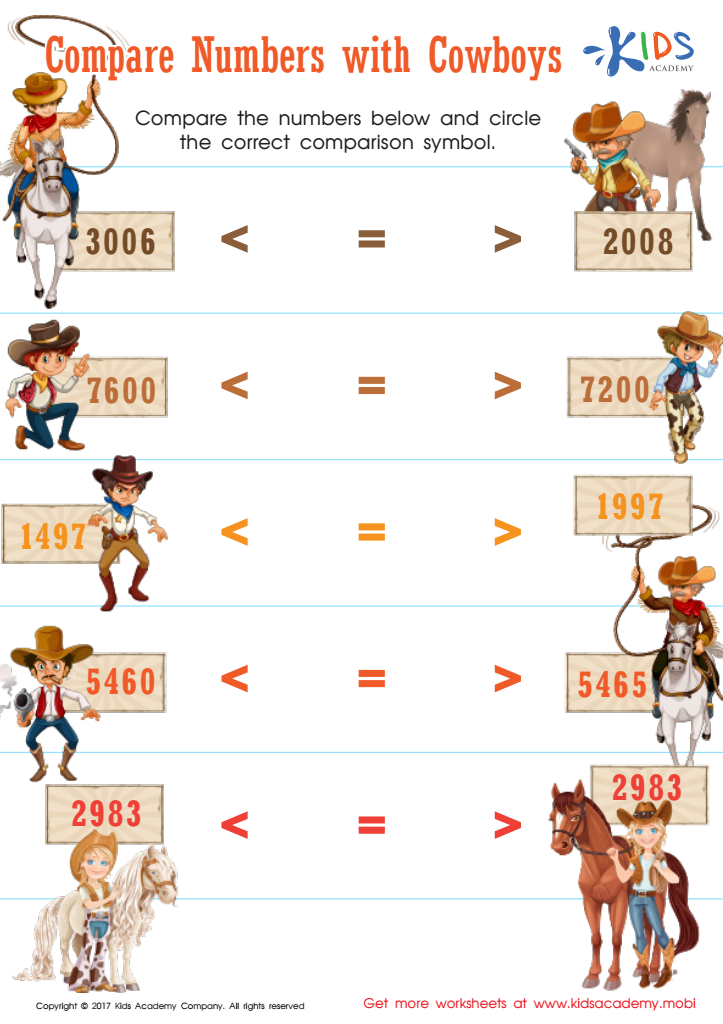
Compare Numbers Worksheet for 3rd Grade
Time to get a roundup on big numbers! Help your 3rd grader practice comparing thousands with this compare numbers worksheet. They'll use >, <, and = symbols for tricky numbers. Jump in and join the cowboys!
Compare Numbers Worksheet for 3rd Grade
Worksheet
Join Kids Academy for Free
Who is primarily going to use this learning content?





Understanding greater than (>) and less than (<) concepts is crucial for 8-year-olds as they form foundational skills in mathematics and critical thinking. At this age, children transition from basic counting to more complex operations, and grasping these relational symbols is essential for their cognitive development. Comprehending greater and less than enhances their ability to compare numbers, which is pivotal in problem-solving and everyday decision-making.
Moreover, mastery of these concepts aids in building a strong base for more advanced mathematical topics, such as addition, subtraction, and eventually geometry and algebra. It encourages logical reasoning, helping children develop the ability to make informed decisions. For parents and teachers, facilitating this understanding fosters an engaging learning environment, where kids can confidently participate in discussions, enhance their mathematical vocabulary, and improve their analytical skills.
Additionally, strong numerical skills contribute to academic success across various subjects, promoting a well-rounded education. By emphasizing the importance of greater and less than, parents and teachers can inspire a love for mathematics, equipping children with essential skills that extend beyond the classroom, into their daily lives and future learning endeavors. Ultimately, promoting these concepts supports lifelong learning and confidence in tackling mathematical challenges.








